



Economics is not just about numbers; it helps us understand the complex issues we face today, like climate change, inequality, and technological advances. In Bangladesh, we need leaders who are not only knowledgeable in economics but also innovative and ethical. To understand economics better, we should focus on people. Nobel winners like Daron Acemoglu and James Robinson remind us that real prosperity comes from inclusive institutions that encourage participation and innovation. Joseph Stiglitz highlights that markets do not always work fairly, and we need smart public policies to fix these failures. Amartya Sen teaches us that true development is about improving people's freedoms and quality of life.
Studying economics at the undergraduate level provides foundational knowledge—like how markets operate. Moving to graduate studies, students explore advanced topics and conduct original research. This shift equips them to tackle complex problems confidently. While traditional economics is important, we also need to consider alternative perspectives. Heterodox economics examines social, political, and environmental factors affecting the economy. This broadens our understanding and helps future leaders address inequalities and crises effectively.
In today’s world, technology is crucial for economists. Tools like Artificial Intelligence (AI) and data analytics can help us analyse vast amounts of information, improving policy decisions. Our education must include these skills to prepare leaders for a data-driven future. For Bangladesh to thrive, we need to adopt innovative strategies post-LDC graduation. This involves encouraging entrepreneurship, fostering competition, managing change, and sustainable growth.
The challenge for Bangladesh's next leaders is to think beyond simple solutions. We need to integrate lessons from successful economists and adopt a holistic view of growth that prioritises human capabilities and innovation. By educating future leaders in a nuanced, ethical manner, we can create an economy that is not just growing, but flourishing and inclusive for all.
The transition to a new administration represents both a symbolic and substantive inflection point in a nation's economic trajectory. For Bangladesh, as it prepares for the responsibilities and challenges of LDC graduation, the incoming government's inaugural economic signals carry profound weight. Among the most consequential early decisions will be the disposition of proposed salary revisions for public sector employees—a matter that sits at the delicate intersection of fiscal policy, institutional credibility, and macroeconomic stability.
There exists a compelling case for the new administration to resist pressures for substantial across-the-board government salary increases, even when such increases have been formally proposed or politically anticipated. This position is not born of indifference to the legitimate aspirations of public servants, nor does it deny the erosive effects of inflation on real wages. Rather, it proceeds from a sober assessment of macroeconomic prudence and a strategic understanding of institutional development that prioritises long-term systemic health over short-term distributive adjustments.
Bangladesh's fiscal space, while improved over recent decades, remains constrained by structural realities. The tax-to-GDP ratio hovers among the lowest in South Asia, limiting the government's capacity to expand recurrent expenditure without corresponding revenue mobilisation. Significant salary increases, particularly when implemented across a large civilian and military establishment, create permanent escalations in committed expenditure. Once encoded into the fiscal architecture, such escalations are notoriously difficult to reverse, consuming an expanding share of annual budgets and crowding out development expenditure, social sector allocations, and essential capital investment.
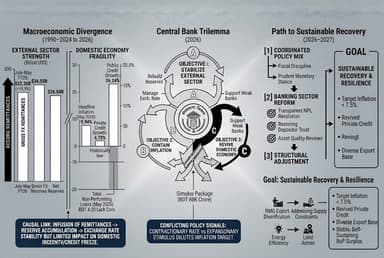
The macroeconomic implications extend beyond immediate fiscal arithmetic. In an economy still navigating inflationary pressures and exchange rate stability concerns, a substantial public sector wage increase transmits powerful signalling effects throughout the broader economy. Private sector wage negotiations frequently benchmark against public sector settlements, potentially igniting wage-price spirals that complicate monetary policy objectives. The Bangladesh Bank's efforts to maintain price stability and contain core inflation—prerequisites for sustained poverty reduction and real income growth—would be rendered more difficult by a large, demand-injecting salary adjustment executed without corresponding productivity gains or revenue offsets.
Furthermore, in a context where remittance flows and export earnings face external headwinds and where foreign exchange reserves require careful husbanding, fiscal prudence is not merely technical good governance but a strategic necessity. The incoming administration's willingness to exercise restraint in its own compensation decisions signals to international financial institutions, credit rating agencies, and foreign investors that Bangladesh possesses the institutional maturity to subordinate short-term political expediency to long-term macroeconomic stability.
Beyond macroeconomic considerations, the decision to moderate salary increases engages deeper questions of institutional design and public trust—precisely the concerns animating the institutional economics of Acemoglu and Robinson. Inclusive institutions are not defined solely by their formal democratic character but by their effectiveness, impartiality, and capacity to deliver public services with integrity. The legitimacy of the state rests fundamentally on a social contract wherein citizens contribute revenue in exchange for competent, responsive governance.
When government salary growth persistently outpaces both private sector comparators and measured improvements in public service delivery, it risks corroding this contract. Citizens observe that the apparatus of the state consumes an increasing share of national resources without commensurate enhancements in the quality of education, healthcare, infrastructure, or regulatory administration. The resulting erosion of public trust is itself an institutional pathology—one that undermines tax compliance, encourages informality, and breeds cynicism about the development project itself.
This is not to argue for the immiseration of public servants. Dedicated teachers, health workers, administrators, and security personnel are the daily executors of state capacity, and their motivation and professionalism cannot be taken for granted. However, the appropriate policy response lies not in undifferentiated horizontal increases but in targeted, performance-linked, and structurally differentiated compensation reforms. Resources conserved by moderating general salary increases can be redirected toward specific cadres where recruitment and retention crises are acute—specialised technical positions, remote postings, and frontline service delivery roles. They can fund improved training, modern equipment, and merit-based career advancement pathways that enhance both morale and productivity more durably than blunt salary adjustments.
The economic philosophy appropriate to Bangladesh's current development stage is not austerity for its own sake but strategic allocation—the conscious direction of scarce public resources toward their highest social returns. Every taka expended on recurrent salary consumption is a taka unavailable for the investments that will determine Bangladesh's competitive position in the coming decade: research universities producing employable graduates, digital infrastructure enabling financial inclusion and e-governance, climate-resilient agriculture and water systems, and the transport and energy networks that underpin industrialisation.
This philosophy finds resonance in the capability approach of Amartya Sen, which insists that development be evaluated by the expansion of substantive freedoms and opportunities for all citizens, not by the consumption levels of particular occupational groups. It echoes Joseph Stiglitz's demonstration that strategic public investment corrects market failures and produces collective returns exceeding those of private consumption. And it aligns with the Schumpeterian insight of Philippe Aghion that sustained growth requires continuous reallocation of resources toward their most productive uses—including the reallocation of fiscal resources away from entrenched expenditure patterns and toward innovation-enabling public goods.
The incoming government possesses a singular opportunity to articulate this philosophy clearly and courageously. By declining to implement proposed salary increases—or by implementing them in a substantially moderated, phased, and productivity-linked manner—the administration signals that its commitment to macroeconomic stability and long-term development is not merely rhetorical. It demonstrates that the era of treating public sector compensation as an automatic entitlement, decoupled from revenue realities and service delivery performance, has concluded.
This stance will encounter political resistance, and its successful execution requires accompanying measures that preserve the dignity and motivation of public servants. Compensation restraint must be paired with visible improvements in working conditions, career progression, and recognition. It must be transparently communicated as a component of a broader fiscal consolidation strategy that distributes sacrifice equitably across society. And it must be accompanied by intensified efforts to expand the tax base, rationalise subsidies, and combat leakage—so that citizens and public servants alike perceive the fairness of the overall compact.
The decision not to raise government salaries as proposed, when situated within the integrated analytical framework advanced in this essay, emerges not as regressive cost-cutting but as progressive state-building. It is an exercise in what Acemoglu and Robinson would recognise as inclusive institutional evolution—the hard work of constructing a public sector that earns its legitimacy through demonstrated effectiveness rather than presumptive entitlement. For a generation of leaders educated to see beyond crude growth metrics and toward the institutional, environmental, and human foundations of durable prosperity, it is precisely the kind of difficult, nuanced, forward-looking choice that defines developmental statesmanship. The rethinking of economic policy, like the rethinking of economic pedagogy, begins with the courage to question established patterns and the intellectual integrity to follow evidence where it leads. Fiscal prudence and institutional credibility are not constraints upon development but its essential preconditions.
The task for Bangladesh's upcoming leadership—and for economics educators shaping that leadership—is to move beyond simplistic, one-size-fits-all models. The path forward lies in a sophisticated synthesis: building inclusive institutions (Acemoglu & Robinson), correcting market failures with smart policy (Stiglitz), exercising fiscal prudence to preserve macroeconomic stability, fostering a culture of innovation (Mokyr & Aghion), all while being guided by a broader vision of human capability (Sen) and informed by the critical perspectives of heterodox thought and the predictive power of advanced analytics.
The objective is to steer the economy towards a high-employment, high-productivity equilibrium—one that leverages the demographic dividend not through cheap labour alone, but through skilled, innovative, and entrepreneurial labour. This requires an economics education that is pluralistic, technologically integrated, and ethically engaged, and a policy framework that exhibits the same intellectual sophistication.
By fostering the next generation of leaders with the intellectual versatility and moral compass needed to navigate the complexities of the 21st century, they will be the architects of an economy that does not merely grow, but flourishes in a way that is resilient, inclusive, and capable of delivering equitable prosperity for all citizens of Bangladesh and beyond.
- Muhammad Mahboob Ali, PhD, is a Professor at Bangladesh University of Business and Technology