


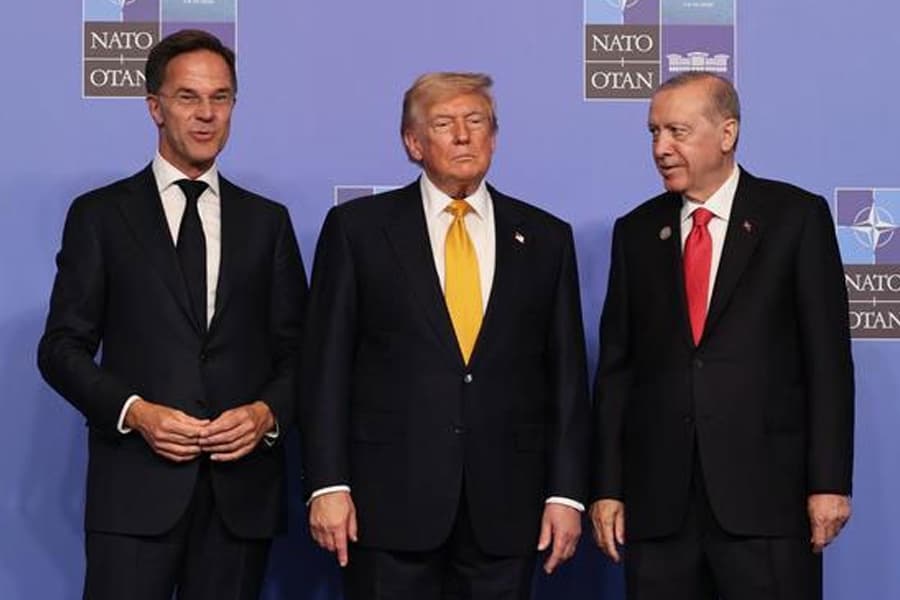
Leaders from NATO's 32 countries, plus NATO allies like Ukraine, gathered in the Turkish capital Ankara on July 7 and 8 this year to discuss a range of issues involving spending targets, defence industrial production, and support for Ukraine, among others.


Policy analyst Juraj Majcin has referred to NATO Secretary General Mark Rutte who has dubbed the Summit in Ankara a "delivery summit". In many ways, it lived up to that description. It did not remove the political uncertainty surrounding US President Donald Trump's approach to NATO. However, it acknowledged that Europeans and Canadians were shaping their renewed commitment to defence investment actively, demonstrating that the Alliance could still function as a potent deterrent force despite strong political headwinds.
The atmosphere in the run-up to the Summit was uneasy. Trump had been sharply critical of European allies that, in his view, had failed to support, or had not sufficiently supported, his campaign against Iran. He had even threatened to halt trade with Spain, revived calls for Greenland to be transferred from Danish to American sovereignty and resumed strikes on Iran.
In another political climate, such statements might have derailed the Summit. This time, however, European allies largely chose not to escalate. Concerned capitals appear have absorbed the remarks, avoided public confrontation and focused on the broader objective of keeping the Summit on track while advancing the Alliance's transformation to greater European responsibility.
Ukrainian President Volodymyr Zelenskyy conducted a relentless series of meetings on July 7 and 8 as he rallied support for Ukraine, which is not a NATO Member. The alliance dedicated a sizable chunk of its declaration to Ukraine and the wider threat posed by Russia, pledging 70 billion Euros in military equipment, assistance and training for Ukraine and affirming "sovereign commitments to sustaining at least equivalent levels in 2027". NATO said the allies "stand united in our unwavering support for Ukraine in defending its freedom, sovereignty, and territorial integrity".
The summit saw some bonhomie between Zelenskyy and Trump, who addressed reporters together ahead of a meeting on the sidelines. Trump said the US would give Ukraine the right to produce Patriot missile systems, which are expensive and in high demand. Such a move would be a huge boost for Kyiv, which recently asked for a licence to manufacture the missiles domestically in Ukraine. "We'll show them how to do it," Trump said. "I think they can produce them pretty quickly." Zelenskyy wrote on X after the meeting that he was "grateful", saying that he and Trump "spoke about some ?ideas that could strengthen ?our positions and bring peace closer". Zelenskyy also said he inked bilateral drone deals with several nations, with more under way.
The NATO meeting also once again became an example of renewed tensions over Greenland. The war on Iran seemed to have briefly quelled Trump's quest to take over Greenland, the autonomous Danish territory in the Arctic. Yet he returned to his Greenland refrain throughout the two-day Summit, claiming Greenland was "very important" for the US "but it's not important for Denmark. However, Danish Prime Minister Mette Frederiksen reiterated on several occasions that Greenland is not for sale. "We are ready to defend every inch of NATO, including our own territory," she said. The EU also waded in to affirm that "decisions about the future of Greenland are for Greenlanders and Danes". "Territorial integrity, national sovereignty and inviolability of borders are fundamental principles of international law," EU spokesman Olof Gill added.
On the industrial front, Ankara produced visible results. The NATO Summit Defence Industry Forum, held before the meeting of Heads of State and Government, set the tone. Allies announced a series of contracts and multinational projects with European and American defence companies. Host nation Türkiye accentuated its role as a key defence industry player at the forum.
The package includes new aircraft to replace NATO's ageing AWACS fleet, with Saab Global Eye and Northrop Grumman MQ-4C Triton platforms set to strengthen the Alliance's intelligence, surveillance and reconnaissance capabilities (ISR). Allies also advanced multinational air-mobility projects, including the expansion of the Airbus A330 MRTT tanker fleet for air-to-air refueling and a new pooled Airbus A400M fleet to strengthen strategic airlift.
The two-day North Atlantic Treaty Organisation (NATO) Summit in July, convened in Turkiye's capital Ankara, came to a close after interesting discussions which revealed different evolving dimensions with which NATO is currently involved. Analyst Fiona Kelliher noted that the two-day Conference had arrived at a particularly tumultuous time for the Alliance, following the United States and Israel's three-month war on Iran and escalating fears in Europe over Russia's military capabilities.
Analyst Fiona Kelliher has also noted that there were certain key takeaways from the NATO Summit:
Back in Washington, critics of the war on Iran were quick to accuse Trump of botching the talks. However, NATO's Secretary General Mark Rutte told reporters that the strikes were "absolutely necessary. NATO's final declaration called on Iran to respect freedom of navigation through the Strait of Hormuz, and reiterated that Iran must not be permitted to acquire a nuclear weapon.
Under escalating pressure from Trump, NATO leaders appear to have agreed to increase defence spending and develop the Alliance's military-industrial capacities, including air and missile defence. The commitments included "more than US Dollar 50 billion in new procurements", the NATO declaration said, with an eye to "deep precision strike, integrated air and missile defence, uncrewed systems, cutting edge technologies, and intelligence capabilities". It also cited "an interoperable transatlantic war fighting cloud and adopting powerful AI models".
However, NATO data has shown that only five of NATO's 32 members are projected to meet the alliance's goal of spending 3.5 per cent of their gross domestic product on core defence in 2026. Members agreed to hike core spending up from 2 per cent during a summit in The Hague last year, while also spending 1.5 percent of GDP on broader defence-related investments. Seventeen members are projected to hit the 1.5 per cent goal. The average core defence expenditure in NATO Europe and Canada was 2.3 per cent of GDP in 2025, which has climbed to 2.53 so far in 2026. The US has reported 3.17 per cent.
NATO Secretary General Rutte was joined in his efforts to make the Summit a success by Turkish President Recep Tayyip Erdo?an. This was apparently partially done because Trump had made it clear that he considered Erdogan a good friend and repeatedly stated he was only participating in the Summit because Erdo?an was hosting it. Trump also came bearing a generous gift for his host-- heavy signals that he planned to allow Turkiye back into a programme for buying F-35 fighter jets, something Erdo?an has been pestering four successive American administrations to allow. Of course, a Congressional ban might still frustrate any emerging plans.
It would be pertinent before concluding analytical comments about the latest NATO Summit in Ankara to also draw attention to the broad role being played by Turkiye in its relationships with the United Kingdom, Germany and the USA.
On April 30, 2025 Türkiye and the United Kingdom signed the Türkiye-U.K. Defense Industry Council (TUDIC) Specification, formalising their cooperation in the defense sector. The agreement was signed in London by Haluk Görgün, Defence Industry Agency (SSB); Deputy Defence Minister Musa Heybet; and Maria Eagle, the U.K. Minister for Defence Procurement and Industry. This move clearly aims to institutionalise collaboration between the two nations' defence industries, addressing evolving global security challenges and shared threats. The meeting also included participation from Turkish and British defence companies, highlighting a mutual commitment to strengthening their strategic partnership in defence. In October 2025, Turkish President Erdo?an also agreed that the UK would sell 20 Euro fighter Typhoon jets to Turkiye in a deal worth up to £8 billion. The agreement marked Britain's biggest fighter-jet deal for almost two decades, and Turkey's first purchase of combat aircraft from a country other than the US.
Germany and Turkiye have also had strong economic ties with one another throughout time. Machinery, electrical goods and motor vehicles and supply parts for the automobile industry account for a particularly large portion of German exports to Turkiye. Textiles/leather goods and food, and increasingly motor vehicles and electronic goods, have also become principal German imports from Turkey. At present, companies owned by Turkish businessmen in Germany employ approximately 200 thousand people. More than three million German tourists also visit Turkiye annually. Nearly 4000 German companies are active in Turkiye. Germany has turned out to be the number one partner of Turkey in fields such as foreign trade, financial and technical cooperation, tourism and defense industry. All of this is happening despite many failed efforts by Turkiye till now to become a Member of the European Union.
According to the U.S. Department of State, Turkey has been a key partner for U.S. policy in the surrounding region. Turkiye partnered with the U.S. for security in Afghanistan (ISAF), and served as NATO's vital eastern and southern anchor, controlling the Turkish Straits, i.e., the Bosporus and the Dardanelles. Turkey has also contributed and continues to have a say on international security alongside U.S. forces in Europe (e.g., in Bosnia, IFOR, KFOR, Baltic Air Policing etc.), and the seas bordering the Horn of Africa.
It is evident that the Turks do not want to be sidelined by the US or the West when it comes to their own national security concerns. Neither do they want to be hamstrung by easily severed logistics. Clearly, they want to be, and have been thinking about becoming important players in regional politics, and their public national security policy says as much.
Muhammad Zamir, a former Ambassador is an analyst specialised in foreign affairs, right to information and good governance.
muhammadzamir0@gmail.com