




The world is witnessing the majesty of civilization where a number of events, as well as the glorified kingdom of any particular community, cover themselves over time.


Discovering the hidden practices of the ancestors or unveiling the culture of any ethnic group is a demand of time, as they occupy a significant portion of history, either through their work or philosophy. Bhisti is one of the names of history, what is now abolished from modern society, where city life could not be imagined in Dhaka and West Bengal without the presence of this profession.
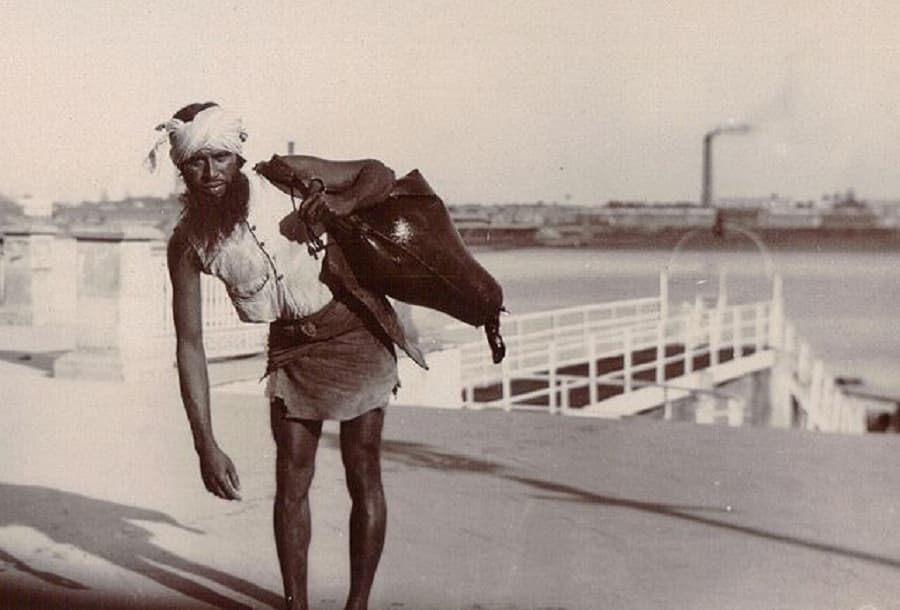
From the Mughal Empire to the mid-20th century, there was a particular job of supplying water from door to door. This job was called Bhisti or Bhistigiri. The male members of this community carried water to households or different public and private institutions through a specialized bag made from leather.
The members of that community are termed as Bhistiwala, who once lived in the bengal part of the Indian sub-continent, especially in Dhaka and Kolkata.
The term 'Bhisti' is a Persian word derived from the word 'Behest' (Heaven). According to the myths, the Bhistiwalas were deemed as the consul of heaven, as heaven is full of sweet water that arouses the vigour other the soul, and Bhistiwalas also enlivened the zippy of life through supplying water.
Rehana Begum is a 60-year-old resident of Aga Sadek Road, Dhaka, and her ancestors were involved in Bhisti. She said, "My father and grandfather were Bhisti, and they supplied water to houses and offices. I could not remember those memories, as I was at a very young age then. But I heard about their activities from my sisters and superiors. They supplied water through a leather bag, and we had those bags in our home, though we did not store them later."
"There are some Bhisti in Kolkata now, but we have yet to become acquainted with them. Now, some people are supplying water to different places through plastic jars. However, my family members are no longer involved with this profession. I heard that my ancestors lived a very miserable life as their income was very low according to their labour," she further said.
Now we are more focused on solving problems with immediate efforts. Inventions took place, and people's lives improved day by day. In this wave, many professions have been created and founded. Bhisti is one of them. However, it is always fascinating to know about the forgotten people, especially those who served people.
Sharmin Akter is the daughter-in-law of Rehana Begum. She said, "We feel very happy when we see that media work to reveal our historical profession. I think that all the people of the country should know about us as it is a part of history. Media and researchers should work more on this issue. I also tried to inform the people about Bhisti while talking or spending time with them."
Canals, rivers, and different watersheds were the staple sources of water before the tube well, which was later used for drinking and household chores. The Bhisti community was engaged in providing water for the soldiers at the battleground, which allowed them to wrestle and conquer against the opposition.
The hegemony of the Bhistiwalas was slacked in the English era, as tube-wells were inducted in some places of Dhaka city, especially after the year 1878. Then, the necessity of Bhisti was optional in all of the areas of Dhaka city, which totally terminated in the mid-20th century.
In Dhaka, Bhistiwala was called Sakka, and the dwelling place of the community was called Sakkatuli, which was renamed Sikkatuli by the evolution of time. The roads of Sikkatuli were echoed by the footsteps of Bhisti, ranging from households to offices, which stirred the scalability of livelihood.
After the division of countries in 1947, the Bhisti community moved to Kolkata. A few of them who stayed in Dhaka switched their profession, and now Sikkatuli did not practice this historical profession any more. Some people in that place are now supplying water to different places through plastic bottles or jars, which may be denominated as the modified form of Bhisti.
The water bag by which the Bhisti supplied water to different places was the main attraction of that profession, and there was a certain process to make that bag.
First of all, the leather from the goat was collected, and then it went through different methods to be free from stink and toxicity. Then this was submerged in water for almost 20 days, and after that, the bag was made with yarn. A special type of wax was also required there and the fat of buffalo was used to make the bag water-proof.
Dr. Muhammad Shakhawat Hussain is a Professor at The Department of Islamic History and Culture at the University of Chittagong. He said, "The practice of Bhisti was present in the different parts of the world for almost 1300 years. There was a role of Bhistiwala in Karbala, which was a significant event in Islamic history. Also, in the Mughal era, visiting was a reliable profession for the emperors."
"Rabindranath Tagore, Sukumar Ray, Shamsur Rahman, and many more poets and novelists wrote about the life of Bhistiwala in their writings. But unfortunately, the new generation is not informed about them, which is very shocking for us", he added.
Professor Shakhawat also pointed out some steps which can help people know about this profession. He said, "At the academic level, there should be the stories of Bhistiwala so that students can know about them. Also, we may arrange some dramas or artistic activities to inform people about them. The street dramas can be an effective way to provide the necessary information about Bhstiwala to the people."
Dr MD Morshedul Alam is the Associate Professor of The Department of Islamic History and Culture at the University of Chittagong. While talking about Bhisti, he said, "Not only Bangladesh, but also India, Pakistan, and Nepal also depended on them to a large extent. In mughal era, vistiwalas supplied water to Lalbagh Fort."
He further said, "I think the people of this country should know about them as they are a part of our history. We may keep their leather bag in the museum with a written description about those bags. Also, the interview coverage from the current generation of the Bhistiwalas and publishing them to the public can be an effective medium to make people know about them."
History reminds the people about their origin and evolution, which manifests a nation's heritage worldwide. Bhisti is a splendid part of the history of the country in this region. The residents of here should mark this illustrious profession and trumpet it to everyone as a symbol of esteem to the ancestral community.