

Published :
Updated :
 For all latest news, follow The Financial Express Google News channel.
Experts at a roundtable discussion on Wednesday observed that although the proposed national budget for FY2026–27 has increased allocations for the agriculture sector, farmers continue to face mounting challenges, including rising costs of agricultural inputs, post-harvest losses, climate-related risks, inadequate market access, and weak implementation of development programmes.
Bangladesh’s crop agriculture sector remains vital for ensuring food security, supporting rural livelihoods, promoting agro-industrial growth, and generating export earnings. Between 1999 and 2019, the value of agricultural production grew at an average annual rate of 3.54 percent, they said.
However, the sector continues to face significant constraints, including climate vulnerability, growing dependence on agricultural inputs, and inefficiencies in post-harvest management, experts stated.
They noted that agriculture’s contribution to Bangladesh’s Gross Domestic Product (GDP) has declined from nearly 38 percent in the 1970s to 11.2 percent at present.
While public investment and policy attention to the sector have increased over the years, speakers stressed that the benefits of budgetary allocations are yet to adequately reach smallholder and marginal farmers.
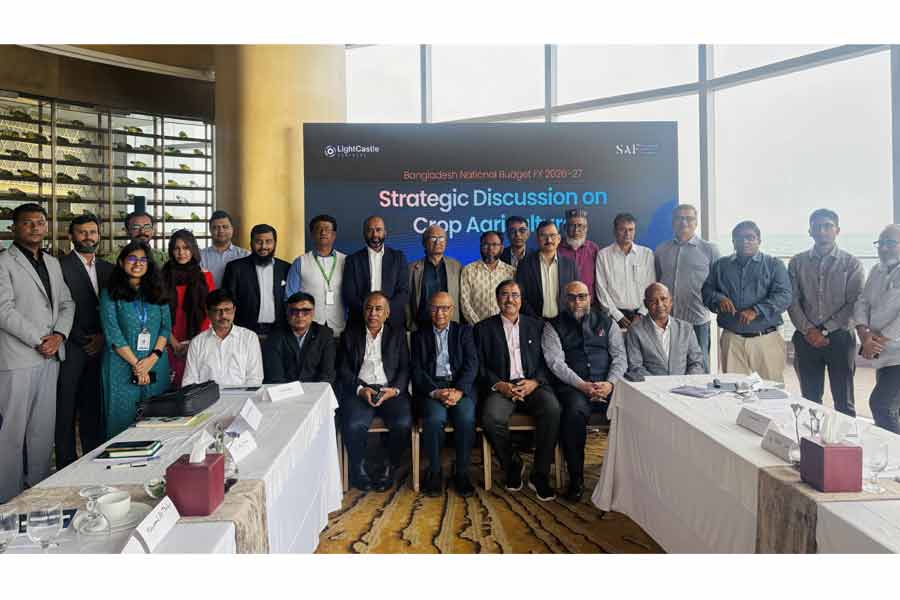
The observations were made at a roundtable titled “National Budget FY2026–27: Strategic Discussion on Crop Agriculture,” held today (Wednesday) at a hotel in the capital’s Gulshan, according to a media release.
The event was jointly organized by LightCastle Partners and the Sustainable Agriculture Foundation (SAF) Bangladesh.
The discussion focused on how proposed budget allocations, policy priorities, and strategic interventions for FY2026–27 can be translated into tangible outcomes for farmers and contribute to the long-term transformation of Bangladesh’s agriculture sector.
Among the speakers were Md. Habibullah, Director, Admin and Finance Wing, Department of Agricultural Extension (DAE); Anwar Faruque, Board Director of Bangladesh Krishi Bank and former Secretary of the Ministry of Agriculture; Hasan Zafir Tuhin, Chairman, Barind Multipurpose Development Authority (BMDA); Dr. Wais Kabir, Former Executive Chairman, Bangladesh Agricultural Research Council (BARC); A. K. Osman Haruni, Senior Policy Advisor, Food Security and Agriculture, Embassy of the Kingdom of the Netherlands in Bangladesh and Ataus Sopan Malik, Managing Director, A.R. Malik Seeds.
The roundtable commenced with opening remarks from Zahedul Amin, Co-founder and Managing Director, LightCastle Partners and a keynote presentation by Zeeshan Abedin, Social Research and Impact Advisor, LightCastle Partners, who presented an analysis of the proposed agriculture budget.
The session was moderated by Professor Dr. M. A. Sattar Mandal, Emeritus Professorial Bangladesh Agriculture University and Principal Advisor SAF Bangladesh, and the closing note was delivered by Md. Farhad Zamil, Executive Director, SAF Bangladesh.
According to the presentation, the proposed FY2026–27 budget allocates Tk 28,881 crore to the Ministry of Agriculture, including Tk 7,946 crore for development expenditure. The allocation represents an increase from the original FY2025–26 allocation of Tk 27,224 crore. In the budget, Tk 17,001 crore has been proposed for agricultural subsidies, including fertilizer support and other related activities.
The presentation highlighted that agriculture’s share in the development budget has increased 2 times with the proposed amount of Tk. 7,945 crore, while the proposed budget for subsidy has declined 1.4% and the relief for industry actors has been shifted to input tax cuts. A significant shift in the FY 2026-27 proposed budget is expected to increase focus on water management and irrigation, post-harvest management, and agricultural assistance to farmers through the Farmer Card.
However, concerns were raised over the low utilization of the allocated budget. While ADP implementation reached 93 percent in FY2022–23 and 95 percent in FY2023–24, implementation rates fell to 60 percent in FY2024–25 and 62 percent in FY2025–26.
Md. Habibullah, Director, Admin and Finance Wing, Department of Agricultural Extension (DAE), said the government’s initiatives, including the Farmer Card pilot and post-harvest infrastructure development, reflect its strong commitment to advancing the agriculture sector and improving farmers’ outcomes.
Anwar Faruque, Board Director of Bangladesh Krishi Bank and former Secretary of the Ministry of Agriculture, said the proposed budget contains several positive measures, including reduced duties on essential commodities, tax relief on fertilizer inputs, and expansion of the Krishak Card programme.
However, he noted that these benefits must effectively reach farmers and help lower production costs to have real impact.
The speakers called for stronger implementation of agricultural programmes, enhanced climate resilience, improved market systems, enhanced post-harvest management, and greater support for farmers to boost productivity and ensure sustainable growth of the sector.
The roundtable was attended by more than 30 policymakers, agricultural scientists, economists, entrepreneurs, development practitioners, and other stakeholders, the release adds.