


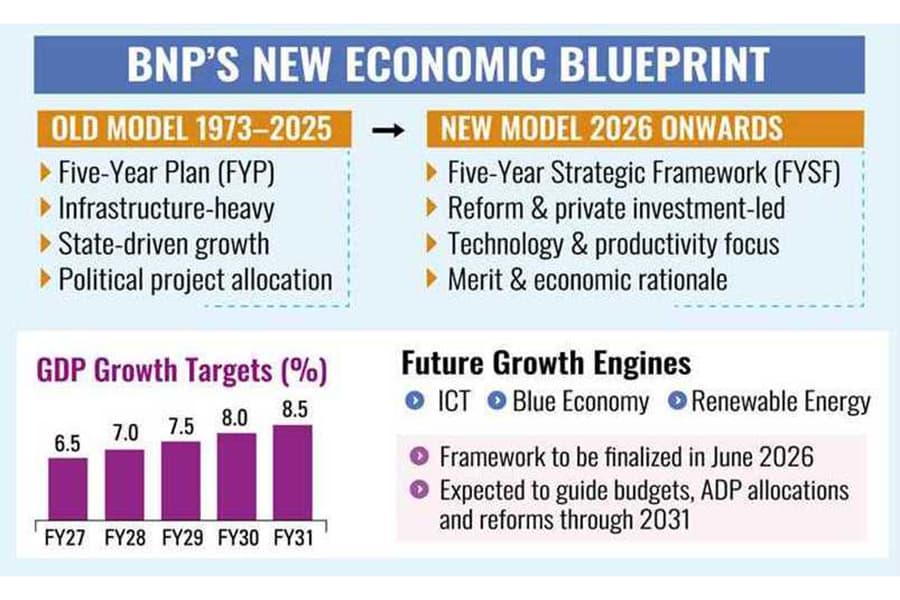
The newly formed BNP government is set to introduce a new development strategy, moving away from the long-standing five-year planning model used during the previous Awami League administration, which remained in power for 17 years.


The ambitious macroeconomic blueprint aims to steer Bangladesh towards a US$1.0 trillion economy by 2034, with a projected terminal growth rate of 8.5 per cent by FY2030-31, ending in June 2031.
Officials at the Planning Commission said the government is preparing to finalise a Five-Year Strategic Framework (FYSF) within June, which will serve as the foundation for reforms and development planning over the next five years.
Under the proposed framework, the BNP government, in line with its election manifesto, seeks to expand the size of the economy from around $450 billion to $1.0 trillion.
The framework is being drafted by the General Economics Division (GED) of the Planning Commission and marks a significant shift in national economic policy direction.
Bangladesh has lacked a formal medium-term development plan for the past two years following the suspension of the 8th Five-Year Plan by the interim administration, creating what officials describe as a planning gap.
Earlier, Bangladesh implemented eight five-year plans -- five between FY1973 and FY2002, and three more from FY2010 to FY2025 -- alongside a two-year interim plan during former president Ziaur Rahman's administration.
Between FY2003 and FY2010, the country followed Poverty Reduction Strategy Papers (PRSPs) instead of five-year plans before returning to the FYP model in 2009.
The upcoming FYSF represents a structural shift from the previous development approach, which largely focused on infrastructure expansion and food security under two consecutive perspective plans up to 2041.
According to GED officials, the new framework prioritises institutional reform, private sector-led investment, and macroeconomic stabilisation, alongside efforts to significantly expand the size of the economy over the next decade.
Key targets include raising GDP growth gradually from 6.5 per cent in FY2027 to 8.5 per cent by FY2030-31, alongside achieving sustained high growth over the period.
Economists say the framework aims to restore a structured development pathway after the recent disruption in long-term planning, which left ministries operating without clear strategic targets.
The suspension of the 8th Five-Year Plan had created uncertainty in policy direction, which the new government aims to address by aligning planning with fiscal policy, budget allocations, and the Annual Development Programme (ADP).
The FYSF is expected to directly shape national budget priorities and development spending until the end of the decade, in line with the ruling party's election commitments.
The GED has also set targets to reduce inflation to 5.0 per cent by the end of the framework period.
Investment is projected to rise to 36.7 per cent of GDP by FY2030, while foreign direct investment (FDI) is expected to reach 2.5 per cent of GDP. The tax-to-GDP ratio is targeted to increase to 10 per cent by 2030 and 15 per cent by 2035.
The framework also signals a shift towards high-value and technology-driven sectors, moving away from reliance on low-cost labour. It targets the creation of 10 million new jobs across various sectors and plans to recruit around 500,000 people into government services through merit-based selection.
Information and Communication Technology (ICT), the blue economy, and renewable energy have been identified as key drivers of future growth.
For the first time, the national plan proposes establishing a structured pension fund for private-sector employees and introducing formal unemployment benefits.
A key highlight of the FYSF is its emphasis on state and institutional reforms to ensure accountability, moving beyond what policymakers described as the "detached, rubber-stamp planning documents" of the past.
It also proposes changes to the ADP selection process, stating that projects will no longer be approved based on political patronage or nepotism, but on strict economic rationale and public necessity.
The framework further introduces localised project dashboards at the grassroots level, giving citizens and journalists real-time access to monitor project expenditure, progress, and implementation timelines, aimed at eliminating the wasteful "June syndrome".
kabirhumayan10@gmail.com