

Published :
Updated :
 For all latest news, follow The Financial Express Google News channel.
The arrival of Ramadan brings a universal rhythm of devotion, self-reflection, and communal warmth to Muslims across the globe. In Bangladesh, the holy month is woven into the very fabric of daily life—echoing with the familiar acoustics of street-side prayer calls and the lively chaos of neighbourhood vendors piling chola, piaju, and beguni into paper bags just before sunset.
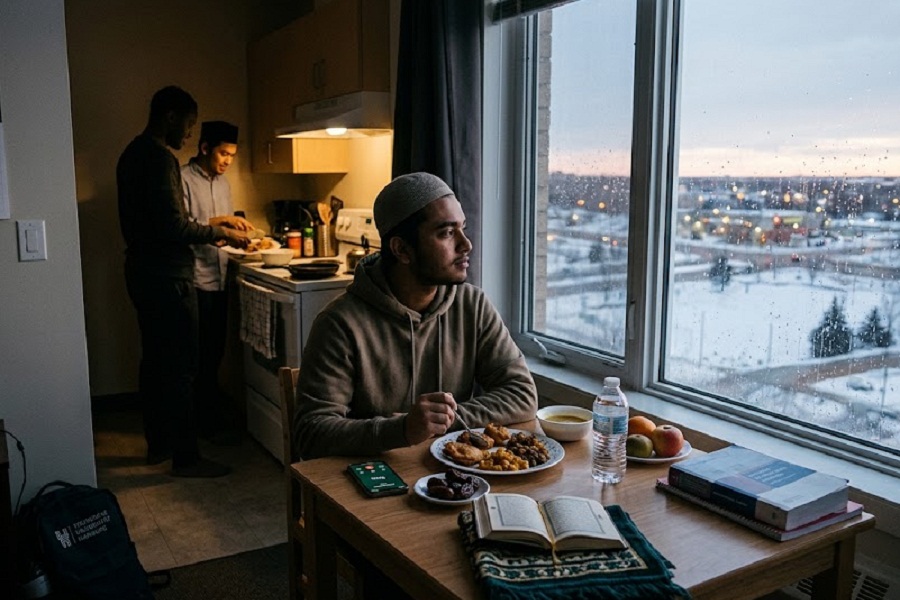
However, for the growing diaspora of young Bangladeshi students pursuing higher education abroad, the month unfolds under vastly different skies. Thrust into unfamiliar environments, these young adults find themselves walking a solitary path of forced independence, transforming their relationship with both their faith and themselves.
The bittersweet growth of self-dependancy
For Tasnim Rahman, a graduate student in Sweden, the onset of Ramadan brings a quiet stillness that contrasts sharply with the vibrant chaos of Dhaka.
"The first year is always a test of endurance," Tasnim shares. "You realise that the comforting rituals you took for granted—waking up to your mother whispering that it's time for Sehri, or sitting at a crowded table full of family laughter—are suddenly gone. You are entirely on your own."
Yet, Tasnim notes that this isolation forces an unexpected internal shift. Balancing demanding lab research with fasting in a country where the sun sets much later requires a unique brand of resilience.
"It teaches you self-reliance. You learn to cook your own traditional meals, manage your time rigidly, and find quiet moments of spirituality in a city that doesn't slow down for your holy month. It makes your faith deeply personal."
Creating chosen families across borders
Further south, the sentiment of turning vulnerability into strength is mirrored by Zayan Al-Deen, an undergraduate at the University of Melbourne in Australia. For Zayan, the initial emptiness of celebrating without family was overwhelming, but it quickly paved the way for new, unexpected connections.
"You start the month feeling like an outsider, missing the warmth of home," Zayan reflects. "But then you connect with other international students—some from Malaysia, others from Egypt or Pakistan. Suddenly, you're not eating alone anymore. You are building a new, makeshift family in a foreign land. We share our diverse cuisines, and while it doesn't replace home, it fills the void with a beautiful sense of global brotherhood."
This sentiment is echoed at local Islamic community centres and suburban mosques, which act as vital sanctuaries for young expatriates. From the icy streets of northern Europe to the coastal cities of Australia, these institutions bridge the geographical gap by hosting community Iftars and late-night Taraweeh prayers, transforming rooms full of strangers into tight-knit support systems.
Balancing academics with devotion
The relentless pace of academic life often compounds the mental toll of navigating Ramadan abroad. Unlike in Muslim-majority nations, where office and school hours adapt to the fasting schedule, universities abroad maintain their rigorous timelines.
In the bustling academic hubs of the United Kingdom, Nabila Chowdhury, a sophomore at the University of Manchester, describes the chaotic balancing act.
"Between midterms, group projects, and late-night library sessions, the days blur together," Nabila says. "There are moments when you are breaking your fast with just a bottle of water and a date during a lecture intermission. It's exhausting, but wiping away the homesick tears and pushing forward becomes a regular part of the routine. You pray that Allah accepts these extra sacrifices."
Ultimately, the displacement these young Bangladeshis experience catalyses profound personal and spiritual evolution. Stripped of the cultural routine of Ramadan, they are forced to consciously choose their devotion every single day.
By carrying fragments of their family traditions into their tiny studio apartments—whether through a specific spice blend sent from home or a video call timed exactly to Dhaka's Iftar bell—they keep their roots alive. The lessons of patience (Sabr), gratitude, and the critical importance of human connection take on a much deeper, lived meaning.
Distance may intensify the longing for home, but it also highlights the remarkable resilience of these young scholars. Across oceans and time zones, they continue to redefine the spirit of Ramadan—proving that community and faith are things you carry within, no matter where you land.
Samiha Mamun is an undergraduate student at the Army Institute of Business Administration (Army IBA), affiliated with the Bangladesh University of Professionals in Savar, Dhaka. She can be reached at samihamamunmeem@gmail.com