

Published :
Updated :
 For all latest news, follow The Financial Express Google News channel.
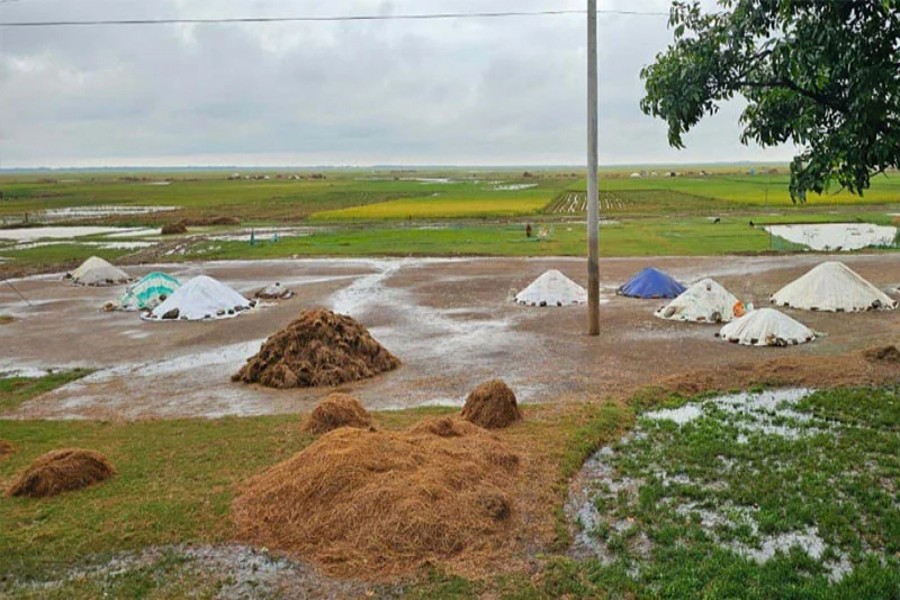
Early rainfall in March flooded paddy fields in the Haor (wetland) region and damaged the Boro paddy crop days before harvesting.
Most farmers in Kishoreganj haor areas have lost more than half of their expected Boro paddy. Much of the paddy they harvested from flooded fields is no longer fit for human consumption.
The Boro crop was expected to produce about 33 million tonnes of paddy, which would produce about 22 million tonnes of rice. However, the lost production is estimated at about 200,000 tonnes of rice, about 1 per cent of expected Boro rice production. This will reduce the supply of rice, and is likely to raise the price.
During a field visit on May 22, men and women in Itna, Mithamoin and Austagram upazilas were seen trying to dry discoloured paddy on roads, open spaces and in the backyards of their homes.
Abu Salek (50), a farmer of Moddhyogram in Itna, cultivated paddy on 25 acres of land in Alaler haor on the bank of the Dhonu river. Almost 90 per cent of his crop went under water during flash floods. He managed to harvest about 350 maunds of paddy, though he had expected 2,300 maunds. He had borrowed Tk 12 lakh in addition to investing his own savings. “A major portion of what we harvested is not fit for human consumption. Traders offer Tk 500 per maund for our paddy, whereas we expected to get Tk 800 for high moisture paddy,” he told this author. The growers sold dry paddy at about Tk 1,200 per maund last year when the government procurement price was Tk 1,440 a maund. “We have no idea how we will repay our loans.”
Another farmer of neighbouring Puranhati village, Abul Khayer (37), said that they could not use harvester machines as the fields were flooded, and they could not harvest manually either, because of labour scarcity. “Crops on a huge area of land went underwater. Hiring labourers at more than double the rate, I managed to harvest paddy from two out of seven acres I cultivated,” he said.
Angur Miah (40), a farmer of Moulovipara in Mithamoin, was able to harvest rice from three acres out of eight acres after his fields in Kunkunia haor were flooded. “I invested Tk 600,000, but it will be difficult to recover even 2 lakh. Traders are not willing to buy the paddy we harvested at the price we expected,” he pointed out.
A female farmer of Barohati, Mithamoin, Ujjola Rani Boishnab (48), mentioned that they were only able to harvest 6 acres of the 18 acres they cultivated. “We increased cultivation area this year after we got a good price last year. We borrowed Tk 10 lakh. My husband is worried about repaying the loan,” she added.
A farmer of Khoyerpur haor in Austogram, Islam Uddin (40), said that they harvested paddy from neck-deep water, but it has rotted. Mizanur Rahman (45) of Kalimpur of the same upazila, said that many farmers like him could not harvest any paddy. “I don’t know what we will eat for the rest of the year.”
A rice trader of Itna Parvej Bepani (39) informed this author that he usually buys 35,000 maunds of paddy each year from Haor farmers. This year, it will be difficult for him to buy even half of that quantity. “Some farmers spent a lot on labour to harvest paddy, but they can’t sell it at the price they expected. They were not able to dry it, and now it is not fit for human consumption. We expect a shortage of paddy, which will lead to a higher price,” he said.
Another trader of Mithamoin Muhsin Miah (42) said he doubts that he will be able to meet his target of purchasing 20,000 maunds of paddy. He says 60 per cent of the paddy fields were flooded. “The paddy which was harvested now has a bad odour. Some duck farmers are buying this paddy at Tk 500 per maund. If the government does not import rice, there might be a shortage.”
Amrit Barmon (54), the owner of the only rice mill in three upazilas, located at Jetty Ghat, Itna, on the Dhonu river bank, explained that he does not have enough capital to buy much paddy. Most of the paddy produced there is purchased by traders. “I am afraid I will not be able to buy the paddy required for my mill this year. There might be a shortage of paddy in the month of Kartik. People of this region will need to buy rice produced somewhere else,” he said.
sm67bd@yahoo.com