

Experts call for 3.0pc of GDP in climate financing
Dedicated climate plan with water management approach
Published :
Updated :
 For all latest news, follow The Financial Express Google News channel.
Climate activists and speakers on Sunday said that the proposed climate budget for FY 2026–27 does not provide sufficient funding to implement long-term climate adaptation plans.
They noted that despite steady GDP growth, climate allocations have not increased in proportion, reflecting a business-as-usual approach.
In the current budget, climate spending stands at only 0.76 per cent of GDP, which they described as far below implementation needs.
They urged that climate finance be treated as a strategic national priority, with allocation raised to at least 3.0 per cent of GDP to protect vulnerable communities and strengthen adaptation capacity.
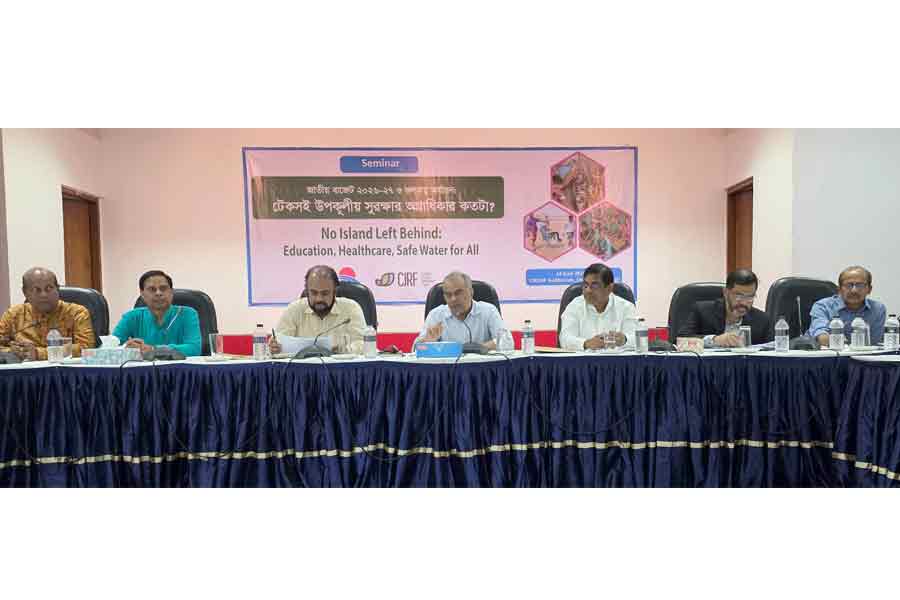
Demands were raised at the seminar titled “National Budget 2026–27 and Climate Allocation,” which was held at the CIRDAP Auditorium in Dhaka, jointly organised by COAST Foundation, BDSCO Process, and EquityBD.
The seminar was moderated by M Rezaul Karim Chowdhury, Executive Director of COAST Foundation. Speakers included Md. Ziaul Haque, Additional Director General of the Department of Environment; Shamsul Haque, Executive Director of SDI; Md. Mosharraf Hossain, Microfinance Policy and Advocacy Specialist; Tarek Sayeed Harun, Director of RDRS Bangladesh, among others.
M. Rezaul Karim Chowdhury, Executive Director of COAST Foundation, stressed that climate justice for coastal communities must be reflected in the national budget.
He said salinity, river erosion, water scarcity, and climate-induced displacement are key challenges affecting livelihoods.
Rezaul Karim Chowdhury called for transparent climate financing focused on vulnerable groups and recognized the role of Microfinance Institutions in socio-economic change.
He also pointed out the severe shortage of safe drinking water and urged scaling up rainwater harvesting, pond-based storage, pond-sand filters, salinity-resilient supply systems, and small-scale desalination technologies.
Md. Ziaul Haque, Additional Director General of the Department of Environment, identified two key priorities: protection from water-related disasters and waterborne diseases, and ensuring adequate, safe water for drinking and agriculture.
To address the severe drinking water crisis, he emphasised seawater desalination, pond excavation, and rainwater harvesting and storage. He strongly stated that these measures must be learned, adopted, and implemented safely and at scale.
Md. Mosharraf Hossain, Microfinance Policy and Advocacy Specialist, stated that the budget deficit can be reduced through improved governance and institutional reforms.
He emphasised strengthening accountability, including reforms in anti-corruption and key ministries, to ensure better financial management and efficiency.
Tarek Sayeed Harun, Director of RDRS Bangladesh, warned about declining private sector investment and noted that MFIs contribute around 22 per cent to GDP but still lack proper recognition.
He described the sector as clean and accountable, and urged government recognition along with funding support from the Bangladesh Bank.