


Rather than strengthening the capital market, the government is playing its habitual game of relying on banks for business financing.
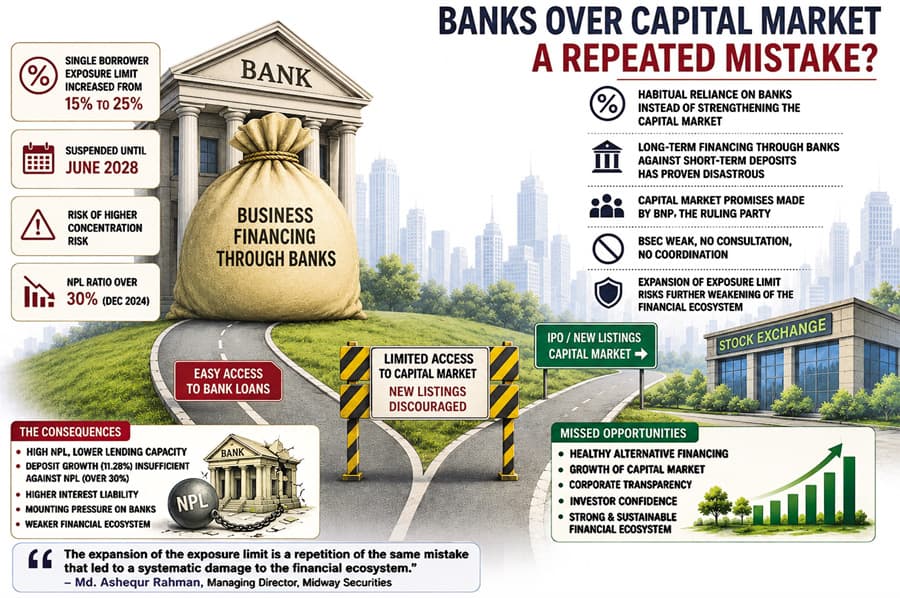
This is evident in the central bank's latest decision to expand the single borrower exposure limit from 15 per cent to 25 per cent of a bank's capital.
The suspension of the effectiveness of the previous 15 per cent limit until June 2028 is feared to discourage new listings of companies from large conglomerates.
"The expansion of the exposure limit is a repetition of the same mistake that led to a systematic damage to the financial ecosystem," said Md. Ashequr Rahman, managing director of Midway Securities.
Long-term financing through banks has continued over the years against short-term deposits, which has proved to be disastrous for the banking sector after a substantial amount of loans turned sour.
Before the last national election, key representatives of the BNP said they, if voted to power, would prioritise the capital market instead of the money market in financing.
In November last year, BNP leader Amir Khosru Mahmud Chowdhury, the incumbent finance minister, said at the Bangladesh Economic Summit that the party would put emphasis on energizing the capital market to lessen pressure on banks.
"We don't want to go to banks that are overused. We want to make the capital market vibrant and we're very serious about it," said Mr Chowdhury at the time.
The ruling party's election manifesto also included plans for the development of the capital market.
"All political parties spoke about a free economy, but eventually they preferred a managed economy after assuming office," said Mr Rahman while speaking with The FE over the phone on the latest policy of the Bangladesh Bank.
The change has been brought apparently to ease financial stress of the borrowers amid economic volatility.
With the high non-performing loan (NPL) ratio, however, the banks will face mounting pressure.
The overall banking sector's NPL ratio stood at over 30 per cent in December last year and deposits grew at a rate of 11.28 per cent year-on-year in February this year.
The deposit growth has not created enough room for fresh lending.
A lender having a 30 per cent NPL ratio means it has to serve purposes worth Tk 100 by Tk 70.
On receipt of fresh deposits worth Tk 11.28, the bank will be able to do the same job with Tk 81.28. Still, there is a shortfall of Tk 18.72. Besides, fresh deposits come with fresh interest liability.
The bank would have been in a better situation in terms of liquidity and for fresh lending had the deposit growth been at least equivalent to the NPL ratio.
In a situation like this, the expansion of the single borrower's exposure limit is not conducive to creating a healthy financial ecosystem.
Mr Rahman, of Midway Securities, said the BB decision is aimed at easing financial stress of business groups but they will borrow money from banks to execute long-term plans. "Will the central bank be able to restore the previous 15 per cent limit after two years?"
In the pre-budget meeting held between the National Board of Revenue (NBR) and stakeholders of the capital market, it was discussed that the companies that would exhaust a certain limit of credit must go to the capital market to raise more capital and that money could be raised through both equity and debt instruments.
After the promise of prioritising the capital market by the government and subsequent discussions in this regard with the revenue board, the central bank expanded the single borrower exposure limit.
Stakeholders of the capital market said both the securities regulator and the central bank are regulatory bodies. But the central bank enjoys the authority to take decisions without consulting other regulators.
On the other hand, since its inception in 1993, the Bangladesh Securities and Exchange Commission (BSEC) has failed to establish its importance before the government and other regulatory bodies.
Alongside the failure of the BSEC, stock exchanges and professional bodies of the capital market have also been unable to play any role in bringing good companies, which heavily rely on bank financing, to the secondary market.
mufazzal.fe@gmail.com