

Published :
Updated :
 For all latest news, follow The Financial Express Google News channel.
The stock market regulator is set to suspend trading in shares of non-operational companies as part of a broader market reform aimed at protecting investors and improving market integrity, said its new chief.
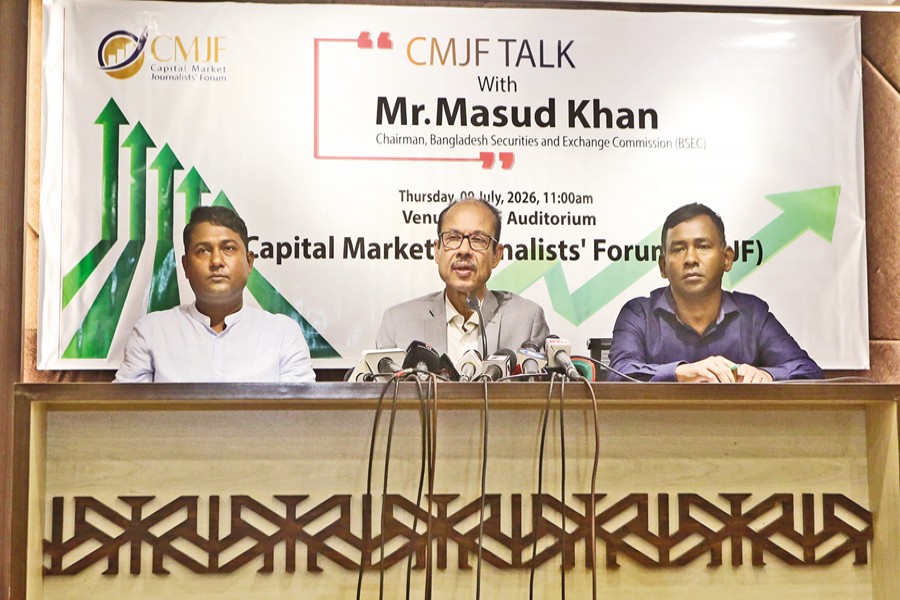
"There is no other market in the world where shares of closed companies continue to be traded," said Masud Khan, chairman of the Bangladesh Securities and Exchange Commission (BSEC), as the chief guest at the CMJF Talk, organised by the Capital Market Journalists' Forum (CMJF) at the CMJF Auditorium in the capital on Thursday.
"In many countries, [share] trading is automatically halted if a company's production remains suspended for three consecutive months." In Bangladesh, many companies have remained non-operational for 10-20 years but their shares are still transacted on the bourses.
The BSEC chairman said the commission had already delegated greater regulatory authority to the Dhaka Stock Exchange (DSE), enabling it to take real-time action against abnormal price movements and suspicious trading without seeking prior approval from the regulator.
Previously, the DSE needed approval from the BSEC before any action, creating scope for irregularities to continue for longer periods.
"We have empowered the stock exchanges to take immediate action and also given them the authority to determine circuit breakers. Such deregulation is essential for a more efficient market," Mr Khan said.
Meanwhile, the DSE on Thursday suspended trading of shares of two more closed companies-Usmania Glass Factory and Meghna Pet Industries-after detecting abnormal price surges.
Presently, the number of closed companies is 34.
The BSEC chief also outlined plans to introduce day netting for selected quality stocks to improve liquidity and attract more investors to the secondary market.
He said the proposal for introducing day netting had recently been submitted by the DSE Brokers Association. However, the facility cannot be implemented for all listed securities under the current market conditions.
"We are considering introducing day netting initially for quality companies. The facility may begin with around 30 fundamentally strong stocks," Mr Khan said.
The BSEC chief also described the revival of the mutual fund industry as one of his top priorities, saying a strong mutual fund sector is essential for the development of the country's capital market.
"Retail investors often lack the expertise to identify fundamentally sound companies. We want to encourage them to invest through professionally managed mutual funds," he said.
To improve investment decisions, the regulator plans to introduce an internationally benchmarked certification programme for financial advisers while revising the Mutual Fund Rules.
To strengthen oversight of brokerage houses, the BSEC will classify brokers into three risk categories-low, medium and high risk.
Brokerage firms labelled as highly risky will be subject to surprise inspections, the BSEC chief said, adding that investor approval through mobile phone or email before share transactions would be made mandatory to strengthen investor protection.
Responding to a question on bringing multinational and large domestic corporations to the stock market, Mr Khan said the BSEC will amend the rules to allow private companies to be directly listed.
"If they still do not come to the market, despite using public money through bank loans, we will fix a ratio. Companies exceeding that threshold will be required to list in the public interest," Mr Khan added.
The BSEC is also reviewing the margin rules and public issue rules to make the market more investor-friendly.
The BSEC chairman said the existing margin loan regulations contain too many restrictions, making it difficult for investors to access leverage. A draft of the revised rules will be published next week, after which obtaining margin loans is expected to become much easier for good investors, Mr Khan added.
As part of broader market reforms, the securities regulator is also preparing to simplify the initial public offering (IPO) process and introduce a direct listing framework to encourage more fundamentally strong and reputable companies to enter the stock market.
Mr Khan said the existing IPO process discourages quality companies from going public because of lengthy approval procedures and excessive documentation.
"Companies have to wait nearly one-and-a-half years and submit piles of documents for an IPO. Bank financing is much quicker. We have to simplify the IPO process if we want fundamentally strong companies to come to the market," he said.
The regulator also plans to expand direct listing facilities. Under the proposed framework, private companies will be allowed to list by offloading only 10 per cent of their shares, compared with the existing provision under which only state-owned enterprises can directly list by offering at least 25 per cent of their shares.
To deepen the debt market, government and corporate bonds will be shifted from the Alternative Trading Board to the main board of the stock exchanges, while preparations are also underway to introduce derivatives trading.
The BSEC is also gearing up to install T+1 settlement, reducing the settlement cycle from T+2. Bangladesh Bank is currently working with the commission on the implementation framework.
To strengthen market surveillance, Mr Khan said an artificial intelligence (AI)-based monitoring system would be introduced within a year. The DSE has already been instructed to bring the necessary changes for the new surveillance platform.
Mr Khan acknowledged that enforcement has long been one of the weakest aspects of Bangladesh's capital market.
He said the BSEC is considering filing criminal cases instead of civil suits when taking action against market manipulation, irregularities and fraud to make enforcement more effective.
The BSEC chief said the previous commissions had imposed around Tk 15 billion in penalties, of which only about Tk 3.3 million was recovered because most cases remained pending with the courts.
To address the problem, the commission is pursuing legal reforms, including the establishment of a dedicated HC bench for capital market cases and authority to file cases directly with the capital market tribunal to ensure quicker punishment for offenders.
The BSEC chairman also defended the commission's decision to remove the floor prices of two stocks despite criticism, saying the move was necessary to restore normal market functioning.
Referring to the recent regulatory initiatives, Mr Khan said the regulator had intervened to prevent the delisting of Beximco Pharmaceuticals from the London Stock Exchange in order to protect Bangladesh's reputation in international capital markets.
Responding to a query on the dismissal of DSE employees, Mr Khan said recruitment and termination of the exchange's employees fall entirely under the authority of the stock exchange and that the BSEC has no role in such administrative decisions.
However, he expressed hope that issues relating to dismissed BSEC employees would be resolved within this month.
Reflecting on his appointment, Mr Khan said he had initially declined the position because many people warned him that almost everyone who had previously served at the BSEC had left office with a damaged reputation.
"I accepted the responsibility only after receiving assurances from the government's top leadership that I would have complete independence to carry out reforms."
CMJF President Md Munir Hossain presided over the event, while General Secretary Ahsan Habib conducted the programme.
babulfexpress@gmail.com