

Published :
Updated :
 For all latest news, follow The Financial Express Google News channel.
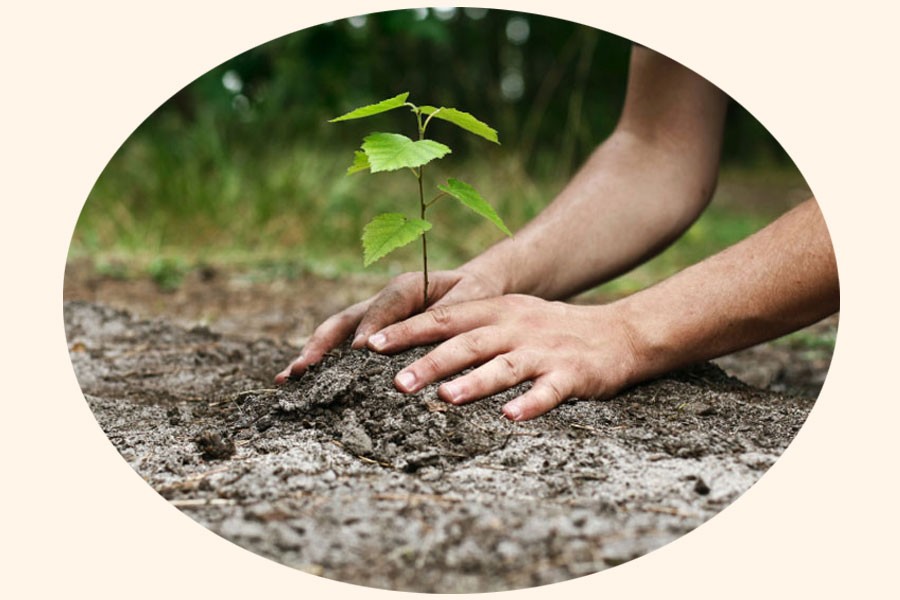
Awareness about the conservation of environment and the role of tree plantation has improved in Bangladesh in recent years. Now an impressive spectacle of green ambition is evident, particularly during monsoon. Government departments, non-government organisations and corporate entities launch tree plantation campaigns while development projects distribute thousands of saplings, resulting in plantation of millions of them throughout the country - in woodlands, on the compounds of educational institutions and homesteads, roadsides and other vacant places. However, data suggest quite a number of these saplings do not survive. With the death of a sapling, all the efforts and resources engaged go in vain. Why does it happen? It is because the saplings are not nurtured properly and monitored carefully.
The country is facing many environmental concerns - rapid urbanisation, deforestation, riverbank erosion, rise in air pollution, destruction of biodiversity and impacts of climate change, All these have made afforestation increasingly significant as trees play the most critical role in absorbing carbon dioxide, controlling the heat at ground level, conserving soil, maintaining biodiversity and promoting good health.
In Bangladesh, most of the institutional plantation projects are geared towards achieving annual targets. The objective is usually the distribution or planting of a specific number of saplings during the year. After the plantation spree is over, the attention shifts elsewhere. Watering, fencing, weeding, replacing dead saplings and protecting young trees from animals are not taken seriously.
It is especially evident in projects implemented with climate-related funds. In recent years, a lot of money has been spent on climate adaptation and environment conservation projects, where tree plantation is an important part. Although the projects report impressive plantation figures, it turns out that the saplings do not survive for more than months. It is because plantation sites become overgrown with weeds, protective fencing collapses and young trees die from a lack of care.
It leads to the fact that money is spent for nothing. Progress is claimed, but outcomes remain below par in terms of environmental benefits - no carbon is absorbed, no additional diversity appears. Communities get disappointed with such initiatives.
Several reasons explain why such problems occur repeatedly. Implementation of the projects pays more attention to expenses than results. The organisations or agencies which are responsible for implementing the projects are evaluated not by the survival rate of the plants, but by the number of saplings planted. Monitoring is typically poor and does not take place after the project completion period. There is a lack of organisations or agencies that would be responsible for maintaining the plantations after the first year.
In many cases, species are not selected carefully and trees are planted without consideration of the soil, water and ecological requirements. Sometimes species which are native to the region and are able to cope with local conditions are overlooked and given priority to species which grow fast. Consequently, survival rates become low.
Community ownership of projects is another missing element. If local communities, educational institutions and local government bodies feel responsible for taking care of trees, the projects are likely to be successful.
There are many examples in Bangladesh that prove better outcomes are possible if communities are engaged. The community-managed social forestry programmes have proved that where there is a sense of ownership, the survival rate increases dramatically.
Technology can serve as an effective tool for enhancing accountability in afforestation projects. Use of digitised mapping of the plantation sites, GPS-based monitoring system, satellite imagery and photographs taken at certain intervals can be helpful to ensure that the trees planted will survive.
Reform in policy is equally important. The measures used for success should be changed from the number of saplings planted to the percentage of survival in one year, three years and five years phases.
Bangladesh has already shown how it can inspire citizens to rally behind national causes. Tree plantation is nothing different. But the country's environmental future depends less on the excitement of planting days than on the quiet, consistent work that follows.
We need to understand that a young plant requires years of care before it can offer shade and shelter, absorb carbon dioxide or guard the populace from the consequences of climate change. If we fail to ensure that care, there is a danger that Bangladesh will keep count of millions of trees which do not exist.