

INTERIM GOVT'S TASKFORCE PRESCRIBES REMEDIES FOR CRISES
A two-year strategy to cure economic ills underway
Published :
Updated :
 For all latest news, follow The Financial Express Google News channel.
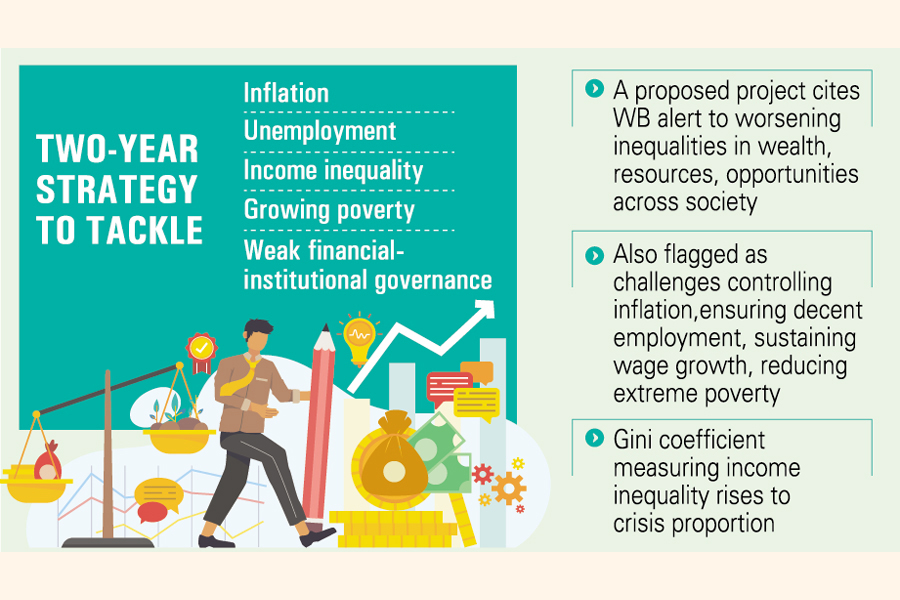
A strategic crash programme is being framed to tackle mounting economic vulnerabilities like persistently high inflation, rising unemployment, declining household incomes, growing poverty and weak governance in the financial and institutional sectors.
Officials say the General Economics Division (GED) of the Planning Commission is to implement the two-year short-term strategy, incorporating recommendations made by a taskforce formed by the interim government to work out a socioeconomic rescue plan.
The strategy will prioritise six key areas: macroeconomic management and poverty reduction, agriculture, social sectors inclusive of health, education and social protection, industry and trade, physical infrastructure covering transport, communications and information technology, and governance reforms.
Following the expiry of the eighth five-year plan last June, the GED initiated the move to ensure policy continuity, drawing on recommendations from the taskforce on 'Re-strategising the Economy and Mobilising Resources for Equitable and Sustainable Development', led by Dr KAS Murshid, former BIDS director-general.
The short-term strategy will also mark the conclusion of a 15-year era of medium-term economic planning in Bangladesh, spanning three consecutive five-year plans that commenced in FY2010-11.
The Planning Division has submitted a Tk 110.36-million project proposal to the Planning Commission to formulate policies, support their implementation, and oversee the execution of the taskforce report, GED sources said.
The project will also align the revised economic strategy with the Sustainable Development Goals (SDGs) framework, prepare the SDG Progress Report 2026, and establish three pilot SDG villages in the country.
The Socioeconomic Infrastructure Division of the Planning Commission has scheduled a Project Evaluation Committee (PEC) meeting for Sunday to review the Planning Division's proposal.
Officials will seek justification for the high consultancy and survey costs, which account for nearly 46 per cent of the total project budget, reveals the working paper prepared for the meeting.
Also, the project is likely to secure approval easily as its estimated cost of Tk 110.36 million falls well below the Tk 500-million threshold set by Planning Adviser Dr Wahiduddin Mahmud.
The project is aimed at developing and monitoring a short-term strategy to revise economic strategies for sustainable development, while boosting economic and social growth through effective planning, said the officials concerned.
Quoting Bangladesh Bureau of Statistics (BBS) and World Bank data, the proposal underscores persistent inequalities in wealth, resources, and opportunities across society.
It also has flagged challenges in controlling inflation, ensuring decent employment, sustaining wage growth, and reducing extreme poverty.
The Gini coefficient measuring income inequality between urban and rural areas rose to 0.499 in 2022 from 0.458 in 2010, while the Gini for expenditure increased from 0.321 to 0.334 over the same period.
"This indicates that disparities in wealth, opportunities and access remain entrenched among different individuals and groups in our society," the proposal reads.
The World Bank's 2024 Macro Poverty Outlook for Bangladesh rings the alrm bell about a relapse of the poverty indice as nearly 3.0 million people could fall into extreme poverty in FY2024-25, with daily incomes below US$2.15 in terms of PPP.
Quoting the World Bank, the proposal notes that high inflation and declining employment could pose significant challenges, particularly for low-income households.
In the first half of FY2024-25, about 4.0 per cent of workers lost their jobs, while wages fell 2.0 per cent for low-skilled workers and 0.5 per cent for high-skilled ones.
Consequently, the extreme-poverty rate could have risen to 9.3 per cent in FY2024-25, up from 7.7 per cent in FY2023-24.
The report further warns that income inequality is likely to widen, continuing a rising trend in recent years, while real GDP growth is projected to slow.
The proposal notes that post-uprising interim government's measures improved the economy slightly but challenges remained.
A 12-member taskforce recommended immediate steps in the fields of macroeconomic management and poverty reduction, agriculture, social sectors like health, education and social protection, industry and trade, physical infrastructure covering transport, communications and information technology, and governance reforms.
Based on these recommended dos, a short-term economic strategy is being formulated, it explains.
As part of the new economic strategy, six cluster-based plans will be developed, supported by short-term research, studies, and surveys to address data gaps.
Six sectoral advisory committees and a technical committee, chaired by the planning adviser, will guide implementation, with their recommendations shaping the final background studies.
The project will also provide high-level overseas training to 10 government officials in Singapore or another suitable country.
Dr KAS Murshid, chairman of the 12-member taskforce, welcomes the adoption of some of its recommendations.
However, he notes that while SDG villages are being piloted in rural areas, urban initiatives in health, education and social services should also have been tested.
"Rural challenges are identified, with initiatives from government, private sector, and NGOs. Urban problems are more complex, and the government needed to take effective steps there," he told the FE writer.
He adds: immediate measures are needed to revive the economy and warns that delays in project approval and implementation could hold back the introduction of the new strategy.
"The strategy review is underway to chart the economy's current trajectory and serve as a bridge between the Eighth Five-Year Plan and future planning," says a senior GED official.
He says the initiative aims to assess the economy's standing and provide direction for its future course.
jahid.rn@gmail.com