
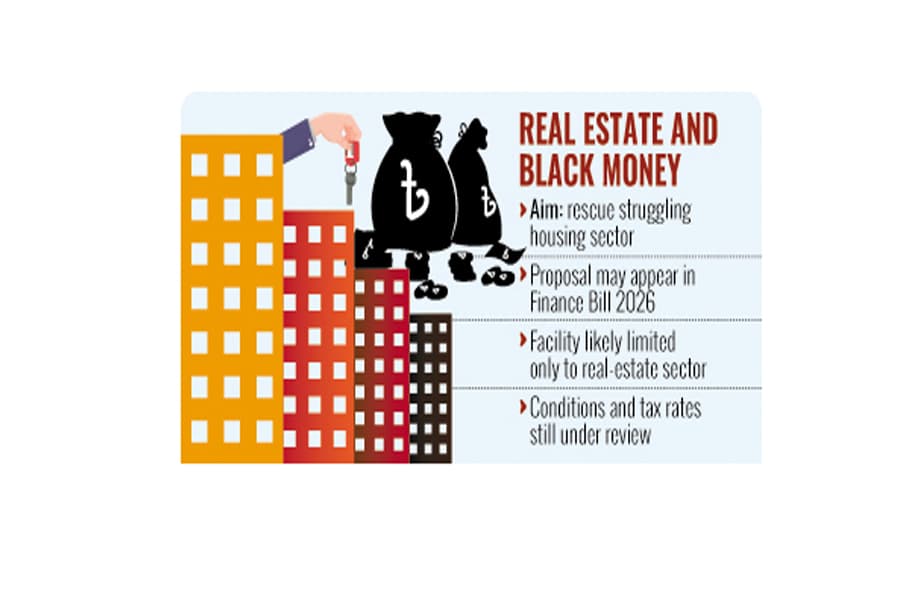
Reintroducing a facility to legalise undisclosed money through investment in real estate is under consideration in a bid to rescue the industry from the brink of collapse, sources say.
At the same time, the upcoming national budget is likely to offer a wide range of tax breaks to encourage investment in capital-intensive and emerging sectors, including semiconductors, active pharmaceutical ingredients (API), and locally produced food- and vegetable-processing industries.
Tax officials say the tax-free income threshold for individual taxpayers may also be raised to Tk 0.4 million for fiscal years 2028-29 and 2029-30.
The proposed measures are expected to be incorporated into the Finance Bill 2026 for the fiscal year 2026-27.
Senior tax officials say the provision allowing the "whitening of black money" was scrapped in the current fiscal year's budget following widespread criticism from civil-society groups.
However, they say, the National Board of Revenue (NBR) has, in principle, agreed to reinstate the facility exclusively for the real-estate sector, although the format and conditions are still under review.
In its budget proposals, the Real Estate and Housing Association of Bangladesh (REHAB) has requested the government to allow investment of undisclosed money in the housing sector at a lower tax rate and without questioning the source of funds.
Currently, taxpayers can get legalised undisclosed income by paying a higher penal tax in addition to regular taxes.
However, such declarations do not provide immunity, meaning the Anti-Corruption Commission (ACC) and intelligence agencies may still question the source of the money.
Liakat Ali Bhuiyan, former senior vice-president of REHAB, says reintroduction of the previous provision under the Income Tax law is necessary for individuals who failed to declare assets earlier.
"For example, expatriates often send money home without filing declarations, which later becomes undeclared income. Similarly, inherited assets may also remain undisclosed if not properly reported," he explains.
"The government must consider the issue to prevent capital flight of money that cannot be shown legally in Bangladesh," he notes.
In the fiscal year 2020-21, the government introduced a provision allowing investment of undisclosed money in the housing sector without any questions from authorities.
At the time, while regular taxpayers paid up to 30-percent tax, investors whitening black money in the housing sector were required to pay only 10-percent tax.
In the current fiscal year's budget, the interim government withdrew tax-holiday facilities for around 40 industrial sectors, including several high-tech and emerging industries, as part of a broader policy overhaul to phase out tax exemptions.
Industries that commenced commercial production between July 2020 and June 2025 had been eligible for the incentives.
The sectors included active pharmaceutical ingredients (API), agricultural machinery, automobiles and auto parts, artificial fibre, biotechnology-based agro-products, boiler and compressor manufacturing, computer hardware, electronics components, furniture, home appliances, and mobile-phone manufacturing.
Other eligible sectors included leather and leather goods, petrochemicals, pharmaceuticals, tyre manufacturing, textile machinery, tissue grafting, toy manufacturing, LED televisions, and plastic-recycling industries.
Advanced technology sectors such as automation and robotics, artificial intelligence-based systems, nanotechnology products, and aircraft heavy maintenance services, including parts manufacturing, were also covered under the previous tax -holiday scheme.
Besides manufacturing, the incentives also applied to locally produced fruit and vegetable processing, biotechnology development, and radioactive diffusion applications in industries, including polymer quality improvement, food preservation, and medical device sterilisation.
Officials say majority of those sectors, including some new ones, may enjoy the facility for next three to five years in the upcoming budget.
doulotakter11@gmail.com