


Finance Minister Amir Khosru Mahmud Chowdhury has unveiled an ambitious vision to transform Bangladesh into a trillion-dollar economy by 2034, even as rising debt and intensifying climate risks threaten to derail progress.
Speaking at the 16th Ministerial Dialogue of the CVF-V20 on April 14, the minister underscored Bangladesh’s position as one of the world’s most climate-vulnerable economies, warning of a tightening fiscal environment driven by recurring disasters and financial strain.
Mr. Chowdhury delivered a stark assessment of the country’s economic trajectory, cautioning that development financing is increasingly constrained by a growing debt burden.
Bangladesh’s debt-to-GDP ratio has climbed sharply – from 26.2 per cent in FY2017 to 36.0 per cent in FY2023 – with further increases expected as repayment obligations rise on large infrastructure projects.
By FY2024, domestic debt is projected to comprise 56 per cent of total liabilities, while external debt will account for 44 per cent, reflecting a shifting financing structure that could heighten internal fiscal pressure.
The fiscal squeeze is already impacting climate-related social protection efforts. Allocations for climate-focused programmes under the Social Safety Net Programme (SSNP) have dropped dramatically to U$592.8 million for FY2025–26, down from U$1.42 billion previously – nearly a two-thirds reduction.
To cushion vulnerable populations, the government has introduced targeted initiatives such as “Family Cards” and “Farmers Cards”, aimed at mitigating the combined shocks of climate change and global economic volatility.
Beyond domestic challenges, Bangladesh is grappling with mounting geopolitical and trade pressures.
The World Bank estimates that the ongoing Middle East conflicts could push an additional 1.2 million Bangladeshis into poverty, exacerbating social vulnerabilities.
Meanwhile, the minister criticised unilateral trade measures (UTMs) that bypass global trade norms, arguing that such policies disproportionately affect climate-vulnerable economies like Bangladesh.
In response, Bangladesh has outlined a five-point reform agenda aimed at reshaping international financial support mechanisms.
The points are adoption of a Multidimensional Vulnerability Index (MVI) instead of GNI per capita to determine aid eligibility, large-scale and fast-tracked debt relief mechanisms, expanded risk-hedging tools to attract private climate investment, pre-arranged emergency liquidity facilities for climate disasters and accelerated climate-focused reforms within multilateral development banks.
“It is time to translate conference into practice and turn advocacy into action,” Mr. Chowdhury said, urging the global community to step up support.
He also proposed establishing a CVF-V20 Regional Hub in Dhaka, positioning Bangladesh as a leader in climate resilience and policy innovation.
Bangladesh’s trillion-dollar ambition signals confidence in long-term growth, but without urgent fiscal space, climate financing, and global support, the path ahead remains highly challenging.
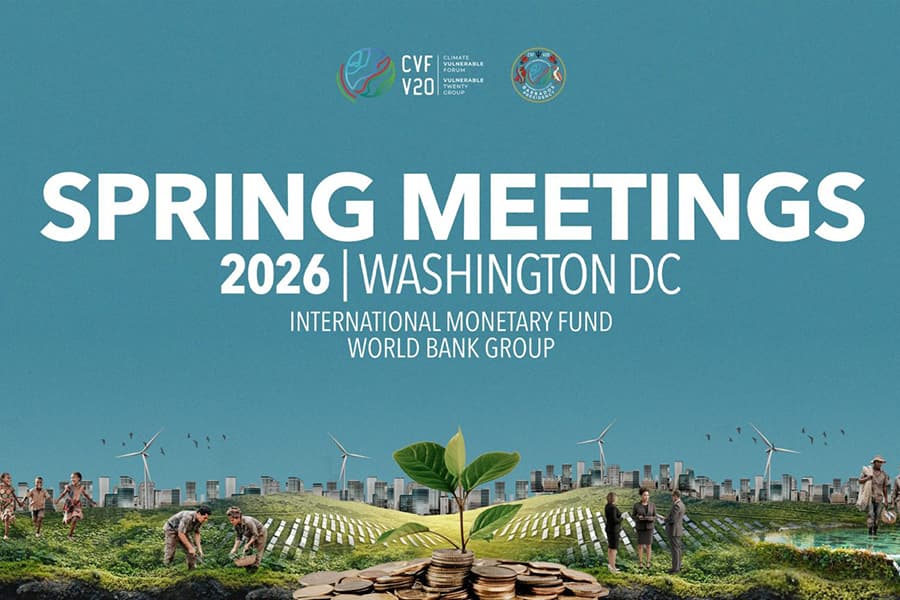
A high-powered Bangladesh delegation is now staying in Washington D.C. led by the finance minister for joining the Spring Meetings of IMF-WBG.
Finance Secretary Dr Md Khairuzzaman Mozumder, NBR Chairman Md Abdur Rahman Khan, Governor Md Mostaqur Rahman, Basumati Group Chairman ZM Golam Nabi and senior officials of different ministries and divisions are members of the panel.
The Spring Meetings began on April 13 and will conclude on April 18.
rezamumu@gmail.com