


Bangladesh's ready-made garment (RMG) exports to its largest destination, the United States, sustained double-digit growth both in terms of value and volume in 2025 amid the declining US import trend caused by tariff-related tension and uncertainty.


Vietnam became the top exporter of apparel items to the US during the January-December period of 2025, surpassing China.
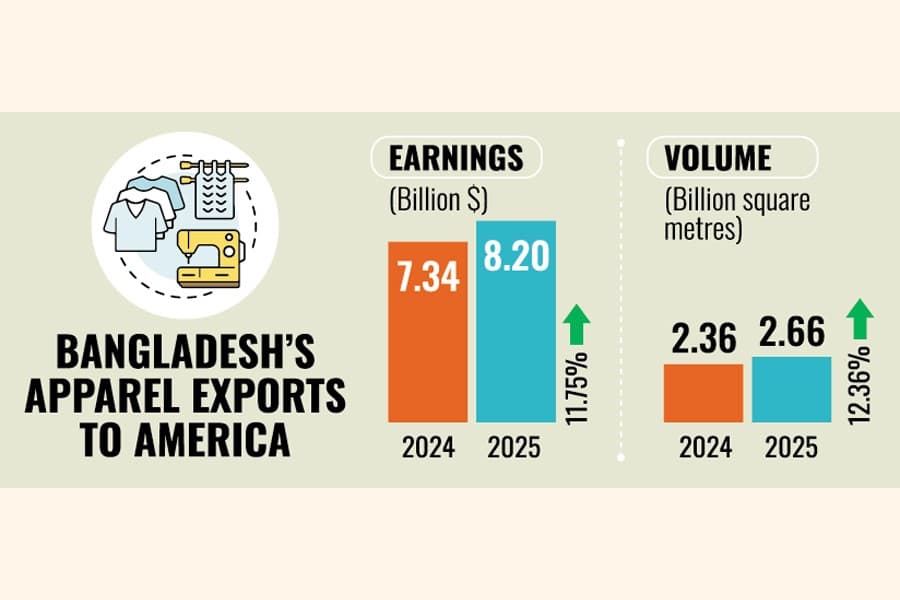
Local garment items fetched $8.20 billion last year, recording 11.75 per cent growth from $7.34 billion in 2024, according to the Office of Textiles and Apparel (OTEXA) data released on February 19.
In this period, Bangladesh shipped 2.66 billion square metres (SME) of apparel, marking 12.36 per cent growth from 2.36 billion square metres exported in 2024.
Although the overall apparel export growth in this period maintained double-digit expansion, shipments in May, October, and November fell by 8.01 per cent, 11.59 per cent, and 14.51 per cent, respectively, the data shows.
In December, exports again entered the positive territory with 3.33 per cent and 1.39 per cent year-on-year growth in terms of value and volume, respectively.
The overall US apparel imports in 2025 declined by 1.70 per cent to $77.88 billion from $79.23 billion in 2024.
Imports also decreased by 3.62 per cent in terms of volume, reaching 24.81 billion square metres from 25.74 billion square metres in 2024.
Shovon Islam, managing director of Sparrow Group, attributes the overall growth to the pre-tariff additional work orders and advanced shipments in fear of high tariffs until July, when the country recorded significant growth, especially in the early months of 2025.
But after the imposition of new tariffs, initially 37 per cent and then finally 19 per cent, on Bangladesh, buyers placed reduced work orders following a decline in US demands, mostly because of the high reciprocal tariffs on the major garment-producing countries, including China and India, he tells The Financial Express.
US buyers placed fewer work orders after July due to high tariffs, which also eroded consumer demand, he says.
They were converting their purchasing budget to match the tariffs as they did not have an additional budget, says Islam.
However, he hopes buyers will start placing higher-volume orders following the US High Court verdict, and a universal 10-15 per cent tariff will be applicable to all garment-producing countries, which buyers will manage.
Risk factors against Bangladesh will improve with the national elections and a stable political situation, he says.
Mahmud Hasan Khan, president of Bangladesh Garment Manufacturers and Exporters Association (BGMEA), says reciprocal tariffs for Bangladesh were lower than those for China and India, which put it in an advantageous position.
Besides, orders from China shifted to other countries, and some also came here, he tells The Financial Express.
US garment imports from China declined by about 35.61 per cent to $10.64 billion in 2025 from $16.52 billion in 2024, according to the data.
Vietnam registered 11.84 per cent growth to earn $16.74 billion and became the top exporter of apparel to the US in 2025.
India recorded over 5.48 per cent growth, earning $4.94 billion, while Cambodia posted the highest growth of 26.95 per cent, fetching $4.82 billion.
Indonesia and Pakistan saw 9.67 per cent and 10.76 per cent growth, earning $4.66 billion and $2.39 billion, respectively, according to the data.
The BGMEA leader fears low or no growth in February due to the national elections, saying buyers have held up some orders over uncertainties related to the polls.
He notes that China and India have grabbed work orders from the European Union (EU) buyers aggressively, offering lower prices to offset the high US tariff impacts even after making losses.
"But such a trend cannot sustain. How long can one do business by incurring losses?" he says, expecting orders will again shift here.
Bangladesh can do better if the newly elected government provides the required policy support, Khan says.
Manufacturers mostly need uninterrupted gas and electricity supply, reduced bank interest rates, higher Chittagong port efficiency, and a stable law and order situation, he adds.
AK Azad, managing director of Ha-Meem Group, tells The Financial Express that Bangladesh is competitive compared to neighbouring countries.
He also says growth may be higher in the coming days if the government provides policy support, especially by lowering bank interest rates, ensuring a smooth supply of utilities, and improving the law and order situation.
"Otherwise, it will be difficult to sustain the double-digit growth," he says, adding that the country will also lose its competitiveness if it graduates from the least developed country (LDC) status in 2026.
Munni_fe@yahoo.com