

Published :
Updated :
 For all latest news, follow The Financial Express Google News channel.
Amid growing fears of job losses and disruption, experts believe artificial intelligence (AI) could unlock vast new economic opportunities for Bangladesh if managed wisely.
While concerns persist over automation and its impact on employment, they argue that the country's focus should now shift toward readiness: shaping policy, modernising education, and protecting local innovation from foreign dominance.
Their views echo a recent World Bank report on 'Jobs, AI, and Trade in South Asia'.
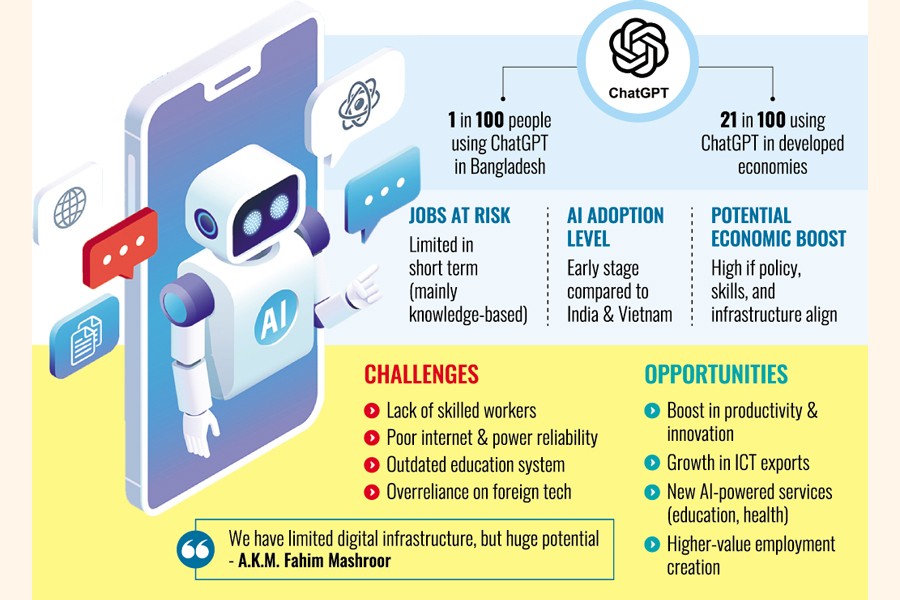
It found that while large-scale job losses from AI remain limited in the near term, Bangladesh and its neighbours face a greater risk - being unprepared to harness AI's full potential due to gaps in skills, infrastructure, and digital capacity.
Artificial intelligence (AI) could reshape Bangladesh's economy by boosting productivity and creating new jobs, but only if the country adopts timely, strategic measures, experts have said.
They urged the government to finalise the draft AI policy, establish clear guidelines and regulations, reform the education system, promote research and development, and safeguard local innovation against overreliance on foreign technology.
The World Bank report warns that South Asia "lacks several preconditions for maximising the benefits from AI", citing shortages of skilled workers, unreliable electricity, and limited access to fast, consistent internet.
Without urgent investment in human capital and digital infrastructure, Bangladesh risks missing the productivity dividend AI could bring, deepening inequality instead.
Dr Khondaker Abdullah-Al-Mamun, Professor of Computer Science and Engineering at United International University (UIU), said with proper policy support, AI could be a "blessing" for Bangladesh's economy, enhancing workforce efficiency and opening new sectors of growth.
"Bangladesh urgently needs to develop three things - policy, strategy, and regulations - for the optimal administration of AI," he said. "Proper and timely adoption will be a blessing, but without pragmatic measures, it could easily become a curse."
He cited online gambling platforms, which heavily rely on AI for data manipulation, as an example of the technology being misused in Bangladesh.
Compared to regional peers like India, Bangladesh remains far behind in adopting AI and developing skilled manpower.
Dr Mamun noted that AI-related skills could generate foreign earnings far exceeding the ready-made garments (RMG) sector, urging a pivot toward higher-value ICT services.
A.K.M. Fahim Mashroor, founder of leading job portal bdjobs.com, said Bangladesh's adoption of AI remains at an early stage, limiting its current impact but also presenting "huge possibilities."
"Our digital industries and IT infrastructure are still underdeveloped," he said. "As Bangladesh is mainly a manufacturing and agriculture-based economy, job losses will be slower to appear … the greater opportunity lies in leveraging AI for growth."
He added that AI could play a crucial role in addressing gaps in health and education, especially outside major cities. "Most HSC candidates this year failed in English and Mathematics due to a shortage of capable teachers. AI-based learning tools can help bridge this gap," he said.
Mashroor also emphasised the need for each ministry and department to integrate AI into their operations to improve efficiency and service delivery.
Dr M. Rokonuzzaman, Professor at North South University and researcher in Artificial Intelligence and Robotics, said Bangladesh produces hundreds of thousands of graduates annually but remains a "replicating economy" rather than an innovating one.
"A large number of graduates fail to find jobs because they enter into a copy-based economy," he said. "Generative AI tools like ChatGPT are already replacing knowledge-based jobs such as writing, translation, image editing, and accounting."
According to the World Bank report, nearly one in every hundred people in Bangladesh and neighbouring countries use ChatGPT, compared to 21 in developing economies.
Dr Rokonuzzaman stressed that the real challenge lies in creating work opportunities for graduates as AI continues to reshape industries.
"We must move from replication to innovation. New technologies can create jobs, but only if we prepare the right policies to capture those opportunities," he said.
He added that even physical jobs are now being replaced by automation, making it vital for Bangladesh to focus on producing home-grown innovations and exporting ideas, not just labour.
"The education system must evolve - from rote learning to innovation, research, and development," he said.
saif.febd@gmail.co