

BD-China trade bonanza in crunch time too
Annual turnover peaks on huge capital goods imports
India second-biggest trading partner in FY23
Published :
Updated :
 For all latest news, follow The Financial Express Google News channel.
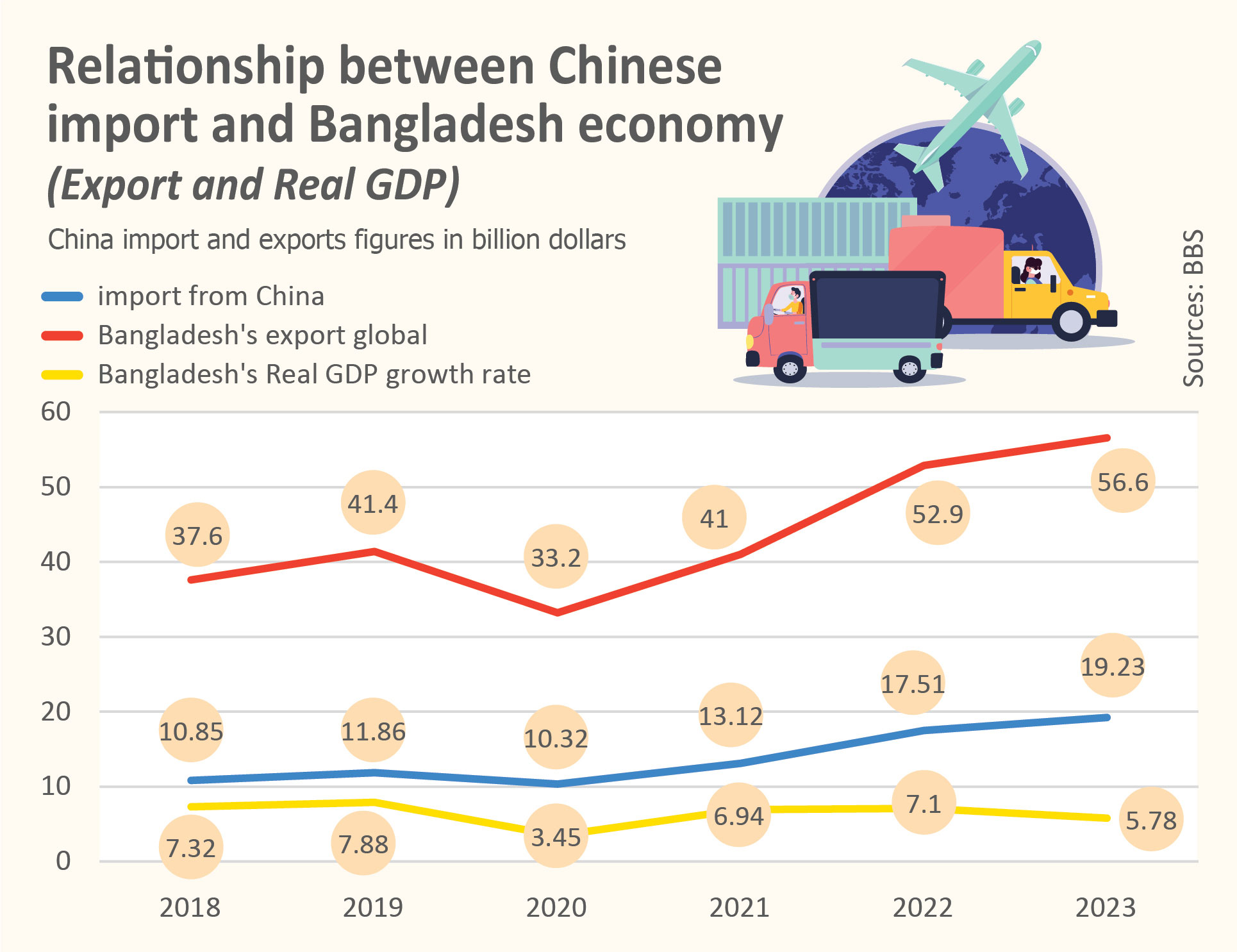
Economic ties between Bangladesh and China have deepened significantly, with Bangladesh’s imports from the world’s second-largest economy continuing to grow despite ongoing import restrictions—largely thanks to the Belt and Road Initiative (BRI).
This trade expansion has strengthened the country’s export capabilities and contributed to its overall economic growth.
Introduced by Chinese President Xi Jinping in 2013, the BRI saw Bangladesh join in 2016, initiating an era of enhanced bilateral trade, according to economists.
During President Xi’s visit to Bangladesh in 2016, he pledged US$40 billion for a number of infrastructure projects, further cementing economic collaboration under the BRI framework.
Trade between the two nations has grown significantly in recent years, with bilateral trade standing at $11.56 billion in 2018. It rose by 8.53 per cent to $12.54 billion in 2019 and reached the bilateral relations at $19.3 billion in the fiscal year 2023, according to the Bangladesh Bureau of Statistics (BBS), the national statistical organisation.
Since 2018, China has been Bangladesh’s largest trading partner, overtaking neighbouring India, which now ranks second.
Economists acknowledge the substantial trade deficit with China but emphasise the critical role of Chinese capital goods in supporting the country’s economic momentum.
These goods –industrial raw materials—essential for the country’s $450 billion economy, where the industrial sector contributes 23 per cent —fuel growth by enabling export-driven industries.
Dr. Wahiduddin Mahmud, a prominent economist and professor of economics, highlights Bangladesh’s dependence on Chinese imports for raw materials and machinery, particularly for the export-oriented manufacturing sector.
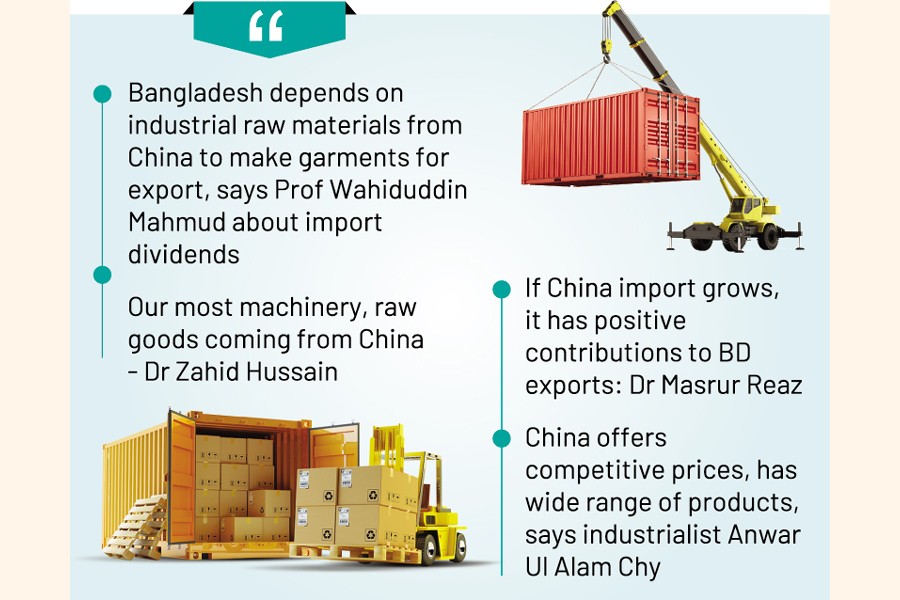
“Bangladesh depends on industrial raw materials from China to make garments for exports,” said Professor Wahiduddin Mahmud about import dividends.
Bangladesh’s primary export markets include the European Union and North America.
Similarly, Dr. M. Masrur Reaz, chairman of Policy Exchange of Bangladesh, a privately-owned think tank in Bangladesh, argued that the trade deficit with China should not be a concern, as Chinese goods dominate the Bangladeshi market due to their cost competitiveness.
Chinese goods dominate the Bangladeshi market due to their competitive prices, especially in machinery vital for the ready-made garment (RMG) industry.
“If China import grows, it has positive contributions to Bangladesh exports,” Dr. Masrur added.
Yet, the rapid expansion of its garment industry—employing around 5.0 million workers, most of them women—has deepened trade ties with China.
Bangladesh, the world’s second-largest apparel exporter after China, heavily relies on Chinese machinery and raw materials.
Bangladesh has been pursuing import restrictions since the beginning of the war in Ukraine in February in 2022 as its foreign exchange reserves have been depleting rapid.
Syed Nazrul Islam, managing director of Well Dress, a concern of leading conglomerate ---Well Food Group ---vividly described this dependence: “We can’t afford not to buy from China; our entire supply chain would collapse.”
The hum of Chinese-made automatic sewing machines in his factory illustrates how imported technology drives Bangladesh’s economic resilience.
Former BGMEA president Anwar Ul Alam Chowdhury highlighted the role of Chinese machinery in making Bangladesh’s ready-made garment (RMG) industry more cost-efficient.
China offers competitive prices, has wide range of products, according to industrialist Mr. Chowdhury.
“China’s products are integral to our industry. We cannot imagine operating without them,” he said.
He pointed out that infrastructure projects under the BRI are enhancing Bangladesh’s competitiveness in global trade.
“When one’s trading partner improves, it impacts associated economies. We have largely benefited from China, which is our largest trading partner,” Mr. Chowdhury also managing director of leading clothing giant –Evince Group---noted.
In the meantime, Chinese foreign direct investment (FDI) in Bangladesh has surged since the country joined the BRI.
Over the past decade, Bangladesh has received more than $2.6 billion in FDI from China, primarily for infrastructure projects such as rail links, power plants, and logistics facilities.
A notable example is Alipay’s 2018 acquisition of a 20 per cent stake in bKash, Bangladesh’s largest mobile financial service provider.
Dr. Zahid Hussain, another leading economist, emphasized the importance of Chinese imports for Bangladesh’s growth, particularly in machinery and raw materials critical to export-driven and domestic industries.
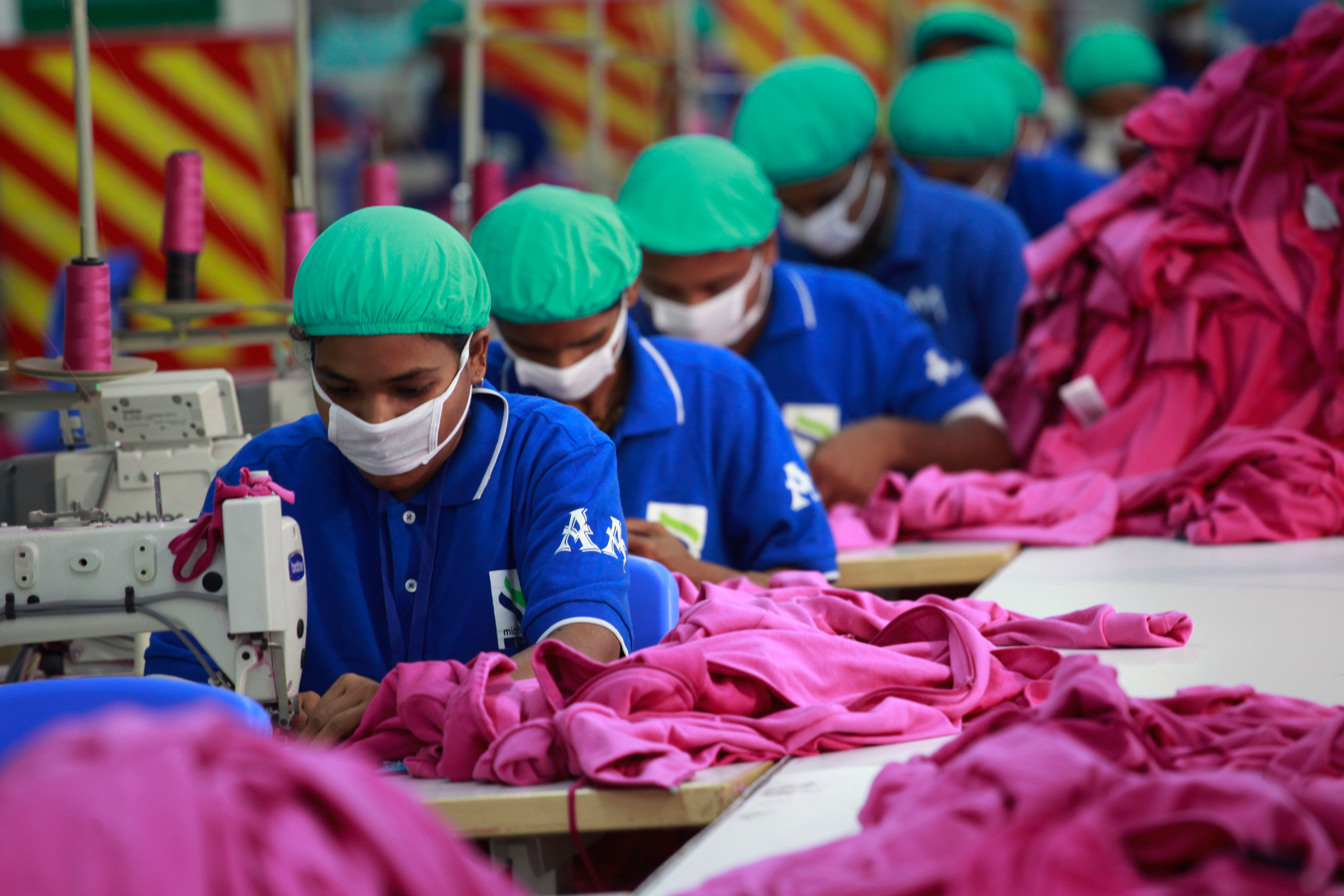
A garment factory operations in Dhaka
Our most machinery, raw goods coming from China, according to Dr. Hussain.
He said that the FDI from China is crucial for Bangladesh, as funding for BRI projects from Chinese banks is more accessible compared to multilateral funding organisations.
Bangladesh’s imports from China—primarily machinery, electronics, textiles, chemicals, and industrial inputs—account for 70 per cent of its total imports.
By contrast, its exports to China are limited to jute yarn, leather, and knitwear.
Globally, China maintains trade surpluses with 174 countries, including the United States, while running deficits with oil-producing nations and countries like Japan and South Korea that supply electronics and machinery.
Despite Bangladesh’s trade imbalance with China, the experts contend that the economic benefits—including job creation, industrial growth, and infrastructure development—outweigh concerns over the deficit.
Reliance on Chinese capital goods will likely sustain Bangladesh’s economic resilience in the years to come.
(USD 1 = BDT 108.9)