

Improving livestock, dairy production
Brazil's success story offers blueprint for BD
Published :
Updated :
 For all latest news, follow The Financial Express Google News channel.
Bangladesh can improve its livestock and dairy production by adopting Brazilian technology and through knowledge transfer, as the South American country boosted its production manifold over the last four decades, experts say.
At the end of 2024, Brazil solidified its status as a global agricultural titan, reporting a record-breaking cattle population of 238.2 million.
According to the Brazilian Institute of Geography and Statistics (IBGE), the country now boasts roughly 1.1 cows for every citizen, a demographic shift that began at the turn of the millennium and shows no signs of slowing.
The Brazilian success story is defined by a paradox - producing more with less.
While milk production hit a historic 35.7 billion litres this year, the actual number of milked cows is at its lowest since 1979, local producers say.
This surge in efficiency offers a compelling case study for developing nations like Bangladesh, which is currently seeking to modernise its livestock sector to ensure food security, Professor Ed Hoffmann Madureira from the University of Sao Paulo in Brazil has told The Financial Express.
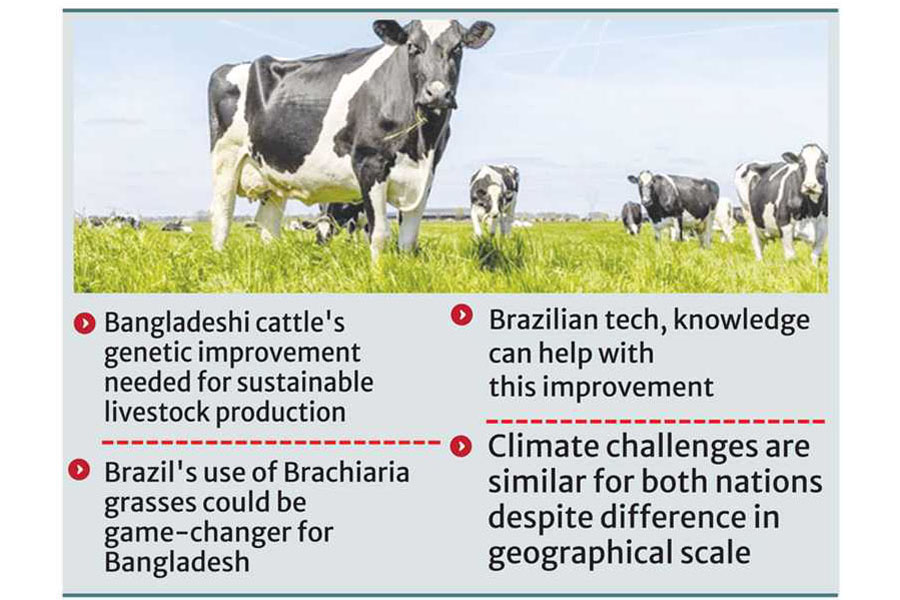
He also emphasises genetic improvement of Bangladesh's local cattle breeds for sustainable livestock production.
Echoing him, Dr Md Shariful Islam, an assistant professor at the Bangladesh Agricultural University in Mymensingh, says, "We are working on local cattle's genetic improvement. We need to improve our own breeds with the help of technology and knowledge transfer from Brazil."
The information and success stories were unveiled during discussions on Brazilian cattle and livestock production on a farm in the country. A trade mission from Bangladesh, African nations, and Brazil is visiting various farms to observe the capabilities of local breeds.
The mission was organised by the Brazilian Association of Zebu Breeders (ABCZ) and the Brazilian Cattle project, with assistance from Apex-Brasil, the Brazilian Trade and Investment Promotion Agency.
Agrotrip managed the logistics.
Local producers, experts, and academicians say the bedrock of the Brazilian industry is the Zebu breed.
Originating from Indo-Brazilian roots, breeds such as Nelore, Gir, and Guzerá were introduced, and they adapted to thrive in harsh tropical climates.
Their natural resistance to heat and parasites provided the raw materials, but technology provided the momentum.
Over the last 47 years, Brazil shifted from extensive ranching to precision livestock farming, according to experts.
By utilising Brachiaria grasses for superior grazing and implementing aggressive artificial insemination programmes, Brazil has dramatically increased beef and dairy yields.
This "intensification" allowed the industry to grow while reducing the total land footprint required per animal, Brazilian experts say.
For Bangladesh, a country with limited land and a growing demand for protein, the Brazilian model represents a potential roadmap.
While the geographical scale differs, the climate challenges are remarkably similar, say Bangladeshi and Brazilian businessmen and experts.
They say Bangladesh has already begun exploring the introduction of high-yield genetic material.
By adopting Brazil's advanced artificial insemination techniques and heat-resistant genetic strains, local farmers could see milk and meat yields double without increasing herd sizes.
Brazil's use of specific tropical grasses like Brachiaria could be a game-changer for Bangladeshi fodder management.
Replacing the traditional, low-nutrient feed with high-efficiency forage would allow small-scale farmers to maximise productivity on fragmented land plots, experts note.
The prospect of bilateral cooperation - transferring Brazilian "know-how" in veterinary technology and pasture management - could bypass decades of trial and error for the Bangladeshi authorities, they opine.
As Bangladesh looks to move beyond subsistence farming toward a commercial livestock economy, the lesson from Brazil is clear: population growth in pastures is not just about the numbers but about the technology embedded within each animal.
By embracing Zebu-based genetics and precision management, Bangladesh could be the next success story in the global livestock arena, experts add.