


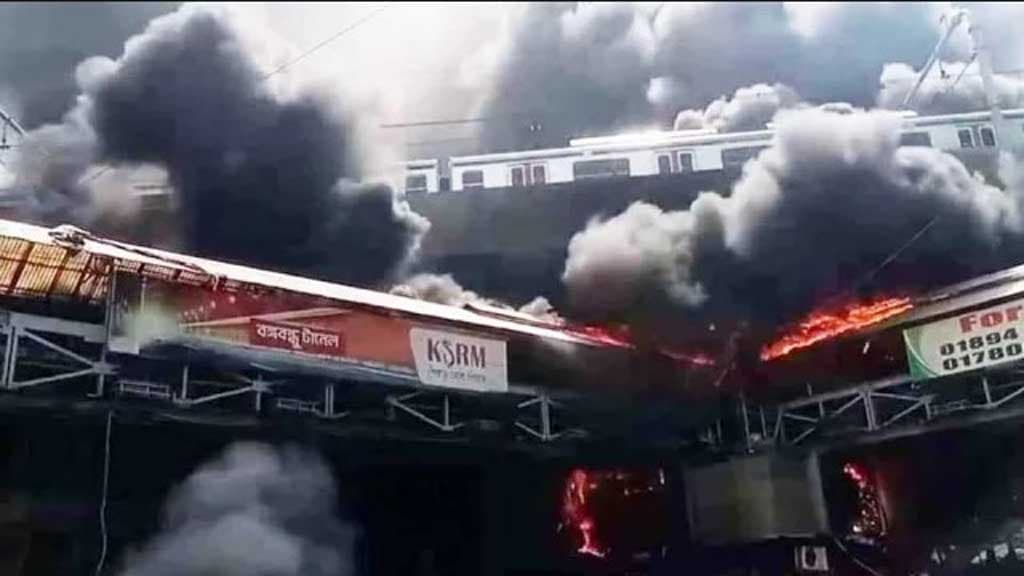
The economic outlook for Bangladesh has been bleak as the country reels from a series of disasters, including violent protests, looting, and devastating floods that have significantly impacted business and trade. The events have cast a shadow over the beginning of the new fiscal year, causing severe financial distress.


Amid widespread unrest and violence surrounding the student-led protests, many expressed anger by vandalising metro rail stations.
The metro, a key transport option for Dhaka residents, was shut down on Jul 18 and remained closed until Aug 25.
Even after reopening, the scars have not fully healed, and traffic congestion has returned to its previous state.
The financial losses from this disruption are substantial but remain difficult to quantify.
The turmoil did not end with the change of government. In the aftermath, a wave of indiscriminate attacks, lootings, and arson swept across the country, further destabilising the economy.
Adding to the chaos was the severe flooding in August. Torrential rains and heavy upstream water flow from India caused floods in several districts in the south and northeast from Aug 20, expanding rapidly to Feni, Cumilla, Chattogram, Khagrachhari, Noakhali, Moulvibazar, Habiganj, Brahmanbaria, Sylhet, Lakshmipur, and Cox's Bazar.
With highways submerged, goods transportation from the main seaport was halted for nearly three days.
Relief operations, rescue missions, and rehabilitation became the primary focus for individuals and organisations nationwide, resulting in an economic slowdown as businesses cut costs, closed operations, or reduced salaries to support flood victims.
WIDESPREAD LOOTING
Looting incidents also painted a grim picture of the unrest.
On Aug 5, the day the Awami League government fell, a large mob looted the Gazi Tyres factory, part of the Gazi Group, in Rupshi, Rupganj, along the Dhaka-Sylhet highway.
The mob, numbering in the thousands, forced open the gates with a truck, looted goods, and later set the factory on fire, which burned for an entire day.
The situation worsened on Aug 25, when the Gazi Tyres factory was completely gutted by fire following a violent confrontation involving local villagers, who were in a land dispute with the Gazi Group.
Clashes, gunfire, and reports of numerous casualties have added layers of mystery to the incident, with many remaining tight-lipped.
The factory's charred remains now resemble a haunted ruin, with ashes, burnt debris, and the anguish of families awaiting news of the missing. The exact death toll, number of missing persons, and financial losses are still unknown. However, a senior official claimed that tyres worth nearly Tk 10 billion were destroyed.
Looters also set fire to the factory's private power substation and looted the 33,000-volt generator room.
Residential buildings and around 50 tin-shed houses on the factory premises were also burned.
These incidents provide a glimpse into the destruction that unfolded during the mass protests of July and August.
IMPACT OF THE PROTESTS
The protests, which began as a movement demanding reform in government job quotas, escalated into a broader anti-government movement in August.
On Aug 5, the Awami League government was ousted from power. The aftermath saw widespread vandalism, looting, and arson across the country.
Businesses owned by former ministers, MPs, party leaders, and members of minority communities were heavily targeted, resulting in significant property damage and loss of life.
The violence brought daily life to a standstill, paralysing road and rail transport and slowing economic activities, including imports and exports.
Curfews and repeated incidents of arson and destruction left a bloody trail on the streets, which significantly impacted the nation's economy.
The new fiscal year began with a setback for the Sheikh Hasina government, which had been in power for four consecutive terms and was hoping to overcome the economic challenges caused by the COVID-19 pandemic and the Ukraine war.
However, the widespread destruction before and after the government fell and the absence of law-enforcing agencies during the transition of power created a sense of insecurity that brought business and trade to a standstill, further weakening the economy.
Economic activities, including imports, exports, production, goods delivery, and project implementation, were severely disrupted.
Private sector credit flow and revenue collection have suffered, with concerns growing over further economic damage.
EXPORTS HIT HARD: APPAREL SECTOR TAKES THE FIRST BLOW
The apparel sector, Bangladesh's main source of foreign currency earnings, has taken the brunt of the impact.
Factory shutdowns, internet blackouts, and incidents of violence have sent negative signals to international buyers, resulting in more hassles and costs for exporters.
Shobhon Islam, a director of the Bangladesh Garment Manufacturers and Exporters Association, or BGMEA, has warned of a potential 12-15 per cent decline in export earnings.
Following this discrepancy, the EPB did not release export data for June of the 2023-24 fiscal year or for July of the 2024-25 fiscal year.
Eventually, Bangladesh Bank reconciled the export earnings data in coordination with the EPB.
According to the revised figures, the country’s export earnings for the 2023-24 fiscal year amounted to $40.81 billion.
However, considering NBR data, the decline in the garment sector’s exports is expected to impact overall export earnings for the current fiscal year.
REVENUE COLLECTION FACES SETBACK
The recent surge in violence and unrest surrounding the quota reform movement severely disrupted business operations and revenue collection in Bangladesh.
On Jul 18, a majority of businesses and factories closed as violence escalated.
Broadband internet services were suspended from that night, with mobile internet already down.
By midnight on Jul 19, a curfew was imposed nationwide, and the military was deployed.
Production at call centres halted, and transportation disruptions prevented shipments from factories to ports.
Export shipments already at the port were stalled due to the internet shutdown.
Similarly, the import of raw materials for industries faced delays at the port.
The NBR later directed customs houses to manually clear industrial raw materials and perishable goods.
Following the partial restoration of broadband internet and the resumption of import-export activities under tight security, the situation began to stabilise.
However, the disruption has had a considerable impact on business operations and revenue collection.
NBR’s statistics department reported that revenue collection through customs for the fiscal year 2023-24 was Tk 76.94 billion.
However, the July figures for this fiscal year have not yet been released.
According to ASYCUDA World data, customs revenue for July was Tk 84.3 billion.
An NBR official said ASYCUDA data includes arrears and unpaid amounts, leading to discrepancies.
Actual revenue collection for July is expected to be significantly lower.
The official also expressed concerns about similar impacts on value-added tax, or VAT, and income tax revenues.
Abdur Rahman Khan, who took over as NBR chairman, acknowledged the potential revenue shortfall due to the business disruption.
He said: “The economy will improve, and we will see the positive effects.”
In his first briefing at the Revenue Building in Dhaka’s Agargaon, Rahman emphasised the need for rigorous diligence, planning, and execution by NBR officers to meet revenue targets.
He stressed the necessity of intense hard work to achieve results.
For the fiscal year 2024-25, NBR has set a revenue target of Tk 4.8 trillion, up from the previous year's adjusted target of Tk 4.1 trillion. The NBR failed to meet even the revised target for the fiscal year 2023-24, falling short by approximately Tk 270 billion.
Typically, the revenue authority experiences around 15 percent growth.
Given the current economic turmoil and the disruptions from July to August, achieving a 25 percent growth compared to the previous year’s target seems implausible, a scenario unprecedented in NBR’s history.
PRIVATE SECTOR CREDIT GROWTH SLOWS
According to data from the Bangladesh Bank, private sector credit growth stood at 9.84 percent in June of the 2023-24 fiscal year, compared to 10.58 percent during the same period in the previous fiscal year.
By the end of June, the total amount of loans disbursed by banks to the private sector reached Tk 16.41 trillion, up from Tk 14.94 trillion at the end of June in the previous fiscal year.
Many had anticipated that the previous government's fourth consecutive term would leverage political 'stability' to boost business activities.
With a new finance minister and a new budget, the private sector was expected to be energised, resulting in increased credit growth and new investments.
However, the government's fall in mid-July and early August upended these expectations, raising concerns about reduced credit growth.
Md Ezazul Islam, executive director (research) of Bangladesh Bank, told bdnews24.com: "Private sector credit growth is likely to decline. It is usually lower in July, but unlike last fiscal year, there was 'political unrest' this time, so a drop is expected."
In July, the first month of the 2023-24 fiscal year, private sector credit growth was recorded at 9.28 percent.
FOREIGN LOAN DISBURSEMENT FALLS
Amid a dollar crisis, foreign loan disbursement in July, the first month of the 2023-24 fiscal year, decreased by 17.15 percent compared to the same period of the previous fiscal year.
In July of the last fiscal year, development partners and lenders disbursed $405.7 million from pledged funds. In contrast, $488 million was released in the same period of the 2022-23 fiscal year, marking a decline of $83.7 million.
According to the Economic Relations Division, or ERD, report, all the disbursed funds in July were project loans.
The quota reform movement and the subsequent economic stagnation in July dealt a significant blow to foreign loan disbursements.
More funds were used to repay loans than the foreign funds received from development partners in July to keep development activities running.
Typically, repayment amounts are lower than disbursements, as seen in both the 2023-24 and previous fiscal years.
Data collection for August is yet to begin.
When asked about a 'stagnation' in loan disbursement activities, Syed Ashrafuzzaman, joint secretary (FABA and ICT) of the ERD, told bdnews24.com: "It's not possible to say from assumptions. Data is yet to start coming in."
"However, the assessments by the IMF and other development partners remain positive about Bangladesh. Thus, the impact of political instability won't be evident until after August. We hope there won't be any problems with foreign loan disbursement."
A similar sentiment was echoed by Abdoulaye Seck, World Bank's country director for Bangladesh and Bhutan.
In response to a question about concerns over Bangladesh's debt repayment, following a meeting with Finance Advisor Salahuddin Ahmed on Aug 28, Abdoulaye said: "There has never been a concern. Bangladesh has been a very reliable partner for over 50 years."
He also pledged continued cooperation with Bangladesh in financial sector reforms.
Martin Holtmann, country manager of the International Finance Corporation, or IFC, for Bangladesh, Bhutan, and Nepal, echoed the same commitment to supporting private sector investment and digitalisation efforts.
Another development partner, the Asian Development Bank, or ADB, has reassured its continued support to the interim government for Bangladesh’s long-term and sustainable development.
After a meeting with ERD officials, the finance advisor told journalists: "Our first task is to create a good image. I have emphasised this in the officials' work, and they have committed to doing so."
COMPLICATIONS IN LC OPENING AMID LIQUIDITY CRISIS
Mohammad Hatem, the executive president of the Bangladesh Knitwear Manufacturers and Exporters Association, or BKMEA, applied to a private bank on Jul 18 to open an import letter of credit, or LC, worth $100,000.
However, due to internet disruptions and the bank closure, it took until Jul 25 to open the LC.
He told bdnews24.com: "Even without this crisis, banks are reluctant to open LCs promptly. The additional delay has further harmed businesses, and it will take time to recover from these losses."
Further inquiries revealed that the state-owned Sonali Bank typically opens around $400-500 million in government LCs daily. However, during the extended closure, this amount dropped to $30-40 million per day in pending LCs.
Syed Moazzam Hossain, president of the Australia-Bangladesh Chamber of Commerce and Industry, or ABCCI, shared a similar sentiment.
He told bdnews24.com: “Banks were closed, so LC openings were halted, and garment factories were also shut down, disrupting production. Now, factories will have to remain operational even on holidays to compensate for the losses.”
Syed Mahbubur Rahman, managing director and CEO of Mutual Trust Bank Limited, or MTB, told bdnews24.com: “During the curfew, banks were closed, so LCs could not be opened. We will know how much LCs have decreased by the end of the month, but the regular process has undoubtedly been disrupted.”
Although the overall LC statistics for July are yet to be released by the central bank, it is evident from the disruptions and delays that LC numbers have dropped significantly.
Production has been disrupted, compounded by the liquidity crisis in banks.
"Export earnings are low, and we are not getting liquidity from the banks against exports, making it difficult to pay July salaries," said Shobhon of Sparrow Apparels.
He added: "We are facing multiple crises—reduced exports and a liquidity shortage in banks."
SLOW ADP IMPLEMENTATION AMID ECONOMIC CONSTRAINTS
The impact of cost-saving measures due to global and domestic economic conditions had already affected development activities.
According to the latest data from the Implementation, Monitoring, and Evaluation Division, or IMED, of the planning ministry, the Annual Development Programme, or ADP, implementation rate for the 2023-24 fiscal year was 80.92 percent of the revised ADP, the lowest since the 2019-20 fiscal year.
In the previous fiscal year, 2022-23, it was 85.17 percent.
Although the implementation rate increased towards the end of the fiscal year, it was 'slow' at the beginning.
From July to January, only 27 percent of the ADP was implemented, the lowest in 13 years.
In June alone, the implementation rate was 23.38 percent, which is also the lowest in the past five years.
Typically, ADP implementation trends increase as the fiscal year progresses.
Factors such as monsoons, delayed revenue collection, and 'indifference' among officials contribute to the low initial implementation rate.
Consequently, ADP implementation remains very low in the first month of the fiscal year.
However, in the current fiscal year, political instability and protests have further exacerbated this trend.
IMED Joint Secretary (coordination and MIS sector) Wahida Hamid told bdnews24.com: "So far, we have received information from 44 out of 57 ministries and divisions. Data from 13 are still pending. The situation is 'slower' compared to last year for all of them."
In July of the last fiscal year, the ADP implementation rate was 1.27 percent.
REMITTANCES HIT 10-MONTH LOW
Remittances in July, the first month of the current fiscal year, amounted to $1.90 billion, which is 3.55 percent lower than the same month of the previous fiscal year due to bank closures amid internet disruptions.
July marked the lowest monthly remittance inflow in 10 months. The last time remittances were this low was in September 2023, at $1.33 billion.
In June, the month preceding July of the current fiscal year, remittances reached a 47-month high of $2.54 billion. This helped the total remittances for the fiscal year 2023-24 amount to $23.91 billion, an increase of 10.64 percent compared to the previous year.
Except for March 2024, all months in the current calendar year saw remittances exceed $2 billion. In March, remittances were $1.99 billion.
Bankers and analysts attributed the drop in July remittances to it being the month after Eid-ul-Azha and to internet disruptions caused by violent protests related to the death during the quota reform movement.
However, after the shock of a tumultuous July, remittances increased by 39.62 percent in August.
In August, remittances rose to $2.22 billion, compared to $1.59 billion in the same month last year, reflecting a 39.62 percent growth.
This was highlighted in the updated data from Bangladesh Bank on Sunday.
RESERVES DECLINE
According to the updated data from the central bank, foreign exchange reserves fell by $1.30 billion from the end of June to the end of July.
At the end of July, reserves stood at $20.48 billion under the IMF's BPM6 methodology, down from $21.78 billion at the end of June.
In this context, economist Ahsan H Mansur, who became the governor of Bangladesh Bank after the fall of the Awami League government, announced a halt to dollar sales from the reserves.
He made the statement during a press conference at the Bangladesh Bank building on Aug 28.
The governor said: "No dollars are being sold from the reserves. Since I took office, not a single dollar has been sold to commercial banks."
‘SKY-HIGH’ INFLATION, WAGES DECLINE AFTER 30 MONTHS
Since January 2022, wages in the country had been rising for 30 consecutive months, but in July of the current fiscal year, the growth rate of wages decreased slightly.
According to the Bangladesh Bureau of Statistics, or BBS, wage index, wage growth for low-paid and unskilled workers dropped to 7.93 percent in July from 7.95 percent in June.
Meanwhile, overall inflation increased to 11.66 percent, up from 9.72 percent in June, which had been in single digits.
WHAT SHOULD BE DONE NOW?
Mir Nasir Hossain, former president of the Federation of Bangladesh Chambers of Commerce and Industry, or FBCCI, suggests that to overcome the current economic crisis and stagnation in trade, the following steps should be taken: addressing line order issues, reducing liquidity problems in banks, resolving LC complications, stopping harassment of businesses by the NBR, and repealing laws and regulations that hinder trade.
He also calls for accurate data on the country's economy and business sector.
Hossain told bdnews24.com: “We have conveyed our demands to the Chief Advisor Muhammad Yunus. They have been in office for only 14 days. Changes will not happen overnight. We all need to contribute to overcoming the crisis.”
Mustafizur Rahman, an honorary fellow at the Center for Policy Dialogue, or CPD, emphasises the need to revise the fiscal year’s targets, exercise extra caution in new projects, and improve market management to repair economic damage caused by recent public unrest.
He told bdnews24.com: “Economic activities have been somewhat disrupted by the protests, and the supply chain has been broken. However, with 10.5 months left in the fiscal year, we may not see immediate fixes, but it is possible to address the crisis with some time.”
He suggests that mid-term targets should be revisited, particularly regarding the ADP and revenue collection goals.
Regarding the destruction of infrastructure and government management caused by the protests, Rahman advises focusing on increasing revenue and taking measures against loan defaulters and tax evaders.
He also recommends heightened caution in new projects, particularly mega projects, and stresses the importance of market management in the short term. “Action must be taken against intermediary syndicates, and import activities should be maintained,” Rahman adds.
For long-term economic recovery, he advises the interim government to take time to prepare the upcoming Ninth Five-Year Plan.
WHAT WILL HAPPEN TO AWAMI LEAGUE-LINKED BUSINESS GROUPS?
Following the fall of the Sheikh Hasina government, there has been a shift in the banking and financial sector. The name of S Alam Group's chairman and managing director, S Alam, who was long accused of using influence during the previous government to acquire ownership in several banks including Islami Bank, has resurfaced in discussions.
On the day after the government fell, there were calls to expel the S Alam Group from the private sector's Islami Bank. This led to incidents of violence and protests by employees of another bank owned by him, Social Islami Bank Limited.
Amid this, there has been renewed focus on Salman F Rahman, former advisor to the prime minister on private industry and investment, and a key owner of Beximco Group.
Rahman was arrested and remanded in connection with the killing of hawker Shahjahan, 24, during the Anti-discrimination Student Movement, sparking discussions about the management of his business group.
Ahmed Shayan Fazlur Rahman (Shayan F Rahman), son of Salman, lost his director position at International Finance Investment and Commerce or IFIC Bank PLC and subsequently his vice-chairman role after being removed from the bank’s board.
When asked about the fate of large industrial groups accused of illegal benefits, various criticisms, and corruption during the Hasina government tenure, Nasir said: “The government is unlikely to interfere with private entities. However, if the owners and senior officials of any institution flee abroad and public interest is at stake, the government may appoint administrators according to international regulations and practices.”
He also supports the same approach for government institutions where public interest is concerned.
According to the ASYCUDA World data of the National Board of Revenue, or NBR, the sector’s exports stood at $3.19 billion in July of the 2024-25 fiscal year, a 19.24 percent drop compared to the same period in the previous fiscal year.
A discrepancy often exists between the NBR data and actual export earnings due to differences in the definition of exports under VAT laws.
Islam said: "This might mean the actual decline in export earnings is less significant."
Export data in Bangladesh is published by the Export Promotion Bureau, or EPB, under the commerce ministry. This data is cited in various reports by the central bank.
However, when Bangladesh Bank recently released the balance of payments, or BOP, data for July-April of the 2023-24 fiscal year, discrepancies in export data became evident, with a notable mismatch between current and financial account figures.
EPB data showed exports of goods and services worth $47.74 billion during the first 10 months of the 2023-24 fiscal year, while Bangladesh Bank recorded export earnings of only $33.67 billion, revealing a discrepancy of $14 billion between the two.
"The drop in exports is common in July, but this year's situation is different," Islam, the managing director of Sparrow Apparels Ltd told bdnews24.com.
In July of the 2023-24 fiscal year, Bangladesh earned $4.59 billion from exports, with apparel contributing $3.95 billion, or 86.05 percent of total export earnings.
However, due to the recent unrest, including curfews that led to the shutdown of banking channels and internet services, the apparel sector—Bangladesh's largest source of foreign exchange—has suffered the most.