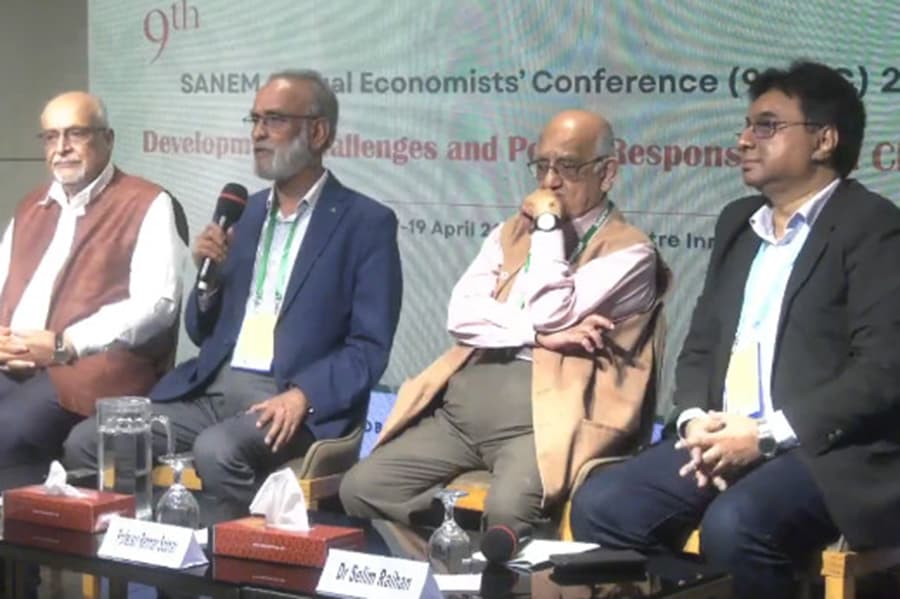
Speakers at two macroeconomic sessions of the 9th SANEM Annual Economists' Conference on Saturday called for urgent reforms to address deep-rooted structural weaknesses in Bangladesh's economic management, warning that these vulnerabilities could undermine growth amid rising global uncertainty.
They said increasing import dependency, inefficiencies in fiscal policy, weak monetary transmission and gaps in institutional transparency are collectively eroding macroeconomic stability.
The speakers noted that external shocks -- ranging from global price volatility to exchange rate pressures -- are now interacting more intensely with domestic policy shortcomings, amplifying risks to the economy.
They emphasised that these challenges are interlinked and cannot be addressed in isolation.
A coordinated, forward-looking and evidence-based policy framework is therefore essential to strengthen macroeconomic resilience, they added.
Presenting research papers at the sessions, economists and policymakers highlighted how market inefficiencies and policy constraints are shaping the country's economic trajectory.
They called for enhanced institutional transparency, improved agricultural productivity -- particularly through climate-resilient crop varieties -- and more disciplined fiscal and monetary frameworks.
A broad consensus emerged that Bangladesh must move beyond reactive policymaking and adopt a more strategic, data-driven approach to navigate an evolving global landscape.
The conference was held at BRAC Centre Inn in the capital.
Dr Bazlul Haque Khondker, chairman of SANEM, and Dr M Shahidul Islam of UNFPA Bangladesh presented a framework using national transfer accounts (NTA) to analyse the country's demographic transition.
Their study identified a significant "measurement gap" in capturing the demographic dividend, particularly in accounting for unpaid care work and the time-use of women.
Dr Khondker said that to fully harness the benefits of a youthful population, policymaking must go beyond conventional indicators and incorporate gender-disaggregated data to ensure equitable and macro-consistent resource allocation across different stages of life.
He also stressed that a well-functioning pension system is critical to realising the second demographic dividend.
Food security and rising import dependency emerged as major concerns.
Ibrahim Hassan of the University of Rajshahi said nearly 80 per cent of domestic wheat consumption now depends on imports, leaving the economy vulnerable to global shocks.
His findings showed that domestic wheat prices are influenced more by international market trends and exchange rate movements than by import volumes.
He warned that this reflects deeper structural inefficiencies, meaning that increasing imports alone would not stabilise prices.
Hassan recommended proactive foreign exchange reserve management and the introduction of hedging mechanisms for essential imports to mitigate external risks. Fiscal policy effectiveness also came under scrutiny.
Khaleda Nasrin of the Ministry of Finance presented evidence showing that although public expenditure has supported economic growth, its long-term efficiency declined between 1999 and 2024.
She cautioned that poorly targeted investment could crowd out private sector activity, arguing that the composition of fiscal spending matters more than its size.
Nasrin urged the government to improve expenditure quality and enhance tax efficiency rather than increasing the overall tax burden.
Monetary policy credibility and communication were also highlighted as key factors in managing inflation and shaping market expectations.
Md Julker Naim of Bangladesh Bank said clear and effective central bank communication plays a crucial role in anchoring inflation expectations and maintaining market confidence.
The sessions were chaired by Director General of Bangladesh Institute of Bank Management Dr Md Ezazul Islam and former World Bank economist Dr Zahid Hussain.
bdsmile@gmail.com