


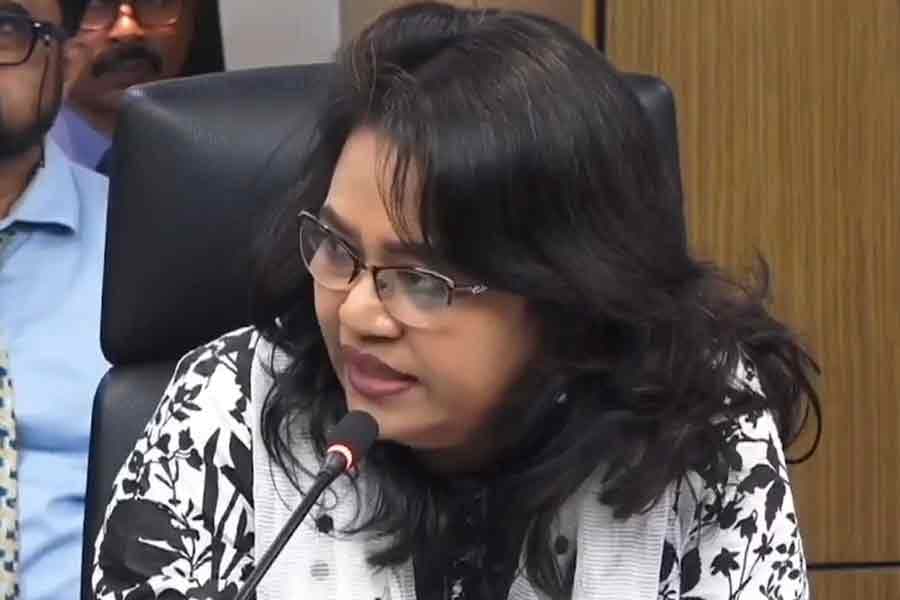
Economic Reporters’ Forum (ERF) President Doulot Akter Mala has said the government should think about a different fiscal policy for small and medium industries (SMEs) so that they can come under the tax net with a tolerable tax rate.
“If we impose an unaffordable tax rate for any section, they would look for ways to evade tax, or they would go against it,” the ERF president said at a pre-budget roundtable titled ‘Transparency and Reform: Redefining the National Tax Architecture’, held at the CA Bhaban in the city on Thursday.
The event was jointly organised by the Institute of Chartered Accountants of Bangladesh (ICAB) and The Financial Express. Dr. Rashed Al Mahmud Titumir, Prime Minister's Adviser on the Ministries of Finance and Planning, was present at the event as the chief guest.
Highlighting the necessity of motivating people to pay taxes, Doulot Akter Mala, also the special correspondent of The Financial Express, said tax collection would not be possible through imposing punitive measures.
The policymakers should think about an appropriate mechanism to collect taxes smoothly, she said.
“Regarding the role of media, the ERF president said economic reporters convey the pain of taxpayers to policymakers as well as inform the people about the issue of national interests. Media personnel will continue its role in this regard,” she added.
She urged the policymakers to find out the reasons behind the lack of inspiring or encouraging outcomes from digitisation and the unification of the tax system.
“The government should think about why a holistic approach wasn’t taken instead of partial digitisation. Is there any loopholes in policymaking or insiders’ influence?” the journalist asked.
She also pointed out that economic journalists face absence of availability and authenticity of data.
“Lack of authentic data provokes misinformation and people’s trust in it,” she said.
Talking about tax culture, she said, “We don’t hesitate to pay thousands of Taka as restaurant bills. But if the government imposes Tk 1,000 tax, we don’t want to pay it. Rather, we try to justify what I get from the government in exchange of the tax. The culture to consider tax laws as like all other laws has not developed so far.”
Explaining the reason behind the existing tax culture, she said people may have questions about the proper utilisation of their hard-earned money. They may remain worried about whether my money is going abroad or not. “As journalists, we work to develop the tax culture,” she added.