


Published :
Updated :
 For all latest news, follow The Financial Express Google News channel.
Agricultural loan activities in Bangladesh have seen significant growth in the first half of the FY 2025-26, with disbursement rising nearly 30 per cent and recoveries also climbing, pushing outstanding farm loans to over Tk 627 billion, official data shows.
The Bangladesh Bank (BB) data revealed that disbursement of agricultural loans rose to Tk 210.08 billion in July-December period of the FY 2025-26, up 29.2 per cent from Tk 162.59 billion in the same period of the FY 2024-25.
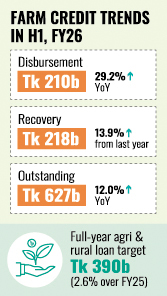
Recovery of agricultural loans also increased, reaching Tk 217.74 billion, up 13.9 per cent from Tk 191.17 billion in the corresponding period of the previous fiscal year.
Outstanding farm loans stood at Tk 627.23 billion in the July-December period of the FY 2025-26, marking a 12.0 per cent rise from Tk 560.19 billion in the same period of the FY 2024-25.
BB set an agricultural and rural loan disbursement target of Tk390 billion for the fiscal year 2025-26 (FY26), which is 2.63 per cent higher than the last fiscal year's Tk 380 billion.
Stakeholders said the rise in agricultural loan disbursement reflects farmers' growing need for institutional credit amid higher input costs and expanding cultivation areas.
They also noted that banks have become more proactive in reaching rural borrowers following the central bank's renewed emphasis on agricultural financing.
They, however, cautioned that the increased lending should be accompanied by improved monitoring and technical support to ensure productive use of the funds.
They also stressed the importance of expanding access for small and marginal farmers, who still rely heavily on informal credit sources.
Commenting on the growth, Dr Masrur Reaz, chairman of Policy Exchange Bangladesh (PEB), said, "The rise in both disbursement and recovery of agricultural loans is a positive signal for Bangladesh's rural economy".
Effective loan management and timely credit flow are crucial to boosting productivity and supporting farmers' livelihoods, he said.
When farmers have easier access to credit, they can invest in modern seeds, irrigation systems, and machinery, which not only increases crop yields but also strengthens overall food security, Dr Reaz said.
Moreover, improved recovery rates indicate that borrowers are managing loans responsibly, creating a sustainable credit cycle that benefits both financial institutions and the farming community, he stated.
Policymakers and banks should continue to focus on expanding outreach to small and marginal farmers, ensuring that financing is inclusive and contributes to long-term rural development, Dr Reaz suggested.
sajibur@gmail.com