

Inflation up for food-price rises
Pricier key consumer items drive Nov count to 8.29pc
Published :
Updated :
 For all latest news, follow The Financial Express Google News channel.
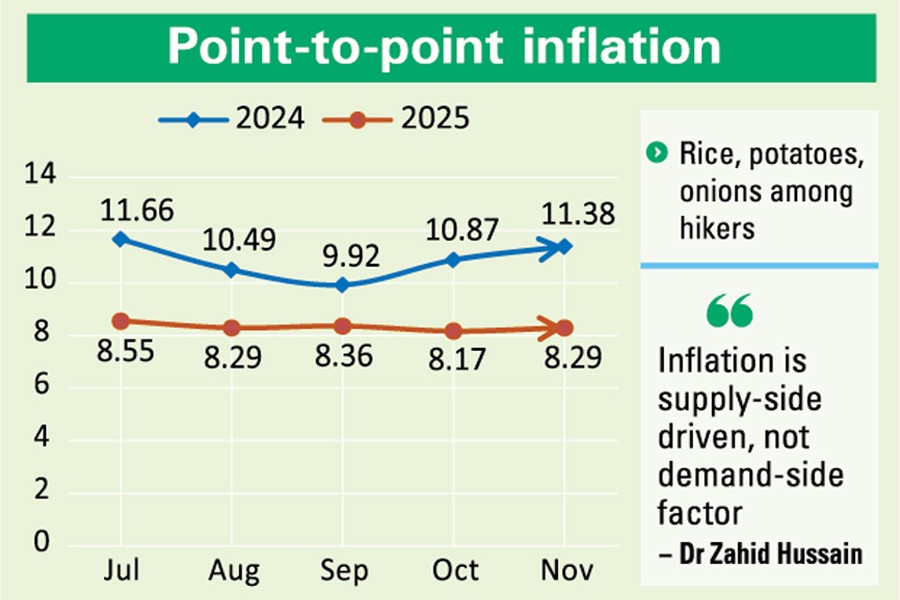
Inflation edges up in Bangladesh as some pricier key consumer items drive November count to 8.29 per cent, overshooting the central bank's 6.5-percent annual target for this fiscal year.
According to official data released Sunday, the month's reading was 0.12-percentage-point higher than October's, driven by rising prices of several key commodities that include the staple--rice.
However, despite the acceleration, November's inflation remained well below the 11.38 per cent recorded in the same month a year before.
The 12-month moving average climbed to 8.96 per cent on a point-to-point basis, signalling persistent price pressures on the limited-income group of people as wage growth was little or naught for farm workers.
Economists say the uptick was largely fuelled by supply-side factors.
"To my mind, the higher inflation is supply-side driven, not demand-side," says Dr Zahid Hussain, an independent economist, adding that November is typically a lean season when prices of many key commodities - rice, potatoes, onions-tend to rise.
Bangladesh Bank, which is tasked with containing inflation through tighter control of money supply, has maintained a restrictive monetary stance in recent months.
While inflation has eased from last year's highs, economists say the improvement falls short of the central bank's expectations.
As businesses say high interest affects trade and business and seek a reduction, the central bank governor told reporters earlier that the policy rate would be reduced once inflation "becomes tolerable".
Food inflation at the national level stood at 7.36 per cent in November, up 0.28-percentage point month on month, while non-food inflation eased to 9.08 per cent, according to Bangladesh Bureau of Statistics (BBS) statistics.
Food inflation rose in both rural and urban areas, while non-food inflation stayed on a downtrend.
The BBS, which collects data pertaining to wages, too, the shows national wage growth edged up to 8.04 per cent from 8.01 per cent in October.
However, agricultural wages slipped to 8.14 per cent from 8.17 per cent while industrial wages rose to 7.86 per cent, up 0.09-percentage points.
Wages in the services sector increased slightly to 8.22 per cent.
The bureau compiles consumer price data using the 2021-22 base year, collecting price information from 154 markets across all 64 districts.
jasimharoon@yahoo.com