


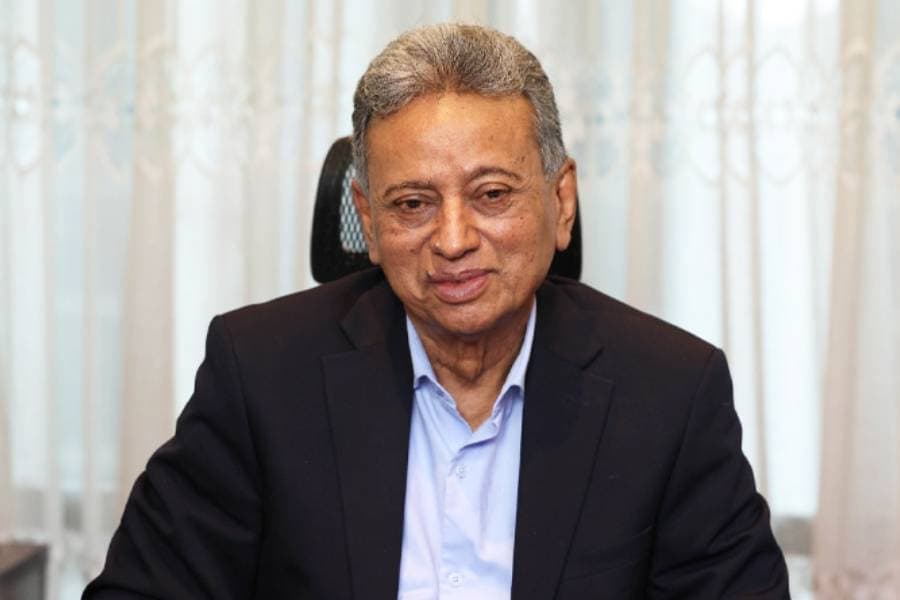


Finance Minister Amir Khosru Mahmud Chowdhury has said the new government is facing a “three-way challenge” in managing the economy—fragile fiscal conditions, rising expenditure pressures, and external shocks.


Speaking to reporters after an internal meeting at the National Board of Revenue (NBR) on Wednesday, he said the administration inherited a “very weak” economy and that stabilising it without printing money is the immediate priority.
Officials at the meeting said the minister approved a waiver of the 7.5-percent Advance Tax (AT) on newsprint imports for the newspaper industry in the next budget. Leaders of the Newspaper Owners Association of Bangladesh (NOAB) had long demanded the withdrawal of the tax.
Currently, newspaper imports face multiple charges, including 3.0-percent import duty, 15-percent VAT, 5.0-percent advance income tax, and 7.5-percent advance tax. With additional costs such as transportation, the total landed cost rises to around 130–132 percent.
The minister also directed tax authorities not to impose taxes on sensitive sectors in the FY 2026–27 budget that could affect the general public.
On the upcoming budget, he said discussions are ongoing to design a framework addressing revenue mobilisation, employment, support for women and small businesses, and investment promotion.
“We want to prepare a budget that accommodates all these priorities,” he said, adding that the process is still under review.
He stressed that resource mobilisation remains a key challenge and that strengthening revenue collection is essential to both stabilising the economy and fulfilling electoral commitments.
The minister also cited rising energy-import costs due to tensions in the Middle East as an added pressure.
“This is a three-way challenge—stabilising the economy, meeting public commitments, and managing external shocks,” he said.
Regarding Bangladesh’s LDC graduation, he noted that the process is ongoing through the UN Economic and Social Council (ECOSOC) and later the UN General Assembly, adding that nothing is final until completed.
Addressing the low tax-GDP ratio, he said it is linked to the overall size and strength of the economy. “If we cannot energise the economy, increasing the tax-GDP ratio will be difficult,” he added.
He reaffirmed the government’s shift from a debt-driven to an investment-led growth model, stressing the need to attract both domestic and foreign investment. He acknowledged that frequent policy changes in the past discouraged investors and emphasised the need for policy stability.
On allegations of tax evasion by large corporations, he said the issue is under review along with other fiscal matters.
The minister confirmed upcoming meetings with Japanese and German ambassadors to discuss bilateral cooperation amid current economic challenges.
Defending social-protection measures, he said the government will prioritise marginalised groups. He also stressed the need to diversify exports beyond garments and extend incentives such as bonded-warehouse facilities and back-to-back LCs to emerging sectors.
He announced plans for “serious deregulation” to improve the investment climate and expressed optimism that investment will increase if confidence in the economy is restored.
“We are getting strong responses. If we can ensure discipline in the financial sector and capital market and build trust, investment will grow,” he said.