


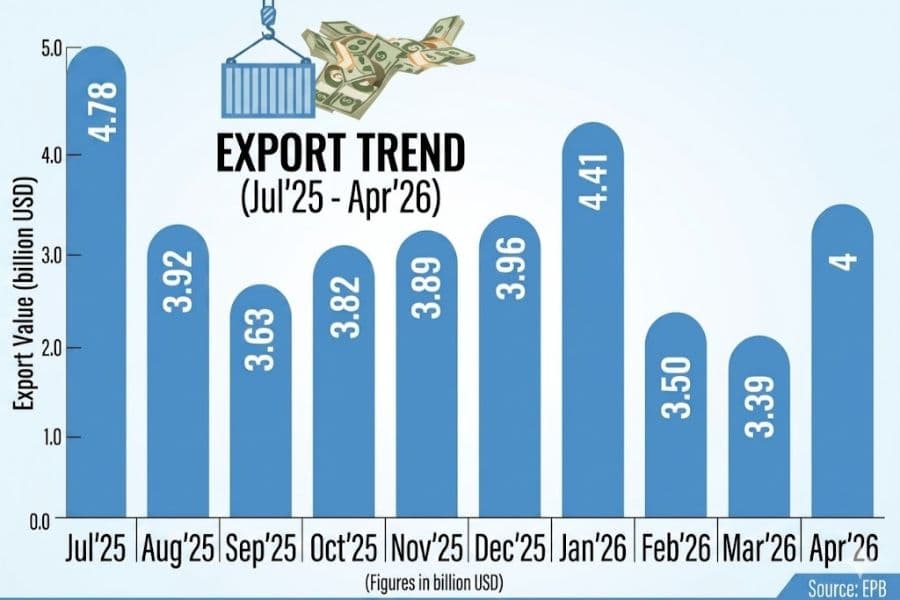
Bangladesh's export earnings rebounded strongly in April, snapping an eight-month slide, with an annualised growth of 32.92 per cent to US$4.0 billion to a solace for the exchequer at a trying time.


The monthly turnover is up from $3.0 billion in April 2025, driven largely by the apparel sector as usual because other potential sectors are yet to make a takeoff.
However, cumulative export earnings in July-April of FY2025-26 fell by 2.02 per cent to $39.40 billion, down from $40.20 billion in the same period a year earlier, according to data released Sunday by the Export Promotion Bureau (EPB).
The EPB says the April surge reflects renewed global demand and the resilience of export-oriented industries.
Exporters, however, attribute the leap to a "base effect", noting that extended holidays in March disrupted production and shipments, which were cleared in April.
They say there has been no meaningful rise in fresh orders or change in buying patterns, despite strong month-on-month performance across major sectors.
Industry insiders say merchandise exports had been in negative territory since March last year, mainly due to weak apparel shipments amid a global demand slowdown.
Seeking anonymity, several leading apparel exporters have expressed surprise at the scale of growth, suspecting possible discrepancies in the official data. They say exporters remain under pressure due to the fragile global economy, affected by the Israel-US war with Iran.
According to EPB data, the readymade garment sector earned $3.14 billion in April 2026, up 31.21 per cent from $2.39 billion a year before. Both knitwear and woven garments posted strong double-digit growth after months of slump.
Bangladesh Knitwear Manufacturers and Exporters Association (BKMEA) president Mohammad Hatem says the April growth was largely statistical rather than demand-driven.
Exports fell in March due to nearly 10 days of factory closure during Eid-ul-Fitr, disrupting production and delaying shipment, he points out. As a result, deferred shipments were executed in April, creating a temporary spike.
"There has been no surge in new orders or shift in buying behaviour," he says.
"Export performance may turn negative again by the end of the current month, as another extended holiday could disrupt production and shipment."
He thinks a clearer trend would emerge by July, as Eid-related disruptions in May could again inflate June figures without indicating sustained recovery.
Bangladesh Garment Manufacturers and Exporters Association (BGMEA) senior vice-president InamulHaq Khan Bablu echoes similar concerns, saying that February's national elections and extended Eid holiday in March disrupted production and shipment, which were later executed in April.
He says the current order situation remains weak, and booking patterns are largely normal.
"May exports would also not reflect the original scenario of the apparel industry," the BGMEA leader adds, noting that export earnings "may see another surge in June following the Eid-ul-Adha vacation".
BGMEA President Mahmud Hasan Khan Babu says the more than 31-percent growth in apparel exports in April does not accurately reflect the industry's overall situation, as export figures were low in April last year due to the Eid vacation during that month.
However, he says April performed well as buyers have restored their confidence following the national elections in February.
After the elections, the government introduced several policy supports for exporters, especially from the central bank support for several factories to pay their workers' salaries to continue their operations.
Law and order have also improved, which is helping restore buyer confidence. "The overall industry situation is gradually improving."
He also notes with concern that any further escalation in the Middle East crisis could deal another blow to the export-recovery process.
According to EPB data, the apparel industry earned $31.72 billion in the first ten months of FY2025-26, marking a 2.82-percent decline from $32.64 billion during the same period of the previous fiscal year.
Knitwear exports fell by 3.68 per cent to $16.81 billion, while woven-garment exports declined by 1.83 per cent to $14.90 billion.
Among other major sectors, agricultural exports dropped by 4.69 per cent to $819 million during July-April, down from $859 million a year earlier.
Leather and leather goods exports grew by 5.65 per cent to $988 million, while home-textile exports increased by 3.46 per cent to $766 million. Jute and jute goods also recorded a 2.52-percent rise, reaching $702 million.
Engineering products posted a notable growth of 20.14 per cent, climbing to $538 million from $447 million, according to EPB data.
Bangladesh's total export earnings stood at $48.28 billion in FY2024-25, registering an 8.55-percent increase from $44.47 billion in FY2023-24.
newsmanjasi@gmail.com