

No extensive external debt for social sectors
Says Planning Adviser Prof Wahiduddin Mahmud
Published :
Updated :
 For all latest news, follow The Financial Express Google News channel.
Planning Adviser Professor Wahiduddin Mahmud on Monday said the government would not take foreign loans extensively for the social sectors.
Rather, it would take loans for the sectors that would attract investments, he said.
Looking ahead, he said, Bangladesh must rethink its development financing strategy.
He argued that long-term development could not be achieved through foreign loans for social sectors.
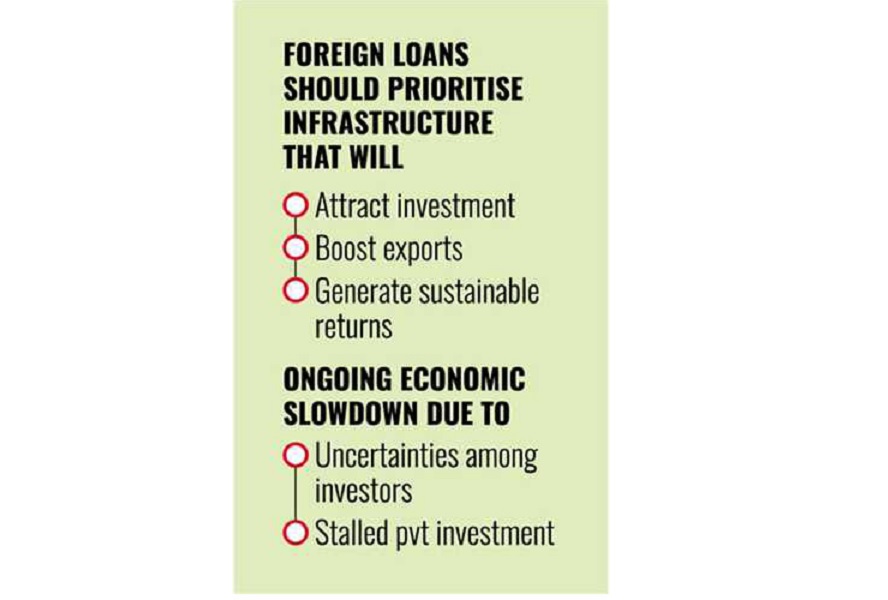
External borrowing, he said, should instead prioritise infrastructure that would attract investment, boost exports, and generate sustainable returns.
He said there was no country in the world that took foreign loans for the health or education sector.
"We want to come out of the previous concept. We want to develop our human capital through our local investments," Prof Mahmud told journalists after the National Economic Council (NEC) meeting in the capital.
He acknowledged that allocations for health and education had fallen sharply in the Revised Annual Development Programme (RADP) partly due to the decline in donor-funded sector-wide programmes and delays in shifting to domestic financing.
Several health projects, he said, had to be approved retroactively to avoid service disruptions.
He expressed confidence that the current slowdown was temporary and expected improvement in the next fiscal year when political uncertainty would ease and the ongoing reforms would begin to take effect.
The adviser told journalists about a major development policy shift, saying the NEC had directed the autonomous and semi-autonomous public bodies to have their projects approved by the Executive Committee of the National Economic Council (ECNEC) from now on.
"The line minister or adviser will be able to approve projects involving up to Tk 500 million. Beyond that, the project will have to be approved by the ECNEC," he said.
He also said Bangladesh's ongoing economic slowdown was primarily the result of uncertainties among investors and stalled private investment rather than the reduced ADP size.
Prof Mahmud said a slightly smaller ADP would not have exerted serious pressure on the economy if investment activities had
remained strong.
If investments had increased, employment and production could have continued at a normal pace, he said.
Prolonged political uncertainties had weakened investors' confidence, while high interest rates aimed at curbing inflation had further discouraged investments, particularly among small and medium enterprise (SME) owners, he added.
Prof Mahmud noted that while large investors focused mainly on political stability and policy certainty, SMEs were far more sensitive to borrowing costs.
The adviser said limited access to credit and the absence of low-interest working capital loans were the main challenges for small entrepreneurs.
Although the central bank had introduced special low-cost refinancing schemes, he said, banks had largely diverted funds to higher-return sectors, leaving SMEs short of credit despite the banking regulator's instructions.
He said the situation could have been more manageable had interest rates been reduced earlier and in a more gradual manner.
But he ruled out the risk of a complete economic collapse.
The adviser pointed to a sharp rise in remittance inflows, much of which was going to rural areas and supporting housing, retail trade, services, and small businesses.
As a result, poverty pressures had been relatively lower in remittance-receiving regions, while areas with limited remittance inflows had been hit harder by slow project implementation and fewer new initiatives, he said.
Explaining cuts in development spending, the adviser attributed those to administrative delays, weak project design, and the rollout of a fully digital public procurement system.
While the transition to 100 per cent electronic procurement initially slowed implementation, he said, it had increased transparency and competition, with a notable rise in the number of bidders per tender.
Prof Mahmud said the government had also deliberately taken a go-slow approach for some large projects to improve quality and curb unnecessary costs.
New approval conditions, including regular progress reporting and independent quality assessments, might slow execution in the short term but were expected to strengthen outcomes, he added.