

Published :
Updated :
 For all latest news, follow The Financial Express Google News channel.
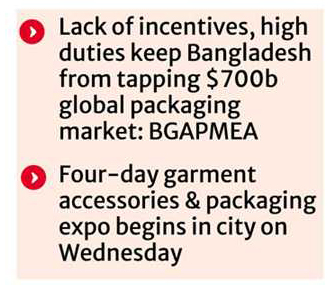
Bangladesh is failing to capitalise on vast opportunities in the global packaging market, estimated at around US$700 billion, due to inadequate policy support and absence of export incentives, industry leaders have said.
Despite strong manufacturing capacity and growing global demand, the sector remains constrained by regulatory and fiscal barriers that limit its ability to scale up exports.
Md Shahriar, president of the Bangladesh Garment Accessories and Packaging Manufacturers and Exporters Association (BGAPMEA), made the remarks at a press conference at a city hotel on Sunday, jointly organised by ASK and BGAPMEA ahead of the Garment Accessories and Packaging Expo (GAPEXPO) 2026.
He said the industry's proven export performance contrasts sharply with the lack of policy backing it receives, leaving it in a disadvantageous situation.
He said the sector has already demonstrated robust export capacity, with direct exports nearing US$1.6 billion and deemed exports exceeding US$7.8 billion.
However, the industry has been unable to expand further because of persistent policy and regulatory constraints, BGAPMEA leaders alleged.
Md Shahriar said that despite rising global demand for packaging products, Bangladesh has struggled to secure a meaningful share of the market mainly because no cash incentive is available for direct exports, along with other structural barriers.
"Packaging products exported directly from Bangladesh are not eligible for any cash incentive, whereas countries such as China, Vietnam, Cambodia and Indonesia offer incentives ranging from 4.0 per cent to 17 per cent," he said, adding that the sector has never been brought under any export incentive scheme, weakening its global competitiveness.
Highlighting policy bottlenecks, Md Shahriar said imports of paper below 300 GSM face very high duties and taxes, in some cases ranging from 58 per cent to 83 per cent, significantly raising production costs.
He described this as a major challenge linked to the National Board of Revenue (NBR), noting that such tariff structures undermine the industry's ability to compete with regional peers.
He also alleged that while the ready-made garment (RMG) sector benefits from extensive policy, banking and regulatory support, the garment accessories and packaging sector remains largely excluded.
"Bank financing, customs facilities and Bangladesh Bank policies applicable to the RMG sector are not implemented in practice for us, resulting in clear discrimination," he said.
Md Shahriar further said that accessories and packaging products are excluded from cash incentives for both direct and deemed exports, even though similar benefits are extended to some other export items, including hogla leaves.
He added that lower GSM paper is not allowed under duty-free import facilities, further limiting production flexibility and increasing costs.
The BGAPMEA president urged the government to extend the validity of Utilisation Permits (UPs) from one year to three years, arguing that shorter durations create operational challenges.
He noted that although import policy provisions allow deemed exporters to enjoy the same facilities as direct exporters, this is not reflected in actual implementation.
He also claimed that Bangladesh is now capable of producing 100 per cent of garment accessories and packaging products domestically, countering claims that certain items cannot be made locally.
"If anyone says a particular product cannot be produced in Bangladesh, we are ready to take them to factories to demonstrate the manufacturing process," he said.
According to him, the existing infrastructure, skilled workforce and factory capacity developed for the RMG sector can be utilised to significantly boost direct exports of packaging products without requiring major new investments or additional manpower.
The press conference was informed that written proposals have already been submitted to the NBR and the Ministry of Commerce, seeking export incentives, tax exemptions on raw material imports and broader policy support.
Speakers expressed optimism, noting that the government has already identified the accessories and packaging sector as a potential driver of export growth and employment.
Replying to questions, Md Shahriar said there is no conflict with the garment sector, describing accessories and packaging as a key supporting industry.
"If this sector advances, it will help increase export earnings and create more jobs," he added.
Meanwhile, the four-day GAPEXPO will begin on Wednesday at the International Convention City Bashundhara (ICCB) in the capital.
The 23rd edition of Garment Technology Bangladesh (GTB) 2026 and the 12th edition of the International Yarn & Fabrics Sourcing Show 2026 will also be held concurrently with the 14th edition of the GAPEXPO.
The combined expos feature around 350 exhibitors from more than 15 countries, spread across 1,500 booths and showcasing over 450 global brands.
Exhibits cover garment machinery and parts, accessories and packaging, yarn and fabrics, bringing the entire RMG supply chain under one roof.
The trade show will remain open to business visitors from 11:00 am to 7:00 pm throughout the event.
newsmanjasi@gmail.com