

RMG exports to EU, non-traditional markets dive
Aggressive pricing by rivals, weak global demand hit shipments
Published :
Updated :
 For all latest news, follow The Financial Express Google News channel.
Readymade garment (RMG) exports to the European Union and several non-traditional markets, including Australia, India and South Korea, posted negative growth during the first five months of the current fiscal year, reflecting mounting pressures from weak global demand and intensifying competition.
The slowdown contrasts with modest growth in exports to the United States, Bangladesh's single largest market, despite the introduction of new US tariff regimes.
Exporters say shifting trade dynamics have pushed major competitors, particularly China and India, to target Europe and other emerging destinations more aggressively.
Industry insiders warn that deep discounting by rival exporters, combined with Bangladesh's rising production costs and high interest rates, is eroding competitiveness and could further weigh on export performance in the coming months.
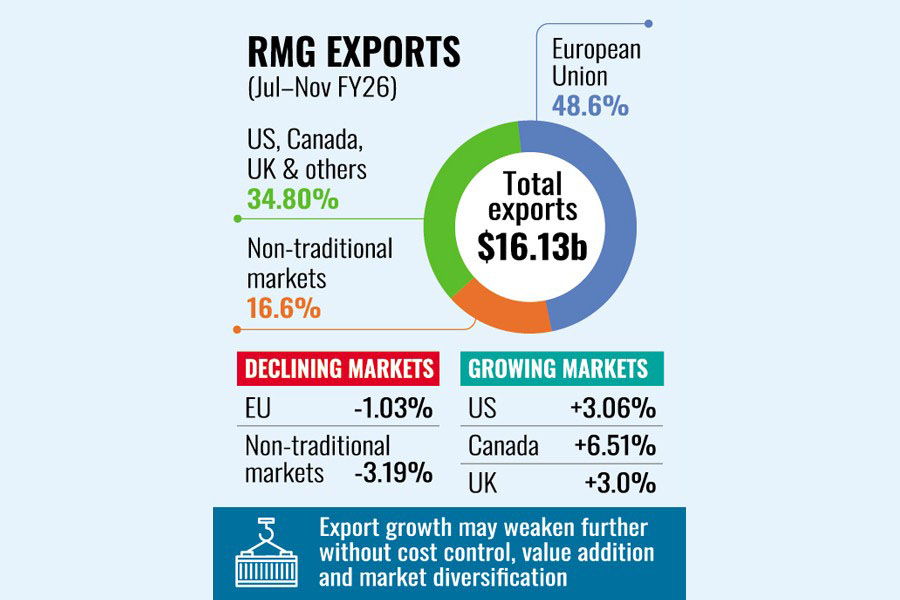
The Export Promotion Bureau (EPB) data show that exports to the European Union fell by 1.03 per cent to US$7.83 billion during the July-November period of fiscal year (FY) 2025-26, compared with US$7.91 billion in the corresponding period of the previous fiscal year.
The EU accounted for 48.57 per cent of the country's total RMG exports, which stood at US$16.13 billion during the first five months of FY26.
Major EU markets, including Denmark, France, Germany and Italy, recorded declines ranging from 3.56 per cent to about 9.0 per cent, according to EPB data.
Similarly, garment shipments to non-traditional markets fell by 3.19 per cent year-on-year to US$2.67 billion during the July-November period of FY26, compared with US$2.75 billion in the same period of FY25.
Markets beyond the traditional destinations (namely the EU, the US, Canada and the UK) are considered non-traditional and emerging markets. These include Australia, Japan, India, Brazil, Chile, China, Russia, South Korea, Mexico and Turkey.
Among these destinations, Australia, India, South Korea, Mexico, New Zealand, Russia and Turkey recorded declines ranging from 8.18 per cent to 24.55 per cent during the July-November period, while Japan posted marginal growth of 0.98 per cent compared with the corresponding period of the previous fiscal year.
Industry insiders attributed the overall weakness to subdued consumer demand in both advanced and emerging markets, driven by high living costs, sluggish global growth and ongoing geopolitical tensions.
Faruque Hasan, former president of the Bangladesh Garment Manufacturers and Exporters Association (BGMEA), said global demand, particularly in the EU and other emerging markets, has declined in recent months, leading to lower import volumes.
He said exports from China to the US dropped sharply due to higher tariffs, prompting Chinese exporters to target the EU more aggressively by offering very low prices.
India is also adopting a similar strategy, he added, while Bangladesh is losing competitiveness due to internal challenges such as high production costs and elevated bank interest rates.
Mr Hasan, who is also managing director of Giant Group, warned that garment export growth could decline further in the coming months, including shipments to the US.
Mohiuddin Rubel, additional managing director of Denim Expert Ltd, said that while traditional markets are struggling to provide stable demand, the decline in non-traditional markets highlights the urgent need for renewed focus on market diversification and value addition.
Fazlul Hoque, former president of the Bangladesh Knitwear Manufacturers and Exporters Association (BKMEA), told The Financial Express that the muted performance reflects a broader slowdown in the global apparel market.
Newspaper subscription
The global economy remains sluggish, and uncertainty and disruptions, including the impact of new US tariff regimes, have dampened demand across markets, he added.
Despite the broader slowdown, earnings from Bangladesh's single largest destination, the US, rose by 3.06 per cent to US$3.22 billion during the July-November period of FY26, according to EPB data.
Exports to Canada and the UK also grew by 6.51 per cent and 3.0 per cent, earning US$554.47 million and US$1.84 billion respectively over the same period.
Munni_fe@yahoo.com