

Published :
Updated :
 For all latest news, follow The Financial Express Google News channel.
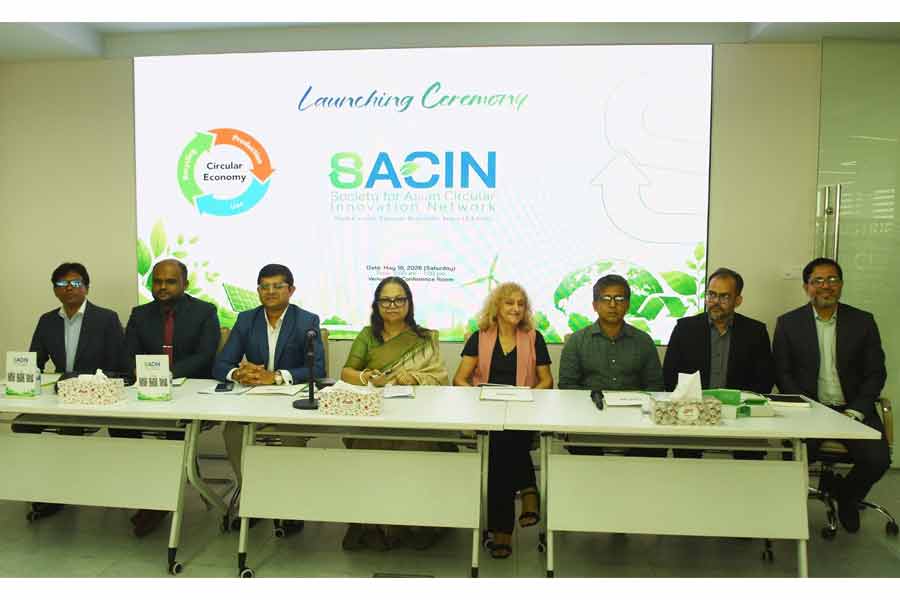
The Society for Asian Circular Innovation Network (SACIN), a research think tank dedicated to advancing circular economy solutions across Asia, officially launched its journey through a programme in Dhaka.
Speaking at the event held at the BCI Conference Room on Saturday, SACIN Founder President Priti Chakraborty said the organisation aims to promote sustainable development through research, innovation, policy engagement, and regional collaboration across Asia, according to a media release.
“Today we are not just introducing an organisation; we are beginning a new journey, a new way of thinking, and a new responsibility,” she said.
SACIN’s slogan — “Think Circular. Innovate Regionally. Impact Globally.” — reflects its vision of building an Asia that leads the world in circular economy and sustainable development.
The organisation initially starts with a focus on textiles and apparel, Bangladesh’s largest export sector, but will now work across a broader range of industries, including agriculture, manufacturing, construction and real estate, healthcare, plastics, power and energy, financial services, water and sanitation, and shipbuilding.
Nuria Lopez, Chairperson of EuroCham Bangladesh, Ashraful Haq Chowdhury, President of Saudi Arabia-Bangladesh Chamber of Commerce and Industry (SABCCI), Prof Dr Monir Uddin, former Chairman of the Department of Chemistry, University of Chittagong, ZM Golam Nabi, President of Organisation for Reduction of Carbon Footprint in Bangladesh, and Mollah Amzad Hossain, Editor of Energy & Power, graced the event, among others, as guests of honour.
SACIN Executive Committee Member Mostofa Azad Chowdhury Babu, Vice-president Shiabur Rahman Shihab, Secretary General Shafayat Hosen, Advisor AKM Jahidul Alam, Joint Secretary Sheikh Md Rezvi Newaz, Treasurer architect Md Nazmuchh Chhakib, and Executive Committee Member Mahfujur Rahman also spoke.
Nuria Lopez, in her speech, said Bangladesh can no longer view circular economy and sustainability merely as compliance requirements imposed by global markets, as climate change and outdated production models are already affecting the country’s future and competitiveness.
“Embracing circularity now presents Bangladesh with a major opportunity to become a sustainable global supply chain hub, attract green investment, strengthen exports to Europe, and ensure long-term economic and environmental resilience,” she said.
Priti Chakraborty highlighted the growing environmental and climate challenges facing Asia and said the traditional “take-make-dispose” economic model is no longer sustainable. She stressed the need for a circular economy approach where resources are reused efficiently, waste is minimised, and industrial growth remains balanced with environmental protection.
Drawing from her long experience in the healthcare sector, she noted that environmental sustainability and public health are deeply interconnected. “If water is polluted, people become sick. If air is polluted, children and the elderly suffer. Sustainable development is no longer optional; it is essential,” she said.
SACIN announced that it will work in four major areas: research and development, policy advocacy and support, networking and collaboration, and knowledge dissemination and awareness-building.
The organisation also unveiled several future initiatives, including the Asian Sustainability Data & AI Portal, Circular Tech & Innovation Marketplace, SACIN Academy & Certification, Circular Solutions Investment Platform, and the Asian Circular Economy & Climate Summit.
The event was attended by researchers, development professionals, industry representatives, academics, and members of the media.
SACIN said its work aligns closely with the UN Sustainable Development Goals (SDGs), particularly SDG 12 (Responsible Consumption and Production), SDG 13 (Climate Action), and SDG 17 (Partnerships for the Goals).
The organisation urged governments, industries, development partners, researchers, universities, youth, and communities to work together in building a sustainable, inclusive, and circular future for Asia, the release adds.