


Commercial banks in Bangladesh are now given a cutoff time until end of this month to significantly downsize mounting non-performing loans to clean up their year-end balance sheets.


Spelling out this direction at a meeting with bankers Sunday, the central bank high-ups suggested top executives of the banks to go by all the instructions the banking regulator recently issued regarding the policy support for the revival of the ailing businesses and partial write-off facility to cleanse the banks' balance sheets.
The Bangladesh Bank top management led by its governor Dr Ahsan H. Mansur made the instructions at the bankers' meeting with the top executives of the country's commercial banks at the BB headquarters.
The FE correspondent talked to nearly a dozen of the managing directors and chief executive officers of the scheduled banks to know the outcomes of the meeting but all of them agreed to share what transpired in the consultation on condition that they not be quoted by name.
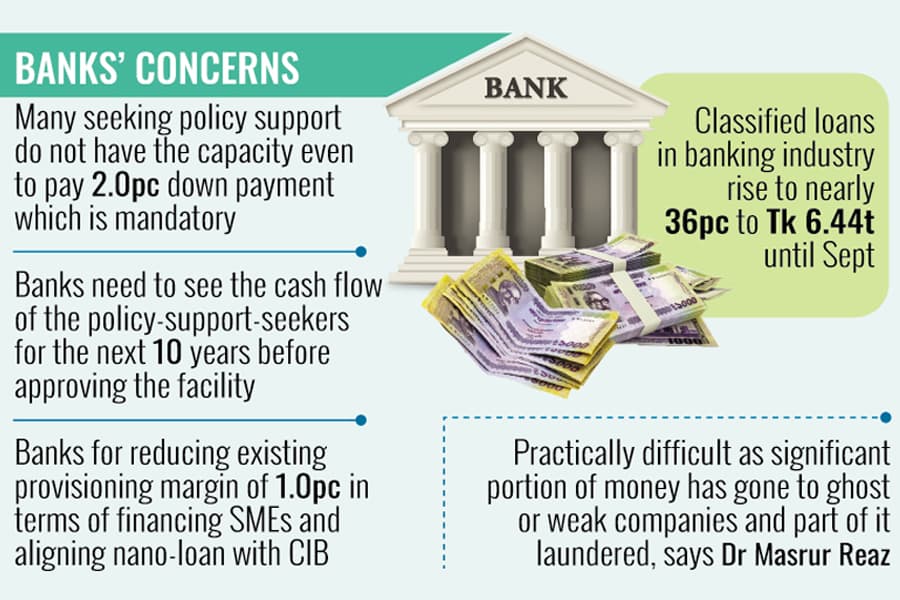
The managing director and chief executive officer of a private bank said the BB governor told them that ratio of classified loans in the banking industry rose as high as to nearly 36 per cent until September last, which is a matter of "serious concern to everyone".
The governor instructed the bank executives to pay serious attention to NPL management and execute all the instructions the regulator recently issued through circulars regarding policy support for reviving the struggling businesses and partial write-off facility for the banks.
"If the banks implement the instructions properly, a significant volume of NPLs is expected to be come down by end of this December," the BB governor was quoted by the bank executive as saying.
Another top executive of a private bank says they raised the problem that arises in terms of providing policy support because a significant number of people coming to get the policy support do not have the capacity even to pay 2.0-percent down payment, which is mandatory.
At the same time, he says, the commercial banks need to see the cash flow of the policy-support-seekers for the next 10 years before approving the facility to them. "The fact is majority of them do not have cash flow, which needs to be certified by a registered auditor. In fact, most of them are not eligible to get such support."
He adds about the dilemma: "If we allow them based on fictional cash-flow calculations, we would get into fresh problem, which the bankers don't want."
Apart from NPLs, another bank top executive says they also requested the regulator to reduce the existing provisioning margin of 1.0 per cent in terms of financing SMEs. Earlier, the provisioning requirement was 0.25 per cent which was enhanced to 1.0 per cent few months ago.
The bankers also requested the central bank to align the nano-loan with CIB (credit information bureau).
The central bank also instructed the banks to pay more focus on digital transformation to ensure cashless society, SME and agri-financing.
The volume of classified loans in the banking sector rose to Tk 6.44 trillion by end of September last, which accounts for 35.73 per cent of the loans disbursed by the banking system. The figure was Tk 4.20 trillion by March this year.
Founding chairman of Policy Exchange Bangladesh M Masrur Reaz says it is practically difficult to bring down the existing stock of NPLs because a significant portion of the money has gone to ghost or weak companies and a part of those was laundered.
If the bank executives become careful in NPL management through ensuring credit governance and properly handle risk management, the fresh flow of the possible classified loans can be avoided, he suggests.
Expressing concern over delay in implementing various institutional and legal reforms like expediting money-loan court and out-of-court resolutions and the introduction of distress-management company.
"It has been 15 months since the governance restoration has taken place. I think these (reform measures) should have been in place now," he tells the FE.
jubairfe1980@gmail.com