
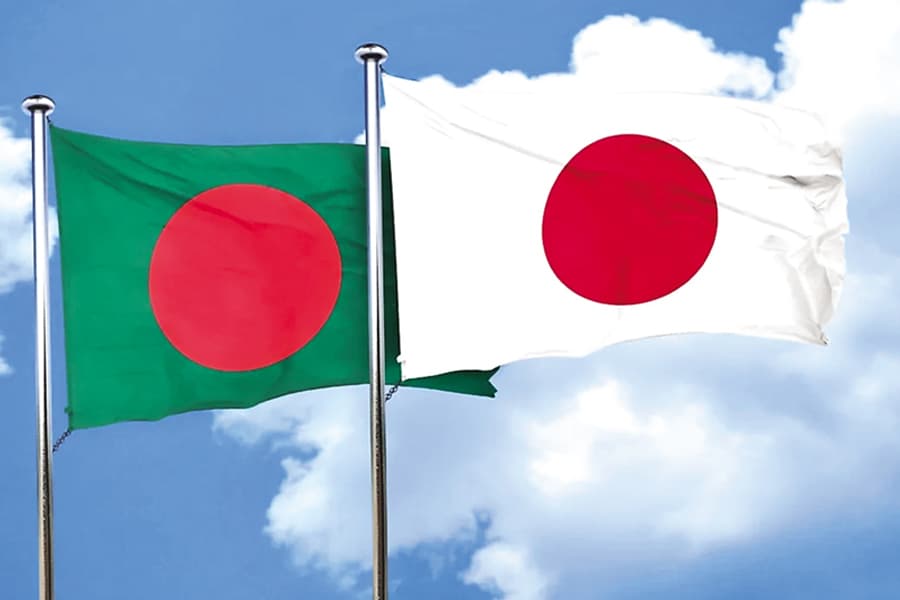
Bangladesh and Japan Friday signed a landmark Economic Partnership Agreement (EPA) that ushers in a new era of bilateral trade and investment cooperation and marks Dhaka's first such comprehensive pact with any country.
Under the agreement, Japan will grant 100-percent duty-free access to 7,379 Bangladeshi products, including key export item readymade garments, providing a major boost to Bangladesh's post-LDC market diversification.
 In return, Bangladesh will offer duty-free or preferential access to 1,039 Japanese products, facilitating greater inflow of technology-intensive goods and industrial inputs.
A key benefit for the apparel sector is the inclusion of the 'single transformation' rules of origin, removing complex conditions on sourcing raw materials and allowing Bangladeshi garments to enter Japan more easily.
The services chapter of the EPA opens Japan's labour market to Bangladeshi professionals in 16 sectors covering 120 categories, including IT, engineering, education, caregiving and nursing, ensuring greater employment opportunities and legal protection for Bangladeshi workers.
Bangladesh, for its part, has agreed to open 12 sectors with 98 sub-sectors for Japanese service providers.
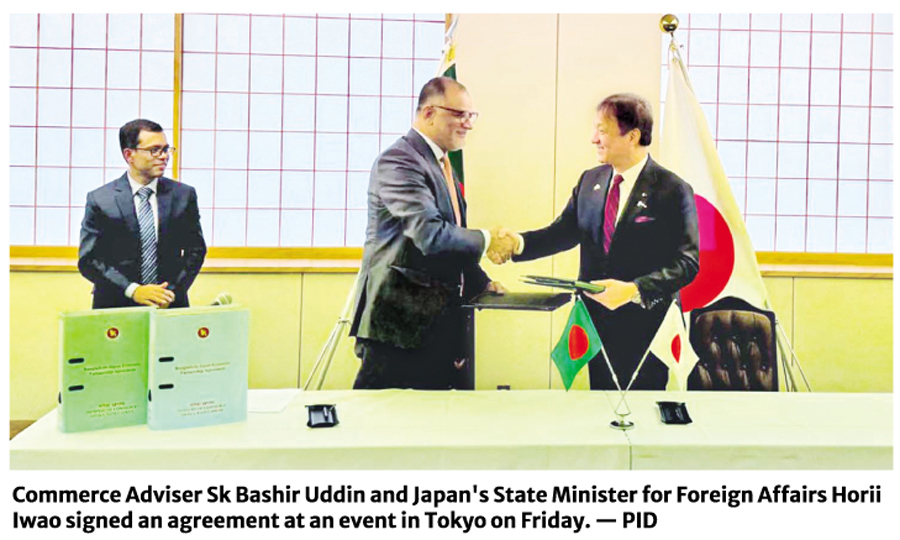
Commerce Adviser Sk Bashir Uddin and Japan's State Minister for Foreign Affairs HORII Iwao inked the deal at a ceremony held in Tokyo.
Commerce Secretary Mahbubur Rahman, Bangladesh Ambassador to Japan Md. Daud Ali, Japan's Ambassador in Bangladesh SAIDA Shinichi, along with senior officials from both countries, were present at the signing ceremony, according to a news release issued by the Press Information Department (PID).
The commerce adviser, in his remarks at the ceremony, described the EPA as a reflection of the longstanding friendship between the two Asian countries.
"The agreement was not merely a commercial document, but an expression of Bangladesh's bright economic future and the deep mutual trust shared by the two nations," he was quoted as saying.
He expressed the hope that effective implementation of the pact would open a new chapter of shared prosperity.
Officials say the accord, concluded after seven rounds of negotiations in Dhaka and Tokyo, covers trade in goods and services, investment protection, movement of skilled manpower and broader economic cooperation.
Titled Bangladesh-Japan Economic Partnership Agreement (BJEPA), the agreement is a strategic "lifeline" designed to ensure continued duty-free access to the world's fourth-largest economy as Bangladesh prepares to graduate from the least-developed-country (LDC) status on November 24, 2026.
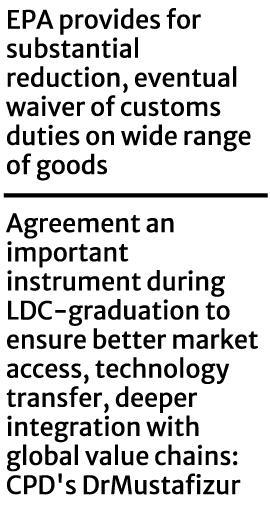
Aggressive tariff liberalization: Central to the EPA is a substantial reduction in and eventual elimination of customs duties on a wide range of goods.
Under the Chapter 02, Japan will eliminate tariffs on numerous Bangladeshi products-categorized as "A" in the schedule-immediately upon the agreement's entry into force. For its part, Bangladesh has committed to a phased reduction in duties, balancing its domestic industrial needs with the treaty's liberalization goals.
The deal also incorporates "National Treatment" clause ensuring that imported goods are not subject to internal taxes or regulations more burdensome than those applied to domestic products.
Robust safeguards and rules of origin: To protect local industries from sudden import surges, the EPA includes "Bilateral Safeguard Measures." These allow either nation to temporarily suspend tariff reductions or increase duties if increased imports cause "serious injury" to domestic producers.
Rigorous "Rules of Origin" have been established to ensure that only genuine products from the member-nations benefit from preferential treatment. This includes specific criteria for "factory ships" and "vessels," requiring at least 50-percent ownership by nationals of the parties to qualify for originating status.
Opening services and labor markets: Moving beyond physical goods, the agreement opens significant avenues for trade in services, including financial and air-transport sectors. Bangladesh has made specific commitments in areas including air transport, environment services.
A dedicated chapter on the "Movement of Natural Persons" facilitates the entry of business visitors, intra-corporate transferees, and contractual service suppliers. While recognizing border security needs, both nations have agreed to process visa applications expeditiously to avoid hindering trade activities.
Intellectual property and digital trade: The EPA sets high standards for Intellectual Property (IP) protection, covering trademarks, patents, and geographical indications. Notably, it includes provisions for enforcement in the digital environment and border measures to seize infringing goods.
On electronic commerce, the parties agree to promote "trustworthy, secure and accessible electronic payments systems" and will reassess the moratorium on customs duties for electronic transmissions within three years.
Recognizing Bangladesh's developing-economy status, the EPA provides calibrated transition periods for compliance with several complex intellectual- property obligations.
Dhaka has been granted 10 years to align with key international instruments, including accession to the Patent Cooperation Treaty (PCT), the Madrid Protocol on trademarks and the regime for protection of new plant varieties.
Officials say certain sensitive areas-such as provisions on unfair competition and regulation of domain names-could receive an additional five-year extension if implementation challenges persist.
The agreement also establishes a formal Dispute Settlement mechanism to resolve conflicts through consultation or, if necessary, binding arbitration.
Trade experts say the deal would help Bangladesh retain competitiveness in Japan after graduation from least-developed-country status and attract fresh Japanese investment in manufacturing and infrastructure.
Both sides described the EPA as a strategic framework to deepen supply-chain integration, technology transfer and people-to-people connectivity in the coming years.