


A landmark ruling by the US Supreme Court torpedoing Trump tariffs effectively upsets Bangladesh's trade arrangements with the United States, prompting calls for a cautious reassessment of the recently signed bilateral deal.


The media-highlighted "blow" to President Donald Trump's tariff regime -- which threw world trade order into a vortex -- comes close on the heels of Bangladesh electing a new government. Business community has been requesting it to go for a review and renegotiation of the trade deal signed by the immediate-past interim government.
Business leaders and economists told The Financial Express Saturday that the verdict has effectively altered the legal foundation of the reciprocal tariff regime on which much of the Bangladesh-US agreement was based.
They note that commitments reportedly linked to the tariff framework -- including large-scale import arrangements ranging from US wheat to Boeing aircraft -- may now need to be reviewed if they were tied to the invalidated measures.
In this evolving situation, analysts say, Bangladesh must closely monitor developments in Washington and carefully evaluate its obligations under the agreement. With the legal and policy context shifting rapidly, a measured and legally sound reassessment may be essential to safeguard the country's trade interests.
Dr Zaidi Sattar, Chairman of Policy Research Institute of Bangladesh (PRI), says as of now, reciprocal tariffs come to "naught" as a result of the Supreme Court judgment. But RT is replaced with a 10-percent levy for 150 days.
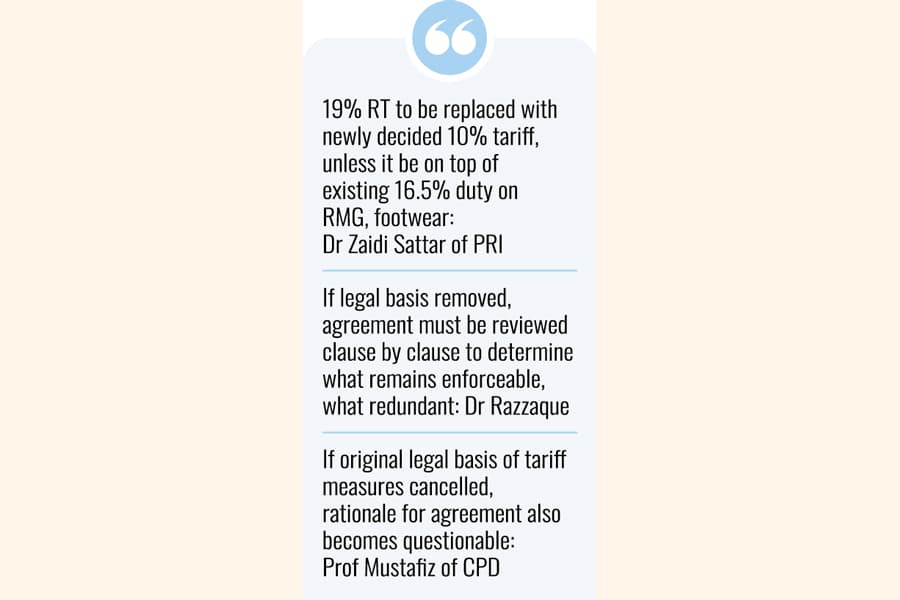
As for the US-BD Reciprocal Trade Agreement, 19-percent RT will be replaced with 10-percent tariff. What is not clear as yet is if the 10 per cent will be on top of existing tariffs, which is 16.5 per cent on RMG and footwear.
"Then the new situation gets worse for BD, except that the saving grace is the 'Buy American Cotton Act 2025', which allows duty-free export of apparel that uses US cotton and MMF."
He says, "If anything, it creates a messy situation on two grounds: what about refund of tariff rev already collected, and what happens to the US-BD Reciprocal Trade Agreement"
Shovon Islam, Managing Director of Sparrow Group, says the reciprocal tariffs became "null and void" following the American apex court's decision.
"The President has to follow the Supreme Court's ruling. There are no ifs or buts," he notes.
According to the apparel exporter, if any agreement entered into by a US government department -- including the Office of the US Trade Representative (USTR) -- was based on modifying or applying the reciprocal tariffs, then that specific portion of the agreement would also lose its legal standing.
However, he clarifies that other components of trade agreements not directly linked to the reciprocal tariffs, such as commercial buying and selling commitments, would remain valid unless separately challenged.
Mr Islam notes that, based on information from US business partners, the Bangladesh-US trade agreement has not yet come into effect. As the deal-required exchange of formal notifications remains incomplete, its current status is still unclear.
He adds that buyers who have already paid tariffs are preparing to seek refunds from the US Treasury if the reciprocal duties are formally withdrawn.
In his view, any attempt by President Donald Trump to reintroduce similar tariffs would require fresh legislation in Congress -- a process he describes as lengthy and politically challenging.
Meanwhile, corporate America is a making a demand for US$130 refund of import tariffs already paid under the new tariff regime.
Dr Abdur Razzaque, chairman of Research and Policy Integration for Development (RAPID), says the Supreme Court ruling leaves limited room for ambiguity from a legal perspective, although its practical implications remain uncertain.
The reciprocal tariffs were introduced under the International Emergency Economic Powers Act (IEEPA), but the court held that the statute does not authorise tariff measures of unbounded scope, magnitude and duration, given Congress's constitutional primacy in tariff-setting.
For Bangladesh, he mentions, the immediate implication is that the bilateral arrangement now stands on shifting ground.
"A large part of the agreement's logic was anchored to a specific tariff regime," he observes. And if that regime's legal basis is removed, the agreement must be reviewed clause by clause to determine what remains enforceable and what has become redundant.
The economic analyst adds that the court order would likely lead to the abolition of reciprocal tariffs, but bilateral agreements already concluded would not automatically become void. Determining which provisions are directly linked to the reciprocal tariffs will require careful legal interpretation.
He also notes that the existing 19-percent tariffs on Bangladeshi exports -- reportedly negotiated down from a proposed 37 per cent under reciprocal terms -- could be reduced to 10 per cent in line with the newly announced uniform tariff applied to all countries.
Prof Mustafizur Rahman, a distinguished fellow at the Centre for Policy Dialogue (CPD), says the core justification for the reciprocal trade agreement has weakened significantly.
"If the original legal basis of those tariff measures has been cancelled, then the rationale for the agreement also becomes questionable."
He suggests that Bangladesh reassess the deal in the light of the changed policy landscape in Washington. The agreement is scheduled to take effect two months after the exchange of formal notifications -- a process that has yet to be completed -- leaving room for further dialogue.
Mr Rahman argues that if the reciprocal tariff structure no longer stands, related commitments -- including expanded market access and other concessions -- may also warrant reconsideration.
However, he points out that the newly announced 10-percent additional tariff applies to all countries, meaning Bangladesh is not being singled out in the revised framework.
At the same time, he cautions that the US administration retains authority under Section 232 of its trade law to impose product- or country-specific tariffs on national-security grounds. If such measures are introduced, Bangladesh would need to continue negotiations accordingly.
He also questions the timing of the agreement, reportedly signed just two days before the national elections in Bangladesh, and calls for a transparent review by the newly elected government.
newsmanjasi@gmail.com