




Budget-support funding from foreign financiers seems drying up as only US$750 million has so far been confirmed although the financial year nears end with the economy facing unanticipated shocks amid global crises.


The country faces severe fund shortages caused due to heightened subsidy pressure amid the ongoing Mideast mayhem.
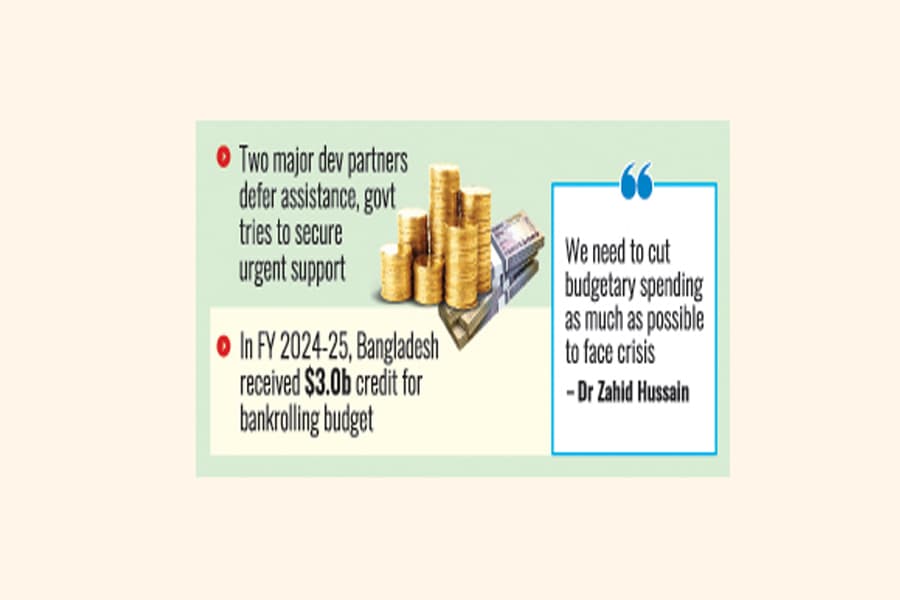
Finance Ministry officials say at least two major development partners have deferred talks on providing budget-support credit under regular arrangement and so they are now pursuing the financiers for lending the money in emergency balance-of-payments support.
According to them, the only development partner having confirmed budget support worth $750 million on completion of negotiations is the Asian Development Bank (ADB). The proposal will now be placed in board meeting early May, and if passed, the loan agreement will be signed when ADB President Masato Kanda visits Dhaka late next month.
Confronting such a situation at the very outset, the new government is also trying to secure an additional $250 million from the ADB to finance the additional spending incurred due to the fallouts from war and conflicts in the Middle East that force buying fuel oils and gas at excessive prices.
Sources have confirmed that the World Bank has rejected a government proposal for $250 million in budget-support credit under regular arrangement. Now the finance officials are pursing the World Bank to provide some $500 million under emergency support to meet the deficit being created under war's domino effect.
Also, the Japan International Cooperation Agency (JICA) has deferred a planned budget-support programme until next fiscal year, "leaving nothing for this fiscal year", sources say.
A JICA team on April 29th is scheduled to meet with finance ministry officials to discuss financial assistances. Sources says the finance ministry officials may request the agency team to provide some $500 to $700 million as emergency assistance from the $10-billion fund Japan has created to help its Asian neighbours whose economy is reeling from severe crisis caused by the Iran war.
Sources say the government is also in talks with the Asian Infrastructure Investment Bank (AIIB) for $700 million worth of budget support. However, the confirmation of AIIB financing will depend on consent from the co-financer.
The finance officials are not sure until now whether the AIIB credit will be finally available or not within this fiscal year that expires in little over two months.
Finance and Planning Minister Amir Khasru Mahmud Chowdhury recently visited Washington, DC, to attend the Spring Meetings of the International Monetary Fund and the World Bank Group.
The IMF has yet to give confirmation as to whether two due tranches of an ongoing credit programme, amounting to $1.3 billion, will be released for Bangladesh within this fiscal year, 2025-26.
As such, the finance minister, in meetings with top officials of the IMF and the World Bank in Washington, requested emergency assistance worth $1.0 billion each from them to offset the energy shocks of an unprecedented scale amid the blockade of the Strait of Hormuz and Iranian ports.
"All the development partners of Bangladesh are very positive to support us at this crisis moment," the minister told reporters after return from the United States. However, he wouldn't confirm how much assistance was secured so far.
"We are discussing with them emergency assistance," he says. In fiscal year 2024-25, Bangladesh had received around $3.0 billion as budget support from the development partners.
Dr. Zahid Hussain, a former lead economist at the World Bank's Dhaka office, told The Financial Express that getting budget-support credit from development partners in many aspects depends on government's "comfort position" with the IMF, which remains absent for a long.
"We need to cut budgetary spending as much as possible to face the crisis," he says, adding that containing spending will help lower import and thus the requirement of foreign currency will lessen.
He suggests maintaining exchange-rate flexibility and ensuring that no gap remains between domestic and international energy prices.
syful-islam@outlook.com