Taxpayers may soon sigh with relief from the rigours of responding separately to multiple queries from tax and VAT officials as the government's revenue authority is integrating its outmoded auditing system.
A joint audit system for income tax and VAT (value-added tax) payers is set to be launched with a twin-purpose: to remedy taxpayer vacation and curb tax evasion through inter-agency data sharing. Both individual and corporate taxpayers will no longer have to respond to the same queries or submit the same documents twice.
Income-tax and VAT officials will conduct audits simultaneously to obtain a comprehensive picture of a taxpayer's financial position.
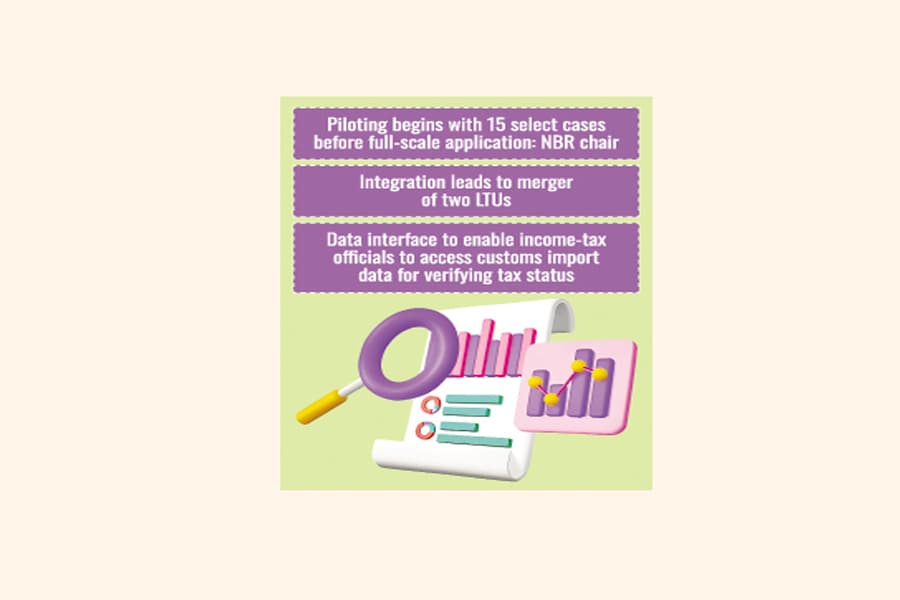
"Initially, we will start with 15 cases on a pilot basis to assess its feasibility," says Abdur Rahman Khan, chairman of the National Board of Revenue (NBR), in an interview with The Financial Express.
He mentions that the NBR has already begun selecting taxpayers for the piloting. A joint team comprising VAT and income -tax officials will conduct the audits and submit reports.
"If this model proves successful, the number of joint audits will be increased gradually," he adds.
The initiative -- which comes amid a recast of the revenue system, including bifurcation of the NBR into policy and implementation divisions -- is also expected to pave the way for merging the two separate Large Taxpayers Units (LTUs), which currently handle income tax and VAT matters independently.
Additionally, a data -integration system between the income-tax and customs wings will be introduced, allowing income tax officials to access customs import data for verifying tax returns, Mr Khan further mentions.
Currently, the income -tax and customs wings maintain separate databases, which will be bridged under the new initiative.
President of the Institute of Chartered Accountants of Bangladesh (ICAB) NK Mobin appreciates the move. He hopes it would reduce taxpayers' time and hassle caused by multiple audits from different agencies.
"This will provide comfort to taxpayers who previously had to furnish the same documents before income-tax and VAT officials during separate audits," he explains.
"Corporate taxpayers spend significant time and incur substantial costs in facing several audits by different agencies each year."
Apurba Kanti Das, former income-tax member at the NBR, mentions that the concept Large Taxpayers Unit (LTU) was introduced with a focus on income tax under the Revenue Reforms and Modernisation Project (RIRA), funded by UK's Department for International Development (DFID) in 2003.
Although the LTU initially had separate chambers for VAT officials, the VAT wing later opted to establish its own LTU, he notes.
Former customs member Farid Uddin, who served on the NBR reform advisory committee, says the two wings currently operate under separate laws and should be brought under one administrative structure.
In its reform report, the expert advisory panel recommended merging VAT and income tax into a single department.
"The two wings need to work in an integrated manner to conduct central audits effectively," he opines.
Talking to the FE, several field-level officials, however, have given some different views. They think the process would be difficult to conduct on a large scale as filed offices for income tax and VAT are scattered across the country.
There are numerous tax files with several timelines and natures which would need a rigorous brainstorming to make the model successful.
doulotakter11@gmail.com