

STOCK-LISTED FIRMS, MNCS FEEL PROFITABILITY CRUNCH
Corporates’ profit drop dents govt’s tax revenues
Published :
Updated :
 For all latest news, follow The Financial Express Google News channel.
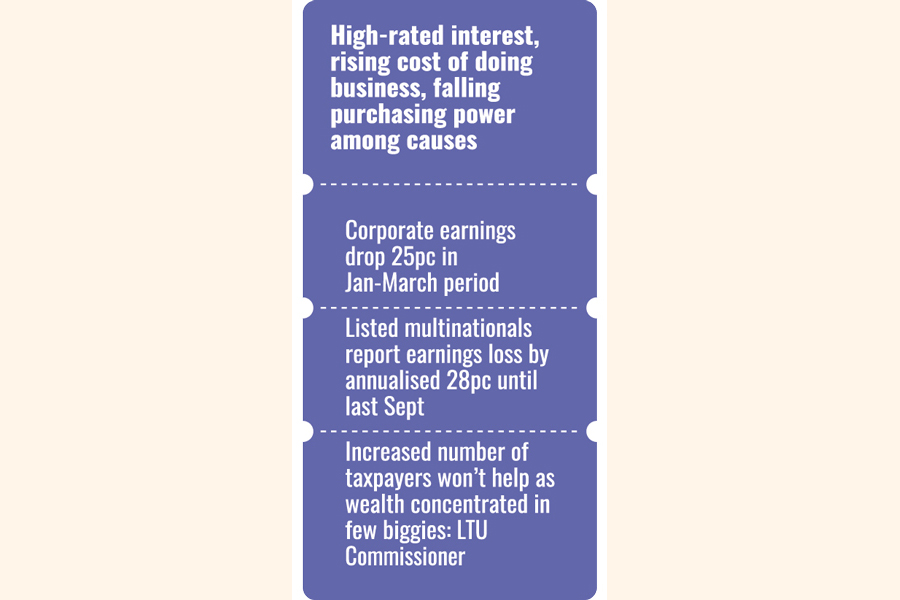
Collection of corporate taxes from large taxpayers has declined for a fall in their business profitability for factors like high-rated interest, rising costs and falling purchasing capacity for inflation, sources say.
Corporate insiders say their ability to pay taxes squeezing as profit margins have been going down owing to high bank interest and increased cost of doing business.
Capital-market data show most of the listed firms saw profits fall in last January-March period. Earnings dropped by 25 per cent for reasons like rising costs and erosion in people's purchasing power.
Listed multinational firms also reported earnings loss, by 28 per cent year on year until September 2025.
The gap between target and collection of corporate- income taxes came to Tk 66.58 billion in the fiscal year 2024-25 in a rise from Tk 48.48 billion in FY24, Tk 31.42 billion in FY23 and Tk 38.23 billion in FY22.
However, in FY21, the large taxpayers unit (LTU) under the income-tax wing of the National Board of Revenue surpassed its target by Tk 0.116 billion.
Talking to the FE writer Thursday, Commissioner of the LTU-Income Tax Ikhtiaruddin Mohammad Mamun pointed out a mismatch like rise in target of revenue collection against actual mobilisation growth.
"Our revenue-mobilisation target often hovers around 30 per cent while average revenue-collection growth is 15 to 16 per cent," he says.
The LTU has 281 large corporate taxpayers under its domain, including all commercial banks, insurances, non-banking financial institutions, mobile-phone operators and multinational companies.
Industry insiders often allege that a few taxpayers have been chased by the NBR while a large number of untaxed companies remain comfortable.
Mr Mamun, however, says the increase in the number of taxpayers won't help trigger corporate-tax collection as wealth is concentrated into the hands of a few biggies.
An economic taskforce report, in February last, said the top 10 per cent of the population controls 58.5 per cent of total wealth in Bangladesh.
"Income inequality is at its peak in Bangladesh, so few large businesses hold the major part of assets," he remarks.
World Bank's latest Gini index shows income inequality, which includes earnings, remittances and returns on assets, worsened.
The revenue official thinks if all corporates pay taxes properly, tax collection could be much higher.
Md Arifur Rahman, founder-chairman of Corporate Academy for Professional Excellence (CAPE), says businesses are struggling due to high dollar prices, stuck at a high rate.
"Businesses are now compromising profits as they are not able to increase prices despite import cost being high," he adds.
Though the dollar rates are stable now, but this increase is beyond expectation, he observes.
Another issue is high bank interest rate, which was 9.0 per cent earlier but now reached 12 to 20 per cent, pulling down overall profitability of businesses, he says.
Inflation also erodes the actual revenue of corporates and lower GDP growth is one of the reasons behind erosion of profits.
"Buying capacity of people has also declined due to inflationary pressure affecting business profitability," he says.
doulotakter11@gmail.com