

Published :
Updated :
 For all latest news, follow The Financial Express Google News channel.
The deal is done for release of the next installment of International Monetary Fund (IMF) loan to Bangladesh as its review mission appreciated progress in reform implementation and "continued commitment" towards decisive policy actions.
"Further monetary tightening, supported by neutral fiscal policy, and greater exchange- rate flexibility, is needed to restore near-term macroeconomic stability," the lender said in a statement Thursday after reaching a staff-level agreement with the government of Bangladesh.
For a two-week period, the IMF mission had reviewed progresses the government made in carrying out reforms which are preconditions for releasing further instalments of the US$4.7-billion credit programme.
The lender says its programme will continue to support Bangladesh's efforts to preserve macroeconomic stability and protect the vulnerable, while accelerating economic reforms and delivering on the climate agenda.
At the same time, the IMF team also concluded Article IV policy consultation which focused on reforms to create additional fiscal space for social and developmental spending, modernise policy frameworks, enhance governance, and strengthen climate resilience.
The IMF team, led by Rahul Anand, its Mission Chief for Bangladesh, visited Dhaka on October 4-19 to discuss economic and financial policies in the context of the first review of the IMF's Extended Credit Facility (ECF), Extended Fund Facility (EFF), Resilience and Sustainability Facility (RSF) and the 2023 Article IV consultation.
The staff-level agreement is subject to IMF management approval and executive board endorsement, which is expected in the coming weeks, according to the statement.
Completion of the first review will make available a total of US$681 million under the ECF/EFF and the RSF.
"The authorities have made substantial progress on structural reforms under the IMF-supported program, but challenges remain," said Mr Anand.
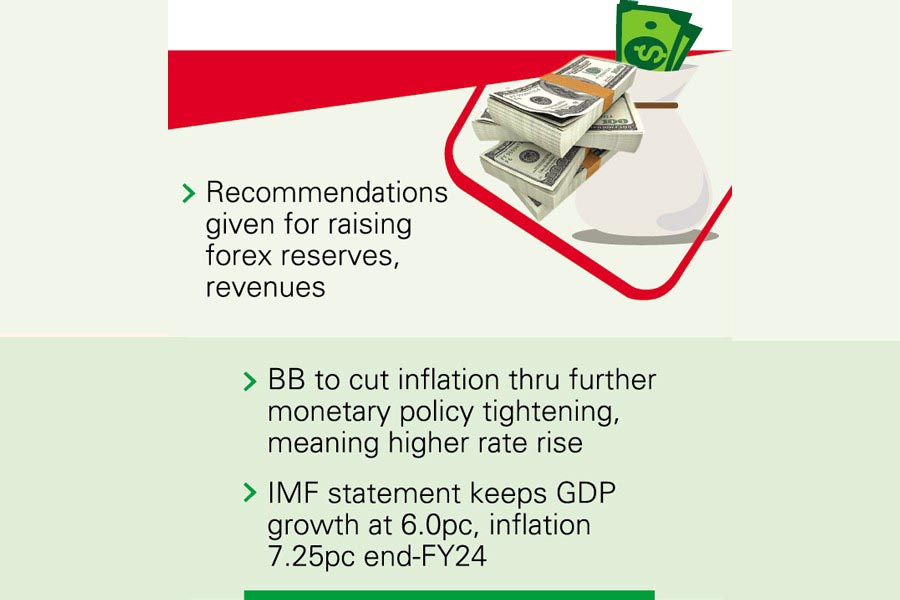
Continued global financial tightening, coupled with existing vulnerabilities, is making macroeconomic management challenging, putting pressures on the Taka and forex reserves, he said.
The IMF suggests that the near-term policy priorities should focus on containing inflation, softening the impact of these economic disruptions on the vulnerable, and building external resilience.
"We welcome Bangladesh Bank's decision to raise the policy rate by 75 basis points (bps) on October 4, 2023. Further calibrated monetary policy tightening, greater exchange rate flexibility, and tight fiscal policy will help restore macroeconomic stability," said the country chief of the Washington-based Fund.
The statement continues says the growth is projected to stay at 6.0 per cent in FY24, while inflation is projected to moderate to 7.25 per cent by end-FY24.
The IMF expects that forex reserves may increase gradually in the near term and are projected to reach an amount worth about four months of prospective imports in the medium term. However, uncertainties around the outlook remain high and risks are tilted to the downside.
"Raising revenue is critical to create additional space for social spending and investment," the lender alerts.
Concerted tax policy and administration measures are needed to raise Bangladesh's low tax-to-GDP ratio in a sustainable manner. Rationalising subsidies, improving expenditure efficiency, and managing fiscal risks will allow for additional spending on social-safety nets and growth-enhancing investment.
"Modernising monetary and exchange -rate policy frameworks and improving FX management remain important to bolster external resilience," the IMF suggests.
The Fund praised introduction of the interest-rate corridor system and the adoption of a unified single exchange rate. Building on these, Bangladesh Bank should continue to fully operationalise the interest rate targeting framework and gradually move to a flexible exchange-rate regime.
It also calls for addressing banking-sector vulnerabilities to meet Bangladesh's growing financing needs.
"Reducing non-performing loans of state-owned commercial banks, enhancing supervision, strengthening governance, and improving regulatory frameworks would increase financial-sector efficiency. Developing domestic capital markets will help mobilize financing to support growth objectives."
The IMF and Bangladesh authorities' discussions also focused on the structural -reform agenda to support the ambition to reach an upper-middle-income status by 2031.
"Expanding trade, attracting more FDI, enhancing the investment climate, and raising women's economic participation are crucial to boost growth potential," says the lender.
On Bangladesh's high vulnerability to climate change, the IMF emphasises scaling up resilient infrastructure investment, through climate-responsive public investment management and green public financial management reforms.
"Better management of climate-related risks will help enhance financial- sector resilience and mobilise private climate finance," it notes.
Contacted, Dr Zahid Hussain, a former lead economist of the World Bank's Dhaka office, said it seemed that the explanations made by the government about the failures to meet the targets on issues like forex reserves and revenue earnings could satisfy the IMF staff mission.
The government already informed them that it plans to carry out the unmet reforms after the national election.
Mr Hussain said some reforms were done in case of interest rate, exchange rate, reserve calculation, now carried out according to BPM6 formula, and prompt corrective actions ordered for NPL reduction, and bank companies' act amendment.
"After reading the statement I assume that they will recommend the release of the second instalment of the loan," he said.
He said had there been any intension of not recommending for release of the second tranche of the loan, the statement could have borne some indications.
Ahsan H Mansur, executive director of the Policy Research Institute of Bangladesh, thinks the IMF review mission was flexible this time as they could understand that the government would not be able to meet the conditions.
He said the IMF team now agreed to set forex-reserve target for next June similar to the amount set for this June. Even they agreed to further cut down the forex- reserve target responding to government's plea.
"This is a very flexible approach," says Mr Mansur, also a former high official of the IMF.
He thinks release of the second tranche of the loan is still at uncertain stage and will remain so for some more days.
Meantime, the central bank at a press conference on Thursday expressed the hope that the second instalment of the loan will be released by December next.
"We have reached an agreement. We hope the IMF's board meeting on December 11 will approve the second tranche of the loan," said Mezbaul Haque, the spokesperson for Bangladesh Bank.
He said some of the conditions put forward by the IMF, like forex reserves and revenue earnings, have not been met.The IMF was apprised of the local and global reasons behind this.
Mr. Haque, however, said interest- rate regime reform is the biggest reform on the financial market this time.
He said the IMF team did not put forward any new conditions this time but the central bank "will carry out reforms for the interest of the economy, whenever needed".
On the single exchange rate, Mr. Haque said that the central bank will now focus on how to make it more market-oriented.
He said non-performing loan was a major issue for Bangladesh's economy. "The Bangladesh Bank will work on reduction in NPL even if IMF does not put pressure on us."
Mr. Haque said Bangladesh Bank and other government agencies have been working to ensure good governance on the financial market. "We have to tackle it (NPL)."
syful-islam@outlook.com
jasimharoon@yahoo.com