


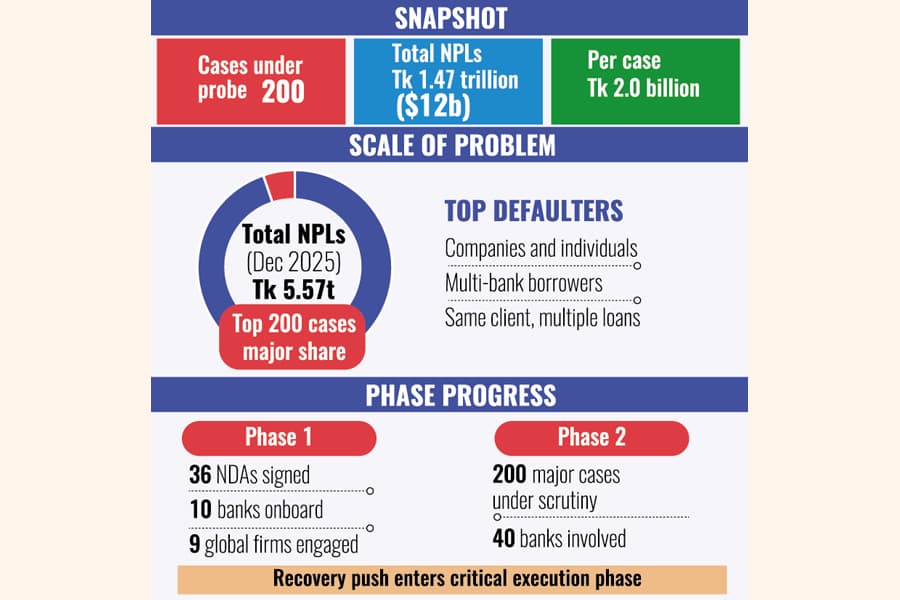
A dedicated division under Bangladesh Bank spearheads anew stolen-asset-recovery initiative with over 200 high-value non-performing loan (NPL) cases under scrutiny, each involving an estimated Tk 2.0 billion.


A newly established unit--Stolen Asset Recovery Division--is currently validating the amounts using data from the Credit Information Bureau (CIB), says Farhanul Gani Choudhury, adviser to the governor on stolen asset recovery.
Talking to The Financial Express, he said the 200 cases were shortlisted from NPL data submitted by commercial banks to the central bank. According to compiled information, these cases collectively account for approximately $12 billion or Tk 1.47 trillion in NPLs.
Bangladesh's total NPL volume stood at Tk 5.57 trillion as of December 2025, according to BB data.
Mr Gani clarifies that while the total NPL amount in these 200 cases is under intelligence scrutiny, it does not necessarily mean that the entire sum has been siphoned off.
"The SAR has now started working under a single platform to proceed in a structured way," he says.
The division will prioritise cases based on the number of banks affected by each NPL, he adds.
Under the second phase, SAR has engaged with 40 banks.
Through civil proceedings, the division aims to determine how much of the NPL amounts in these 200 cases has actually been siphoned off the banking system.
Meanwhile, the first phase of the SAR initiative is also progressing in full swing.
"These 200 cases involve around 200 companies and individuals - a mixed group. While individuals are involved, they often operate through companies," Mr Gani says, without naming names of the suspects.
He notes that many of these borrowers are multi-bank clients, meaning a single individual has taken loans from multiple banks.
Sharif Zahir, chairman of UCB, which was the first bank to sign an NDA in the case involving former land minister Saifuzzaman Chowdhury, has said the response from litigation funders on asset recovery has so far been disappointing.
"One firm, FT, initially responded but later backtracked. Perhaps they found the amount not large enough or not sufficiently attractive," he says.
He adds that UCB moved quickly to claim the alleged stolen assets in order to appoint an administrator. Grant Thornton has since taken over the administratorship.
"If we proceed through civil litigation, it is not that difficult to recover stolen assets. However, criminal proceedings require government-to-government agreements, which make the process more complex."
Mr Zahir expresses optimism about recovering at least part of the assets linked to Saifuzzaman Chowdhury, some of which have already been put up for sale in the UK.
On the 200 cases, Mr Gani explains that in cases where a single defaulter is linked to 10 or 15 banks, coordination becomes essential.
For cases involving only one bank, such coordination is not required, and the choice of international firm becomes less critical. However, in multi-bank exposures, a consortium or lead-bank approach is necessary.
"I have established an entirely new department. This work would not be sustainable without a strong institutional structure," he told the FE.
The SAR division consists of around 12 officials led by a director, in line with the organogram approved earlier by former BB governor Dr Ahsan H Mansur and endorsed by the current governor.
At a meeting with senior journalists on Sunday, the new BB governor reaffirmed his position to proceed on SAR without political and other interventions.
A director has already been appointed and is actively working on SAR. Previously, these responsibilities were partially handled by the Bangladesh Financial Intelligence Unit (BFIU), but now all asset- recovery functions have been consolidated under one umbrella.
All members of this division are officials of Bangladesh Bank. The structure includes one director from BFIU, two additional directors, four joint directors, and several assistant and deputy directors. Given the technical nature of the work, an IT specialist will also be appointed.
BFIU Director Syed Mahbub, who has been closely involved in SAR efforts from the outset, is also part of the division.
The division of crusaders for stolen asset recovery includes two to three joint directors who have completed two-year master's degrees in asset recovery from the UK, bringing valuable international expertise and knowledge of global best practices.
Under Phase 1, SAR has completed 36 non-disclosure agreements (NDAs) with 10 banks. NDAs have also been signed with nine international firms, and data sharing is now underway.
United Commercial Bank, Janata Bank, National Bank, Al-ArafahIslami Bank, Agrani Bank, AB Bank, and Islami Bank Bangladesh, among others, have signed the agreements with the law firms.
The global law and litigation firms engaged are Kroll, R1 Consortium, Interpath, Dentons/EY, DLA Piper/Unitas Global, PwC/Baker McKenzie, Omni Bridgeway, and Grant Thornton.
"Data is the most critical element. Everything I have done so far has been through coordination. Now we will be able to assess how viable this data is for building cases internationally," Mr Gani further says.
He explains that prior to signing NDAs, international firms did not have access to case-level data and were relying only on broad macroeconomic estimates of capital flight.
"Now it will become clear how much of this can actually stand up in international jurisdictions. Based on this, they will need to convince their litigation funders. Once they receive positive feedback from those funders, they will proceed with commercial contracts."
The SAR division has already begun seeking feedback from international firms, with mixed responses so far.
Some banks have performed well by properly organising and indexing their data and clearly presenting their proceedings in the Money Loan Court. Others, however, have submitted unstructured data, reflecting gaps in capacity and understanding.
"I plan to organise a best-practice session where better-performing banks will demonstrate to others how to prepare and present data to the required standard," he says.
SAR has also asked international firms to formally outline their minimum data requirements to ensure clarity in expectations.
Officials have observed that not all international firms operate the same way - some are more supportive and flexible, while others are less so.
doulotakter11@gmail.com