

BANKERS SHOW WAYS OF RECOVERING PILED-UP DEFAULT LOANS
Display defaulters' list on BB website, prohibit their car, house buy
State-owned banks' CEOs suggest
Published :
Updated :
 For all latest news, follow The Financial Express Google News channel.
Top executives of public-sector banks have suggested posting the loan defaulters' list on the central bank's website and prohibiting them from buying personal property like houses as preventive action, sources said.
These are among some unsparing actions they spelt out at a meet Monday as part of efforts to recover accumulated classified loans, some of which are believed linked to siphoning off funds.
The chief executives of the banks also demanded taking steps for boycotting the loan defaulters in social arena to create pressure on them for returning money they have taken from banks and financial institutions.
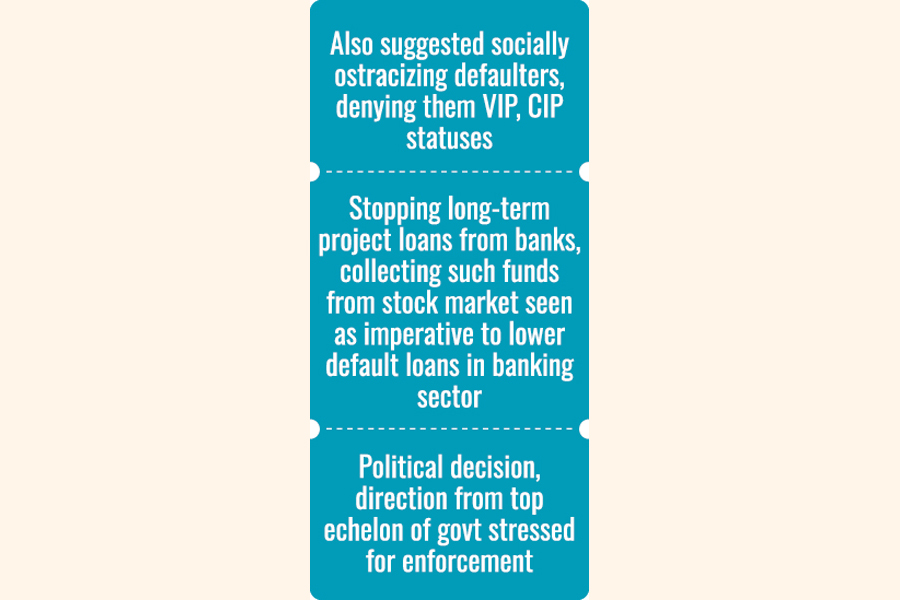
Also suggested are actions like not awarding them very important person (VIP) or commercially important person (CIP) status and curtailing all of their state privileges.
They suggested mandatory checking of credit status of businessmen from the credit information bureau (CIB) before they buy new homes and cars.
The top officials of the PCBs came up with the suggestions at a workshop organised by Financial Institutions Division (FID) at Bangladesh secretariat. FID secretary Nazma Mobarek attended the event as chief guest wherein chief executives of state-owned banks and representatives from the central bank participated.
Additional secretary of FID Sayed Kutub presented the keynote paper titled 'strategy to recover default loan' at the workshop.
Sources, however said the workshop was told that publishing lists of loan defaulters on the central bank website and barring them from buying assets need political decision and directives from the top level of the government.
At the event, sources said, the chief executives of the state-run banks also suggested stopping providing long-term project loans from banks and collecting money from stock markets in this case to lower the volume of default loans in banking sector.
Sources said at the workshop the managing directors of the banks noted that while providing project loans, the valuation of mortgaged property is not being done properly. In many cases, central bank's guidelines are not followed properly.
They flagged the faulty valuation of property as one of the main reasons for ballooning default loans.
The volume of default loans in Bangladesh's banking sector now stands at around 31 per cent, as of December last, amounting to Tk 5.57 trillion out of total outstanding loans of Tk 18.21 trillion.
"The central bank should publish the list of approved property-valuation companies on its website," says none of the suggestions.
In the rural areas, they said, the advance-deposit ratio fixed by the central bank is also not followed properly. Thus, in many cases, it was found that the AD ratio in case of some bank branches reached 400 per cent against the permissible limit of 83 per cent.
The workshop has suggested that the central bank should enforce the AD ratio branch-wise instead of bank as a whole to maintain the ratio properly.
In his key note speech, FID additional secretary Sayed Kutub described the reasons behind creation of default loans which include providing loans without selecting appropriate entrepreneurs, excess loans over the requirements, lending under pressure or being motivated, overvaluation of mortgaged property and accepting forged documents, and misuse of funds by the borrowers.
Also, he listed the reasons like a "trend of becoming willful defaulter, absence of adequate operating capital, and borrower's unwillingness to repay loans".
Mr Kutub suggested not providing loans beyond the banks' mandated areas, selecting suitable clients, making proper assessment of loan risks, and securing proper and adequate mortgages against loans.
Sources said at the workshop, the managing directors were asked to ensure monitoring loan sanction and recovery status on a daily basis and make the process online.
syful-islam@outlook.com