


A survey supported by two international agencies has found jacked-up US tariff's emerging but uneven business impacts on Bangladesh's garment export as factories mostly linked to the American market are already showing signs of strain.


High market concentration with exports heavily reliant on the European Union and the United States is also identified with mixed impacts. The survey shows EU exposure offers some relief at a time when factories' concentration on the US market is "already in a strained state".
The Better Work Bangladesh (BWB) survey report, titled 'Assessing the early impacts of tariff uncertainty on the garment sector in Bangladesh', was published recently. It is a joint initiative along with the International Labour Organisation (ILO) and the International Finance Corporation (IFC).
Through its regular factory assessments, BWB monitors compliance with national labour law and international labour standards in about 490 factories that supply to 50 global brands across eight key clusters.
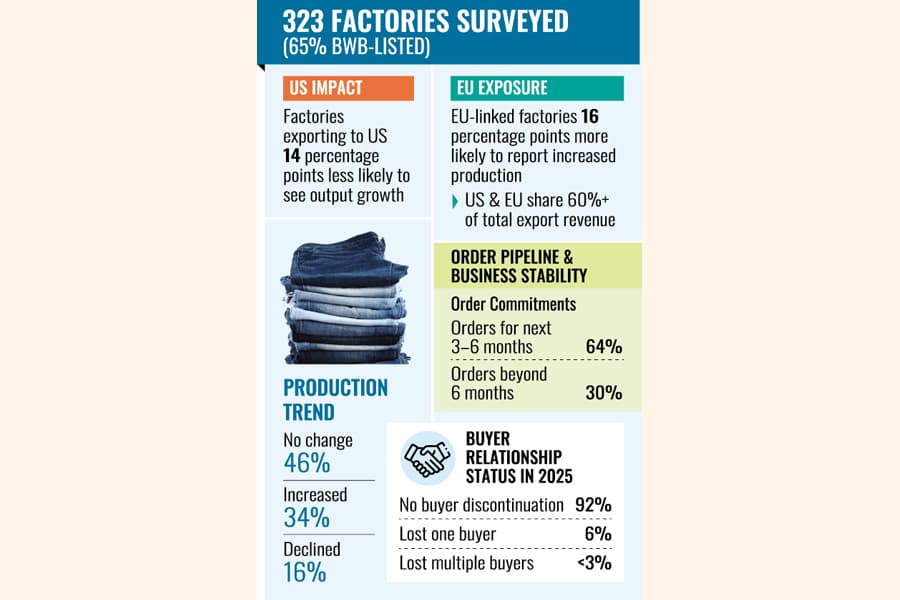
Production volumes in the first quarter of 2025 remained relatively stable compared with the same period in 2024, though not evenly across markets, according to the findings.
Nearly half of factories, or 46 per cent, reported no major change in output, while around one-third (34 per cent) experienced increases and 16 per cent reported declines.
Factories exporting to the United States were about 14-percentage- point less likely to report an increase in production than those exporting elsewhere, while exporters to the European Union were around 16-percentage-point more likely to report higher production, says the report.
According to the survey output, most factories are resilient with medium-term orders and stable sourcing links though risks included retrenchments and worker grievances as early warning signs.
"Shorter-order pipelines in some markets underline the sector's vulnerability to prolonged or renewed shocks," the report says.
A majority of factories had secured medium-to long-term orders as 64 per cent reported that they have commitments for the next three to six months, and 30 per cent had orders stretching beyond six months.
The analysis of trade metrics suggests factories linked to the EU were more likely to report holding medium-term contracts but less likely to secure longer-term orders, potentially reflecting more cautious purchasing strategies.
More than half of respondents (53 per cent) indicated that their current pipeline of orders and raw materials would allow them to sustain operations for at least three months, reducing the risk of immediate disruption.
However, it says vast majority of factories (92 per cent) reported no buyer discontinuation in 2025 with only a small minority having experienced disruption while 6.0 per cent lost one buyer and fewer than 3.0 per cent lost multiple buyers.
Amid the uncertainty created by the new ramped-up US tariffs, the BWB launched a Factory Pulse Tracker Survey to quickly assess how the policy shift was affecting factories' expectations, production, and workforce dynamics.
Implemented online via Qualtrics in May 2025, the survey gathered 323 responses, covering around 65 per cent of BWB-listed factories, focusing on factory performance, buyer relations, production trends, business sustainability, workforce dynamics, and overall business sentiment.
The BWB says this timing allowed the programme to capture early reactions precisely when uncertainty was the highest, providing timely evidence for policymakers, industry stakeholders, and partners to inform mitigation strategies.
In 2024, Bangladesh received US$38.48 billion from garment exports, underscoring the sector's vital role in driving growth and job creation.
The country's RMG industry depends heavily on access to international markets, particularly the European Union and the United States which together accounted for over 60 per cent of export revenues in fiscal year 2024-25.
This reliance makes the sector especially vulnerable to changes in trade policy, tariffs, and global demand, and because of the new US tariff regime, the trade relation between the two countries reached a critical turning point.
The Trump administration in April 2025 introduced a reciprocal tariff of 37 per cent on Bangladeshi exports, in addition to an existing 15-percent duty, raising the total tariff incidence to 52 per cent. The rate was, however, later reduced to 20 per cent in August this year following several rounds of negotiations that includes an increase in imports from the United States, in a tradeoff.
During January-August period of 2025, garment exports to the US market fetched Bangladesh US$5.64 billion, marking a 19.83-percent growth, according to US official data.
Munni_fe@yahoo.com