

Published :
Updated :
 For all latest news, follow The Financial Express Google News channel.
Experts have underscored more major reforms to remove the existing hurdles and enable Bangladesh to tap the emerging business opportunities, calling for faster democratic transition to accelerate the system-recast process.
Speaking at a roundtable Monday in Dhaka, they also said reforms aligned with entrepreneurs' needs are to boost business confidence and ensure sustained private-sector growth.
The speakers-including leading apparel exporters, agrochemical entrepreneurs, ceramic makers, representatives from chambers, and regulatory officials-called for more easing of business environment to attract investment and drive competitiveness.
They opined that the next elected government should continue the ongoing reform agenda with time-bound commitments, enabling the country to tap emerging business opportunities as the demographic dividend is shrinking fast.
The discussants also recommended adopting best practices from peer economies as the local enterprises often face multiple regulatory hurdles.
They demanded submitting application to the UN for further review of the country's LDC graduation as they believe the planned graduation in 2026 would hit hard the domestic industrial sector as well as the economy.
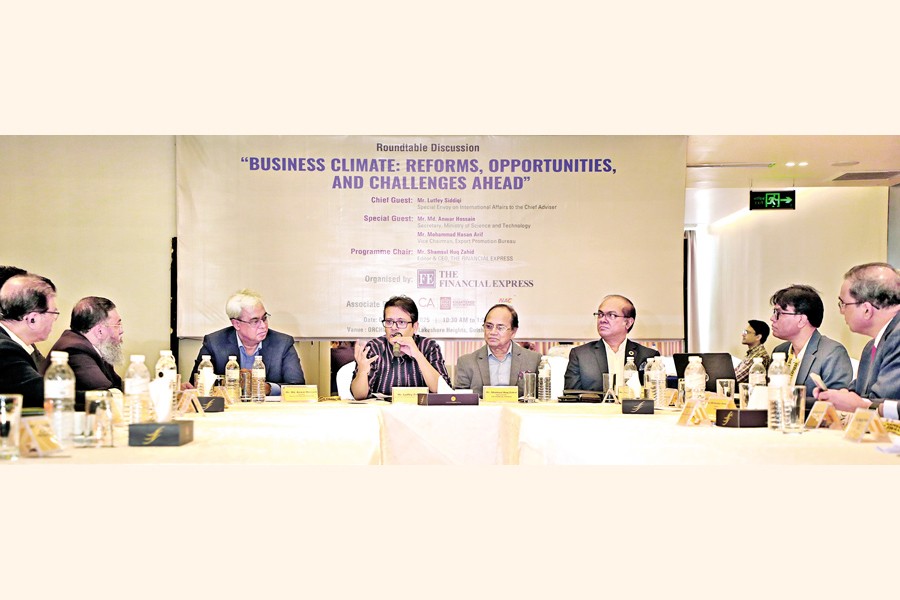
The speakers came up with the observations at a roundtable on 'Business Climate: Reforms, Opportunities, and Challenges Ahead', organised by The Financial Express in a city hotel in association with Institute of Chartered Accountants of Bangladesh (ICAB) and National AgriCare.
Bangladesh requires reforms "from the design level" to heal fundamental flaws in governance and administrative systems, said Lutfey Siddiqi, Special Envoy on International Affairs to the Chief Adviser.
"We have a fundamental design flaw," Mr Siddiqi told the meet. "Our bureaucracy has no clear accountability for the logistics or export sectors. Piecemeal reforms will not fix systemic issues."
Drawing comparisons with Singapore and Malaysia, he said both countries assign inter-ministerial coordinators under the Prime Minister's Office to ensure seamless operation. "We need similar structural redesigns."
He also cautions businesses not to delay in pressing for reforms during the tenure of the next elected government, noting that "opportunities were missed after the student-led uprising in Bangladesh".
Highlighting achievements in trade facilitation, he cited the National Single Window, which has delivered over 500,000 services and prevented 1.2 million office visits.
He added that automated e-gates have reduced port clearance time from 20 minutes to just 20 seconds. Yet, he acknowledges, legal provisions allowing pre-arrival customs clearance remain underutilised due to bureaucratic resistance.
"The main barrier to automation is mindset," he noted.
Reflecting on his early days in office, Siddiqi described an unstable administrative environment: "Half of the government staffs were inactive, there were no police officers for security, and industrial zones were unstable due to worker unrest. Yet, through sustained efforts, we've managed to restore stability."
In his speech of chair, Editor and CEO, The Financial Express, Shamsul Huq Zahid said the government stabilized the situation of Bangladesh following the changeover.
He urged everyone to remember this and look forward to smooth transition to a political government.
Md Anwar Hossain, Secretary at the Ministry of Science and Technology, called for sustained dialogue between policymakers and businesses to identify effective solutions and implement reforms based on best practices from the region.
Speaking as a special guest he emphasised innovation-driven strategies to achieve high-value production.
"Industry and academia must work closely to foster the kind of innovation that drives competitiveness," he said.
Bangladesh must establish dedicated export-promotion councils and adopt a strategic branding approach to unlock new markets, Mohammad Hasan Arif, Vice Chairman of the Export Promotion Bureau (EPB), told the audience.
Arif criticised bureaucratic inertia in the way of collaborating with businesses. "The bureaucracy doesn't want to listen to businesses, let alone bring solutions for their problems."
Highlighting a gap in national identity marketing, the export promoter lamented the absence of a coherent branding strategy for the country. "Such strategy is crucial in competing globally."
Bangladesh Bank Executive Director Kakoli Jahan Ahmed said ensuring data accuracy is critical for attracting foreign direct investment (FDI) into Bangladesh.
She also suggests that the central bank should hold consultative meetings with key stakeholders before finalising any major policy decision so that the policies are well-informed and less likely to draw criticism after implementation.
Showkat Aziz Russell, president of Bangladesh Textile Mills Association (BTMA), questioned the government strategy to attract foreign direct investment.
"When a country can't even extinguish a fire at its international airport for lack of equipment, lacks policy consistency, and faces an energy crisis-who would invest here?" he asked.
"Instead of chasing foreign investors, the government should focus on facilitating local investors. They are the ones generating revenue and creating jobs."
Dhaka Chamber of Commerce and Industry (DCCI) President Taskeen Ahmed said discussions on business reforms cannot reach a meaningful conclusion until Bangladesh has a predictable, mandate-backed government.
Highlighting that the current key issue is energy security, he noted that without it, sustainable progress is impossible.
"Over the past 20 years, we have made significant development, but there were some missteps along the way. That's a learning for us," he said.
Mohammad Hatem, President of Bangladesh Knitwear Manufacturers and Exporters Association (BKMEA), said the government should reconsider its decision to proceed with LDC graduation, as the country's industries are not yet prepared for such a transition.
"We have individually and collectively spoken with policymakers, and from the beginning, many of us have favoured deferring graduation," he said. "However, the government has now decided to move forward, leaving little scope for further discussion."
Hatem mentioned that during a meeting with the Chief Adviser on August 20, 2024, industry leaders urged the government to request the United Nations to reassess Bangladesh's current economic reality before making a final move. "If the UN reviews the situation, it will find that the economy and industries are still not ready for graduation," he added.
Shams Mahmud, president of the Bangladesh-Thai Chamber of Commerce and Industry (BTCCI), said, "The interim government has introduced several reforms, but none is yet visible. It's time to pause further policy changes and focus on holding the election so an elected government can take up reforms with legitimacy."
He thinks foreign investment will be eluding the country until an elected government is in office.
Inamul Haq Khan, Senior Vice-President of BGMEA, stressed that the transition from LDC status poses "existential challenges" for the sector, which contributes the highest share to the country's export earnings.
"We must make sure that we get three years' time for LDC graduation. That is going to help us to actually sustain and survive," he said.
Abul Kasem Khan, Chairperson of Business Initiative Leading Development (BUILD), has called on policymakers to urgently enhance Bangladesh's global competitiveness to avoid being stuck in the middle-income trap.
"Bangladesh is at the bottom 10 in many global indices, including passport strength and ease of doing business," Khan notes. "If we can't increase competitiveness, we will not grow and will be stuck in the middle-income trap."
Emphasising institutional performance, he said, "Accountability across public institutions is essential if we want sustainable reform and growth."
Sharif Zahir, Chairman of United Commercial Bank (UCB), called for introduction of a 'fast-track' mechanism to expedite the resolution of non-performing loan (NPL) cases.
Highlighting the urgent need for differentiation within the banking sector, Mr Zahir said: "A clear distinction must be made between genuine shareholders and wrongdoers. Without this, the ongoing reform agenda in the banking sector will not achieve its goals."
Moynul Islam, president of the Bangladesh Ceramic Manufacturers and Exporters Association (BCMEA), underscored the need for good governance to ensure sustainable growth of the country's ceramic industry.
Referring to ceramic goods, Moynul Islam said, "I call this a 'dumb product' because it doesn't make any sound, yet we use it every day without realising its importance - and it's very difficult to produce."
Md. Ahsan uz Zaman, Managing Director & CEO, Midland Bank, said the banks are motivated by profit and shareholder returns, which can sometimes conflict with aggressively financing the SME sector, despite recognizing its importance as a driving economic force.
Key issues addressed by him include the higher cost of financing for newer or less-established businesses due to perceived higher risk and lower trust, and the significant problems caused by NPLs, which are exacerbated by a legal process that often favours the debtor and makes loan recovery difficult.
Bangladesh Agrochemical Manufacturers Association (BAMA) President KSM Mostafizur Rahman urged the government to lift duty on chemical raw materials to produce pesticides in Bangladesh.
He also drew government attention to the need for removing other non-tariff barriers as well.
Khourshed Alam, COO (Building Materials), Akij Bashir Group, said policy inconsistency directly impacts their business.
"In the glass industry, we have invested crores of taka. Suddenly, local sand extraction was banned - a major setback for us," he said, adding that sand is extracted responsibly in other countries-it's not banned outright.
Strengthening auditor independence and enforcing good governance are vital to improving Bangladesh's business environment, said Shubhashish Bose, Chief Executive Officer of the Institute of Chartered Accountants of Bangladesh (ICAB).
Drawing from recent experiences in banking audits, Bose criticised the current system in which auditors' findings are influenced by tripartite meetings between Bangladesh Bank, the auditor, and the bank in question.
"The auditor's report was not accepted by the meeting. The auditor was asked to change all those figures," he said, describing how losses were allowed to be spread over years to preserve bank image.
Economic Reporters' Forum President Doulot Akter Mala said many reform decisions taken by the interim government didn't pay back properly and those should be reviewed.
She questioned the import restrictions on some food products by Bangladesh Bank.
In a keynote presentation, economist and senior policy adviser Hasnat Alam of Policy Exchange Bangladesh outlined the country's lax investment performance relative to its potential, particularly in sectors critical for export diversification and value-chain integration.
While Bangladesh has made considerable strides in manufacturing and maintains steady GDP growth, Alam warns, the investment climate still suffers from policy uncertainty, infrastructural bottlenecks, slow trade facilitation, and a low level of innovation-driven productivity.
Shiabur Rahman Shihab, Head of Online and Digital Content at the FE, moderated discussions.
fecjuh@gmail.com, bdsmile@gmail.com, newsmanjasi@gmail.com