
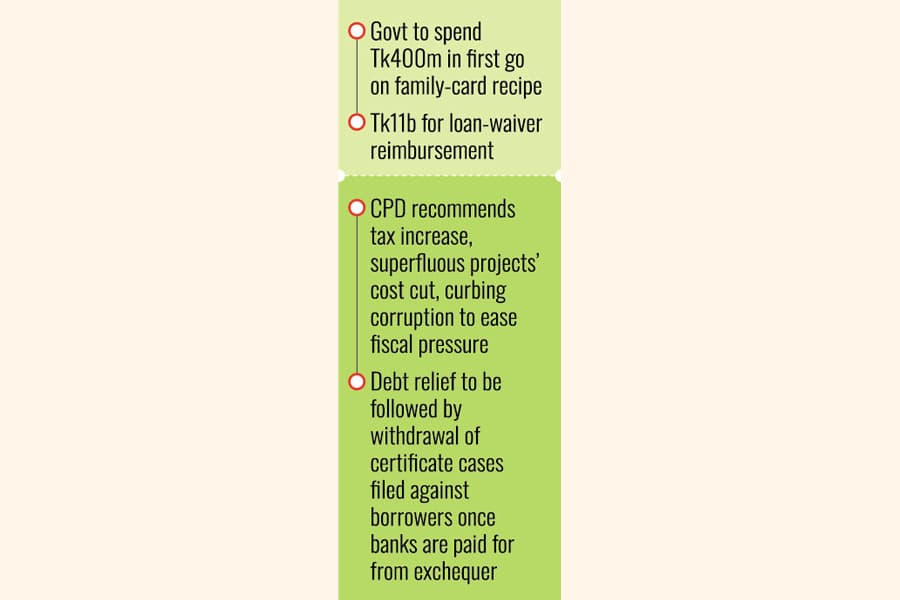
Financing new government's flagship schemes family card and farm-loan waiver cost the exchequer Tk 11.4 billion immediately that has to be managed with from the current national budget.
The government has already allocated a lump-sum Tk 400 million from the country's revenue budget for payouts under the newly evolved "family card" programme during the remaining four months of the current fiscal year.
Meanwhile, the Finance Division is set to allocate some Tk 11 billion for the waiver of agriculture loans along with cumulated interest of some 1.287 million borrowers as the new government's election pledge is going materialise in no time, officials say.
A study by the Centre for Policy Dialogue (CPD) estimates that providing family cards to five million rural families with monthly support of Tk 2,000-2,500 would cost the exchequer between Tk 96 billion and Tk 120 billion annually - equivalent to 0.15-0.20 per cent of GDP.
The CPD has recommended adopting a poverty-scorecard method with strong transparency and accountability mechanisms in selecting beneficiaries.
The organisation has also cautioned that fiscal constraints could pose a significant challenge to scaling up the programme.
Dr Fahmida Khatun, Executive Director of the CPD, says the family- card concept is appreciable as it is universal in nature.
"The government needs to make the selection process transparent and must ensure the actual beneficiaries for this safety-net scheme," she adds.
Dr Fahmida suggests proceeding with the family-card initiative in phases being fully prepared to list genuine beneficiaries and digitise the database.
Distribution of family card needs good governance.
If the government wants to give family card worth Tk 2000 each to 50 million beneficiaries as it targets, it would need around Tk 120 billion in a year, she says about their estimate.
"The government has to increase tax, cut unnecessary project expenditures, check corruption to ease fiscal pressure," she suggests.
The flagship initiative is scheduled to be launched on a pilot basis on March 10, covering 6,500 families across 14 upazilas. Each selected family will receive directly Tk 2,500 per month through mobile financial services or bank accounts.
As the expenditure was not included in the national budget for FY2025-26 announced by the interim government, the Ministry of Finance has allocated the funds from the "unexpected expenditure" head, says a senior official of the Ministry of Social Welfare.
The allocated amount would cover all expenditures, including data collection and administrative costs, along with family card's Tk 2500 each.
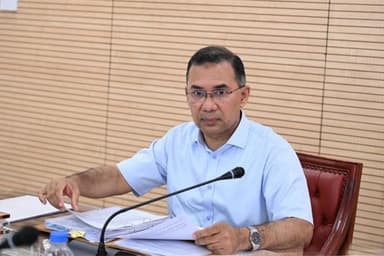
Prime Minister Tarique Rahman is expected to inaugurate the pilot programme on March 10, 2026.
The Ministry of Social Welfare has already collected data on nearly 50,000 households as part of preparation to issue family cards in phase.
Beneficiaries will be selected using the Proxy Means Test (PMT), a scientific poverty-assessment method used to categorise households from extreme poor to ultra-rich.
Under the pilot phase, priority will be given to households ranging from ultra-poor to lower-middle-class groups.
Officials have said the number of eligible households identified during field data collection is 60-70-percent higher than the figures in the Household Income and Expenditure Survey conducted by the Bangladesh Bureau of Statistics (BBS).
Talking to The Financial Express on Monday, Secretary of the Ministry of Social Welfare Dr Mohammad Abu Yusuf said teams comprising primary and secondary schoolteachers, deputy commissioners and other officials are working relentlessly to complete data collection in the 14 upazilas by March 8.
"In many areas, survey teams had to visit households two to three times, particularly in slum areas where residents could not immediately provide national ID cards or other necessary documents for enlistment," he said.
He added that densely populated slums presented different socio-economic realities compared to BBS survey data.
The pilot programme will cover Dhaka's Banani Korail and Sattala slums, Mirpur Bhashantek, Begunbari, Olimiatek, Pangsha of Rajbari, Patenga, Bancharampur, and Lama in Chattogram, Khalishpur in Khulna, Charfassion in Barishal, Dirai in Sylhet, Bhairab in Mymensingh, Bogura Sadar, Lalpur in Rajshahi, Thakurgaon Sadar and Nabaganj in Rangpur.
Currently, 95 social-safety-net programmes are being implemented by 23 ministries. The total allocation for these programmes in the current fiscal year stands at Tk 1.26 trillion, accounting for 1.87 per cent of GDP.
Under the family-card scheme, cards will be issued under the name of the mother or the female head of the household.
About financing the farm-loan waivers a senior official of the finance division told The Financial Express Monday that they would make the budgetary allocation this week.
The division's high-ups held a meeting with top officials of 15 banks on the day to check the nitty-gritty of the waiver process, sources say.
According to the officials concerned, the majority of the 1.287 million borrowers set to get the loan and interest waivers are from Bangladesh Krishi Bank, Rajshahi Krishi Unnayan Bank, and Sonali Bank.
The waiver is planned on a one-farmer-one-loan-interest-waiver basis, meaning a farmer will not get the facility for more than one loan.
State reimbursement of funds in favour of the banks waiving the farm loans of up to Tk 10,000 each and interest thereof will begin after Eid-ul-Fitr.
The banks will be asked to withdraw the certificate cases filed against the borrowers once the payments are made by the government.
Another senior Finance Division official told The Financial Express they initially calculated that some Tk 15 billion would be needed for the farm-loan- waiver programme.
But, after scrutinising the information forwarded by the banks concerned, they found that around Tk 11 billion would be required.
In line with the electoral pledges of the Bangladesh Nationalist Party (BNP), the government on February 26 in its first cabinet meeting decided to waive farm loans of up to Tk 10,000 for each farmer.
The initiative was hailed by many as it would free over 1.2 million farmers from longstanding debts.
The money the farmers would have spent to pay loan instalments can now be invested in better-quality seeds or modern irrigation technology, which will increase production, officials say.
doulotakter11@gmail.com
syful-islam@outlook.com