

Floor price to stay until ‘investors’ capital is safe’
Says BSEC chief at ERF seminar on how to help the market gain strength
Published :
Updated :
 For all latest news, follow The Financial Express Google News channel.
The floor price will be lifted as soon as the market gains enough strength to be able to protect the investments of small investors, said the chief of the securities regulator.
The Bangladesh Securities and Exchange Commission will remove the price movement restriction when "it sees investors are safe, their capital is safe", said Chairman Prof Shibli Rubayat Ul Islam at a seminar titled 'Economic Challenges for Bangladesh Capital Market: Possible Remedies', organised in the capital by Economic Reporters' Forum (ERF) on Tuesday.
"Most of the investors want to know when the floor price will be removed. I also do not support floor price. But we had to put it in place to protect the interest of small investors."
In July 2022, the present Commission reinstated the floor price to avert free fall of the market indices amid economic uncertainties and raging inflation.
The tool was first introduced in 2020 by the then Commission when there was little economic activity and people were home quarantined.
The Russian invasion of Ukraine happened at a time when the world just started recovering from the fallouts of the two-year-long pandemic.
The war sent out a shock wave across the globe.
Supply chain disruptions have led to serious economic challenges for Bangladesh like any other import-dependent countries, said the BSEC chief.
Against this backdrop, the floor price was imposed to shield small investors, he added.
Prof Islam, however, highlighted that the present Commission had brought in new instruments, including Treasury bonds, in the capital market. Investors have the scope of taking part in auctions of Treasury bonds, which is expected to boost transactions.
He expressed hope that the economy would recover riding on the initiatives by the central bank and the government.
"[Foreign currency] Reserves will see a rise very soon and the currency exchange rate will decline too," the BSEC chairman said.
He urged investors to invest in fixed-income securities, which are now tradable in the secondary market.
Talking at the event, Chairman of Capital Market Stabilisation Fund Md. Nojibur Rahman insisted on listing of more fundamentally-strong companies for the capital market to play a vital role in the economy.
But companies are not showing interest in becoming public while the number of institutional investors is very limited.
"Investors' lack of confidence is another reason why the market is lagging behind," Mr Rahman said.
Prof Dr. Hafiz Md. Hasan Babu, chairman of the Dhaka Stock Exchange, pointed out the challenges facing the stock market - a lack of quality stocks, a lack of product diversification, and a narrow investor base.
He emphasized that multinational and government entities should join the stock market, and if needed, the existing laws be amended to encourage them to do so.
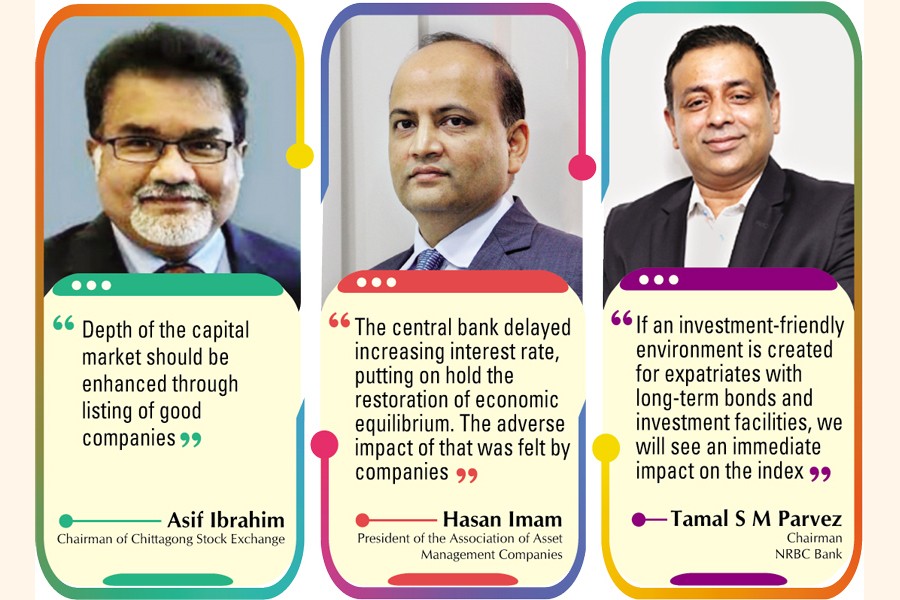
"It's a moral responsibility of multinational companies" to share their profits with the public as they are doing good business in Bangladesh," said ASif Ibrahim, chairman of the Chittagong Stock Exchange.
The depth of the country's capital market should be enhanced through listing of good companies, he added.
NRBC Bank Chairman Tamal S M Parvez said banks invest for short term and the capital market is meant for long-term financing in other parts of the world, whereas in Bangladesh banks are going for long-term investments.
"People in developed countries invest 10 to 15 per cent of their income in the capital market as there is guaranteed risk-free return. But risk-free return is elusive in Bangladesh"
The blue-chip index is an indicator of the economic status of any country. "But for the last two years, almost all of the so-called blue-chip stocks have seen their prices drop, which is very disappointing," said Mr Parvez.
On police-level measures, Dr. Hasan Imam, president of the Association of Asset Management Companies, said, "Due to Covid, the central bank had delayed increasing interest rate, putting on hold the restoration of economic equilibrium. "The adverse impact of that was felt by companies."
mufazzal.fe@gmail.com, babulfxpress@gmail.com