



Policy experts suggest the new government should adopt a realistic fiscal framework for the upcoming national budget as overly ambitious targets could worsen macroeconomic pressures amid geopolitical tensions and domestic economic challenges.
To make it, the Centre for Policy Dialogue (CPD) economists have recommend for the government's finance authorities to set achievable revenue projections and adopt measures for stronger fiscal management and structural reforms in the 2026-27 budget in the offing.
 The CPD suggestion came at a media briefing the think-tank arranged Tuesday in Dhaka for placing recommendations for the budget.
Executive director of CPD Dr Fahmida Khatun noted that the country's economy was currently facing multiple internal and external pressures that require careful and strategic policy responses.
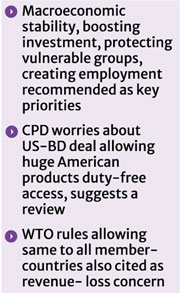
Ensuring macroeconomic stability, boosting investment, protecting vulnerable groups and creating employment opportunities should be the key priorities in the FY2026-27 budget, she said.
The CPD executive makes a point that this happens to be the first national budget of the newly elected government and, therefore, represents "an important opportunity to demonstrate leadership in fiscal management and policy direction".
However, she warns that credible revenue projections and disciplined public spending would must-dos to achieve those objectives.
"The government should avoid setting overly ambitious targets and instead focus on realistic revenue projections, stronger fiscal management and structural reforms," she told the press.
The policy outfit warns that global geopolitical tensions, particularly the ongoing conflict involving the United States and Israel and Iran, pose significant risks to Bangladesh's economy by increasing energy prices and inflating the country's import bill.
Bangladesh relies heavily on imported energy, particularly liquefied natural gas and crude oils from the Middle East, making the economy vulnerable to supply disruptions and global price volatility.
Any disruption to global energy-supply chains could quickly translate into higher domestic inflation, the think-tank alerts.
Dr Khatun raised concerns over a recent trade agreement between Bangladesh and the United States.
Under the agreement, Bangladesh will provide duty-free access to around 4,500 US products, while tariffs on another 2,210 products will be gradually reduced over the next five to ten years.
As a result, CPD estimates, the government may lose about Tk13.27 billion in customs revenue during the current fiscal year.
"The government should reassess the implications of the agreement for both revenue earnings and public spending and, if necessary, reopen discussions with the United States," Dr Khatun said.
According to the CPD, the agreement could also raise issues under World Trade Organisation rules, as Bangladesh might face pressure to extend similar tariff concessions to other trading partners.
She points out that some provisions require Bangladesh to purchase certain products from the United States which could increase government expenditure.
Distinguished fellow of the CPD Dr Mustafizur Rahman said global trade is increasingly being used as a geopolitical tool, weakening the multilateral trading system.
He suggests that the full details of the agreement should be made public as it contains important financial and policy implications.
Since the private sector will be involved in implementing parts of the agreement, the government may need to provide incentives or subsidies to encourage businesses to import US products, he said.
The CPD also expressed concern over Bangladesh's weak revenue mobilisation.
Revenue growth reached only 12.9 per cent until January of the current fiscal year, far below the annual target of 34.5 per cent.
To meet the annual target, revenue collection would need to grow by nearly 59 per cent during the remaining months of the fiscal year, which Dr Khatun describes as unrealistic and impossible.
The revenue shortfall has already come to around Tk600 billion, increasing pressure on government finances.
Due to weak revenue collection, the government's reliance on bank borrowing has risen sharply.
Until December, the government had borrowed Tk 596.55 billion from the banking sector, while non-bank borrowing and foreign financing declined.
"Excessive borrowing from banks creates risks in the financial sector and crowds out private-sector credit," Dr Khatun said.
The think-tank also has highlighted broader economic challenges, including persistently high inflation, weak investment and slow implementation of development projects.
Inflation has remained above 8.0 per cent, while export earnings declined by 3.2 per cent during the current fiscal year. Imports, meanwhile, rose by 3.9 per cent.
Implementation of the Annual Development Programme (ADP) also slowed significantly, with only 20.3 per cent of projects completed by January - the lowest rate in the past 15 years.
The CPD mentions that Bangladesh's tax-to-GDP ratio remains extremely low, around 6.8 per cent, and calls for comprehensive reforms to improve domestic resource mobilisation.
To strengthen the investment climate, Dr Khatun suggests simplifying business-registration procedures and reducing regulatory complexities.
The think-tank also recommends introducing tax incentives for digital infrastructure and establishing a special credit programme offering loans at interest rates of 3.0-5.0 per cent for environmentally sustainable small and medium enterprises.
The Centre further urges improvements in logistics and energy planning.
Among its proposals is also full automation of operations at Port of Chittagong to improve efficiency and reduce delays in trade and cargo handling.
The organisation also calls for a clear national roadmap for energy security, emphasising the need to strengthen electricity transmission and distribution alongside power generation.
The CPD notes that although the government has applied to the UN to extend time for the LDC graduation, it is still pending.
But the government should start rationalising the tariffs and incentives for the domestic industries as well as exploring regional trade agreements.
jasimharoon@yahoo.com