


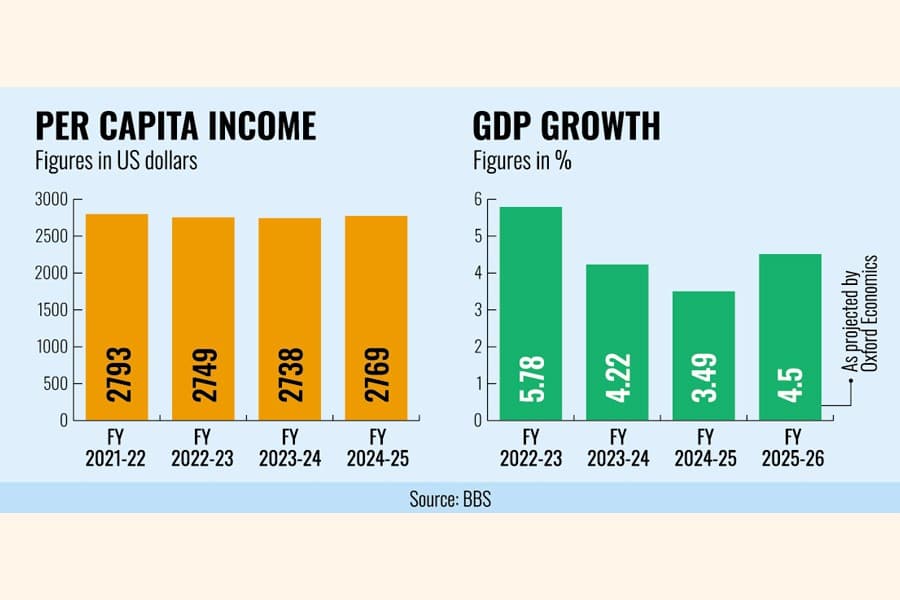
Bangladesh's economy is expected to grow by 4.5 per cent this fiscal year, a little below earlier projections by Oxford Economics, as it believes the second-quarter growth ending December slowed alongside poor export growth in key markets.


However, the growth in fiscal year 2025-26 picks up above 3.49-percent mark determined for the past fiscal year by final official count.
Founded in 1981, Oxford Economics is a global economic advisory firm providing forecasting and analytical services covering more than 200 countries and a wide range of industries and cities.
"We've downgraded our GDP-growth forecast for Bangladesh to 4.5 per cent in FY2025-26 from 4.7 per cent previously," it said Thursday.
The agency predicts activity should continue to recover in FY2026-27, albeit at a relatively moderate pace of 5.7 per cent year on year.
Following a slowdown in FY2024-25, economic momentum improved temporarily in the third quarter of 2025, supported by stronger activity in manufacturing and construction.
However, it says trade data indicate a renewed loss of momentum in the fourth quarter ending December, with goods exports to the United States and Germany falling by 4.1 per cent and 12.8 per cent year on year, respectively.
Inflation remained stubbornly high, with price pressures intensifying since October despite the fact the central bank has been pursuing a tight monetary stance.
Consumer prices rose 8.6 per cent year on year in January.
"Although wage growth remained broadly stable at around 8.0 per cent, stronger remittance inflows provided some support to household incomes."
The Oxford Economics says February's general election, which delivered a decisive victory for the Bangladesh Nationalist Party (BNP), along with the passage of a constitutional reform referendum, could support business confidence.
The firm expects the new administration to maintain its reform agenda through continued engagement with the International Monetary Fund.
"A peaceful transition of power and policy continuity are expected to provide near-term support to economic sentiment," says Oxford Economics report.
However, the outlook for consumer spending remains uneven as wage increases continue to lag behind inflation, eroding real incomes.
Private investment is also likely to remain constrained by restrictive monetary policy.
Bangladesh Bank has kept policy rates unchanged, maintaining a tight stance aimed at containing inflation and rebuilding foreign-exchange reserves.
The restrictive policy environment has helped stabilise reserves, which have risen to about $30 billion, from roughly $17 billion in 2024, marking progress under the IMF-supported reform programme.
The central bank has indicated that inflation needs to fall below 7.0 per cent before policy easing can be considered.
External risks remain significant.
While lower US tariffs could support exports in the near term, the gradual erosion of trade preferences associated with Bangladesh's graduation from least-developed-country status poses a challenge to medium-term export prospects.
Some export orders may be front-loaded ahead of the transition.
Meanwhile, the country's economy expanded by 3.49 per cent in fiscal year 2024-25, as tight monetary policy and restrained government spending weighed on activity, while inflationary pressures remained elevated, says Bangladesh Bureau of Statistics (BBS).
According to final estimates released Thursday by the statistical bureau, gross domestic product (GDP ) reached US$456 billion, with growth slowing from 4.22 per cent in FY2023-24 and falling short of the provisional estimate of 3.97 per cent.
The weak performance followed an unprecedented mass uprising in July-August 2024 that disrupted economic activity and forced the temporary closure of many factories during the fiscal year.
Sluggish consumer demand and subdued private investment also damped growth, reflecting persistently high inflation and prolonged political uncertainty during the period under review.
"The disappointing end to the year largely reflected a self-inflicted drag from consumption and investment following higher inflation and political uncertainty," says Dr Zahid Hussain, an independent economist, about the deceleration reasons.
He adds that the contraction in public spending is expected to reverse by FY2027 as political uncertainty has been eased following polls just held this month.
The slowdown in output occurred alongside continued price pressures.
External projections had been more optimistic.
Global agency S&P Global Ratings forecast growth of 3.97 per cent for the year, while Moody's had projected around 4.5 per cent before revising its outlook downward.
Sectoral data show uneven performance across the economy.
Agricultural output expanded by 2.82 per cent, up 0.63-percentage points from a year earlier.
Industrial growth slowed to 3.35 per cent, down 0.63-percentage points, while the services sector contracted by 4.35 per cent, 0.16-percentage points lower than in the previous year.
Expenditure-based measures indicate weakening macroeconomic fundamentals.
The three main components of GDP -- investment, domestic savings and national savings -- all declined compared to the previous fiscal year.
Total investment fell to 28.54 per cent of GDP, from 30.70 per cent a year earlier.
Domestic savings declined to 21.98 per cent, from 23.96 per cent, while national savings, which include remittance income, dropped to 27.67 per cent from 28.42 per cent despite the fact that after the August 05, 2024 uprising the remittances were robust.
Per-capita income under the final estimate stood at $2,769, reflecting the slower pace of economic expansion.
jasimharoon@yahoo.com