


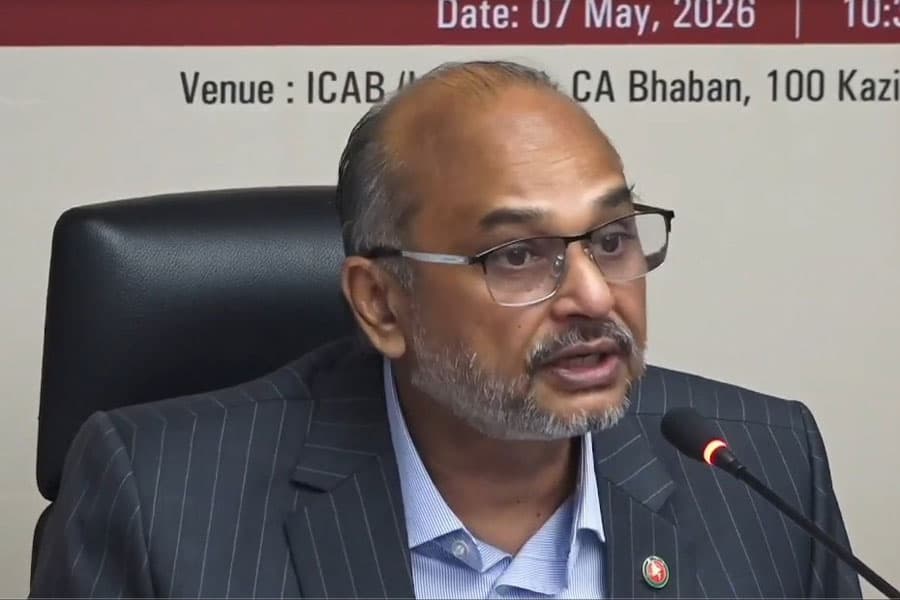
The government does not want to increase tax rates to boost tax collection; rather, it wants to increase the volume of revenue collection, said Dr Rashed Al Mahmud Titumir, Prime Minister’s Adviser on Finance and Planning.
He said tax rates and the amount of tax collection are two different things. Therefore, it is important to highlight this distinction properly in discussions on revenue policy.
Speaking at a discussion organised by ICAB-FE, he said, “We have clearly said that tax rates will not be increased; but the amount of domestic resources will be increased. Please write rate and amount correctly.”
He said the country’s tax structure is weak. Bangladesh has inherited a tax structure where the tax-to-GDP ratio is as low as 6.6 per cent.
According to him, increasing tax collection requires more than just setting targets; the economy must be made functional, production must be increased and employment must be created.
“If the economy does not work, how will taxes be collected?” he said.
Dr Titumir said the interim government had increased total tax collection by only 2.0 per cent compared with the previous year. Yet, it left ambitious target, he said raising question about whether it was aligned with reality.
Dr Titumir said the interim government had increased total tax collection by only 2.0 per cent compared with the previous year, but had left behind an ambitious target, raising questions about whether it was realistic.
He said setting revenue targets without grounding them in reality is not effective. There must be a vision for development, but economic reality must be taken into account in revenue mobilisation.
In his words, “We have to aim high but have a vision. But that does not mean the IMF will say 9.2 per cent, and then we will set a target that has no relation to reality.”
He said the only effective way to increase direct taxes is to increase employment. Direct tax collection will rise if employment increases and people’s income reaches the taxable level.
“There is only one way to increase direct taxes—if employment increases and if employment generates wages that can create taxable income,” he said.
Dr Titumir said tax collection cannot be increased without boosting production, investment and employment. If the size of the economy does not increase, the size of the tax base will not increase either.
According to him, the new economic model must move away from patronage, group dependency and oligarchic culture. Instead, investment, industrialisation, production and employment must be prioritised.
He said ensuring everyone’s participation in the economy would amount to the “democratisation of the economy”. This would increase production, create employment and expand taxable income.
Dr Titumir also said restructuring the relationship between the state and citizens is essential to increasing tax collection. If citizens understand that, in return for the taxes they pay, they are receiving education, healthcare, social security and other public services, their willingness to pay taxes will increase.
He said that, from the next budget, initiatives are being taken to mention in income tax receipts what percentage of the budget is allocated to education, health and social security.
According to him, it is not enough to treat taxpayers merely as people with tax liabilities; they should also be informed about where their tax money is going and which institutions are spending it.
Dr Titumir said the tax system needs both “connectivity” and “disconnectivity”. Reducing direct contact between tax officials and taxpayers would be “disconnectivity”, while informing taxpayers about the use of their tax money would be “connectivity”.
He said that, to increase tax collection, it is also important to bring the informal economy into the formal economy. In this regard, initiatives such as cashless transactions, digital public infrastructure, one citizen-one card and one digital wallet could be important.
Dr Titumir said the government’s goal is not to increase tax rates; rather, it aims to increase revenue collection by expanding the economy, increasing taxable income and connecting citizens with the tax structure.
He said future growth figures would show whether the government’s words match its actions.
The Prime Minister’s Adviser emphasised tax structure reform, domestic resource mobilisation, employment, investment, digital infrastructure and citizen-state relations.