


Bangladesh opts for seeking an additional $2.0 billion in bailout from foreign development partners to buttress the balance of payments (BoP) through minimising shocks stemming from war crises in Mideast countries.


Bangladesh Bank (BB) Governor Md Mostaqur Rahman revealed the plan Sunday during a consultation with representatives of the country's leading print-media outlets regarding the central bank's current role in the context of ongoing tensions in the Middle East after USA-Israel duo launched attacks on Iran.
"Though it is in preliminary stage, we have already shared our plan to the IMF (International Monetary Fund) while ERD is also working with other sources for the BoP-supporting funds," he said.
The media persons expressed their concern over negative impact on foreign-currency reserves if the war in the Gulf countries prolongs further as nearly 70 per cent of the $30-billion remittance comes from this region and it might badly impact the country's BoP position.
But the central bankers attending the meeting dispelled the fear of immediate impact of the war that began on February 28 last, saying that the country has enough stock of foreign currencies to mitigate immediate shocks of the crisis if it arises.
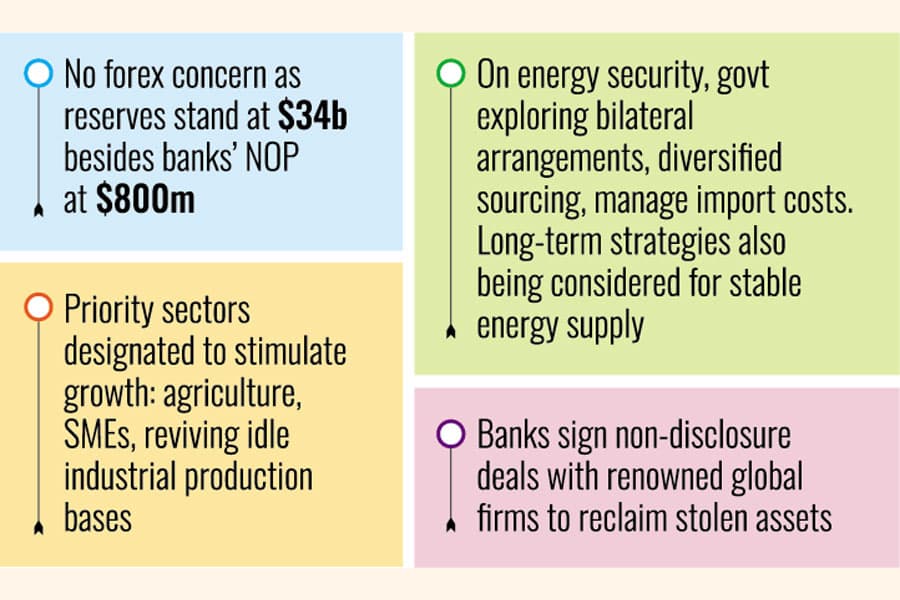
The BB governor said energy security remained another major concern. The government is exploring bilateral arrangements and diversified sourcing to reduce dependence on single suppliers and manage import costs. Long-term strategies are also being considered to ensure stability in energy supply.
There should be no political influence in the financial sector, he said. Instructions have been given to take decisions without any form of external influence, even as they push for stronger governance and accountability.
He mentions that although the global success rate in terms of recovering stolen assets remains nominal, efforts are also underway to recover siphoned-off assets as majority of the banks signed NDA (non-disclosure agreement) with renowned global firms.
On the economic front, Mr Rahman said three priority sectors have been identified to stimulate growth: agriculture, small and medium enterprises (SMEs), and the revival of idle industrial production bases.
The central bank governor stresses the importance of bringing underutilised factories back into production-even partially-to prevent further economic loss and maximize the use of national assets.
The central bank is also concerned over the country's low tax-to-GDP ratio, currently below 7.0 per cent, noting that both administrative reforms and increased economic activity are needed to improve revenue collection.
In a major policy push, the governor said, they are accelerating the transition to cashless transactions. The use of a unified Bangla QR payment system, "Bangla QR," will be made mandatory at all payment points by June 30, with enforcement measures, including penalties for noncompliance, expected from July.
Officials believe this will increase transaction transparency, reduce cash- handling costs, and boost revenue.
Deputy Governor Dr Md. Kabir Ahmed ruled out any serious pressure as far as foreign-currency reserves is concern. The forex reserves stood at $34 billion now and the NOP (net open position) in banks rose to $800 million.
On the other hand, they expect that the country would see at least $2.0- billion-higher remittance inflow in this financial year (FY'26) from the figure of previous fiscal (FY'25). "Simultaneously, the IMF is expected to disburse two remaining installments involving $1.20 billion of its $5.5 billion worth of lending package for stabilising Bangladesh's macroeconomic situations," he said.
Dr Kabir also notes that the demand for US dollar is relatively low in the post-winter season. "So, there is no worry as far as forex reserves is concerned."
Deputy governors of BB Nurun Nahar, Dr Md. Habibur Rahman and Md. Zakir Hossain Chowdhury and BB spokesperson Arief Hossain Khan also spoke at the meeting.
jubairfe1980@gmail.com