


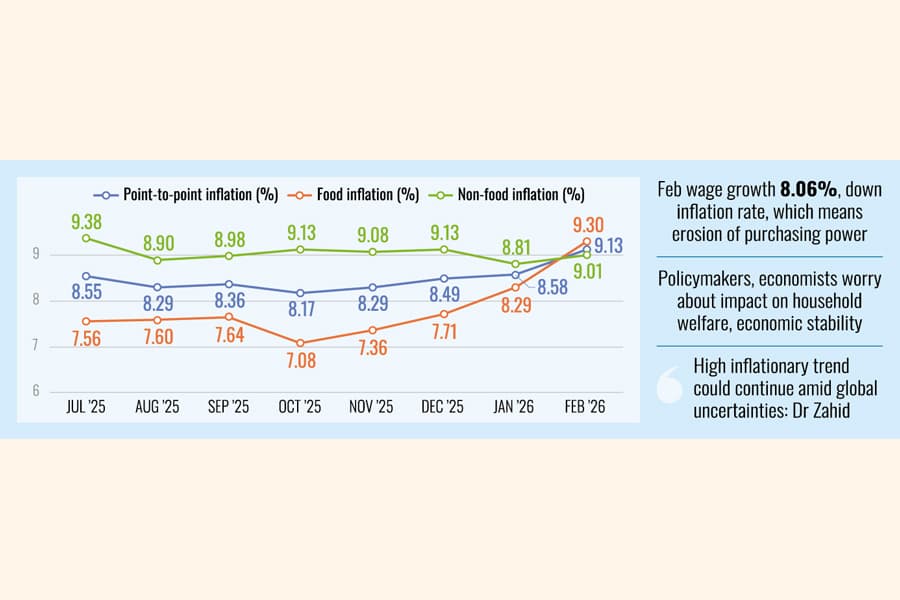
Inflation makes a quantum leap to 9.13 per cent by official count for February, the highest level in nine months, making living costlier especially for the commoners.


According to official data released Sunday, the macroeconomic parameter was heated up largely by rising food prices. Economists also find election-time splurge as another push.
The latest figures from the Bangladesh Bureau of Statistics (BBS) show inflation has now increased for four consecutive months, adding further pressure for households already struggling with a prolonged period of high cost of living.
Food inflation rose to 9.30 per cent in February, while non-food inflation stood at 9.01 per cent, according to BBS findings.
Food prices have risen for five straight months, indicating persistent volatility in the supply and pricing of essential commodities.
The February inflation rate marks the highest since May last year, when overall inflation was recorded at 9.05 per cent.
Despite the monthly increase, the 12-month "moving average" inflation rate showed a slight easing to 8.65 per cent in February, compared with 8.66 per cent in January, suggesting some marginal improvement in longer-term price trends.
The moving average declined significantly when compared with its corresponding period a year earlier at 10.21 per cent.
Price pressures were particularly visible in both rural and urban areas during the month under review.
In rural areas, food inflation rose to 9.21 per cent, increasing by 0.58- percentage points from January.
Urban areas experienced a sharper rise, with food inflation jumping to 9.87 per cent, up by 1.26-percentage points from the previous month's count.
The country has been experiencing persistently high inflation for nearly three years, eroding purchasing power and raising concerns among policymakers and economists about its impact on household welfare and economic stability.
Economists say the recent surge in prices may partly reflect increased spending during the election period, which often boosts demand for food and daily necessities.
"We usually see that during election months, the prices of commodities remain elevated," says Dr. Zahid Hussain, a former lead economist at the World Bank.
He further says inflationary pressures began building from past few months and that the trend could continue amid growing global uncertainties.
According to him, the ongoing geopolitical tensions in the Middle East, including attacks on energy infrastructure, could further push up fuel and commodity prices on the international market, which may eventually pass through into domestic inflation.
Meanwhile, BBS data also showed that the national wage-growth rate stood at 8.06 per cent in February, remaining below the inflation rate.
The gap between wage growth and inflation indicates real incomes continue to shrink, meaning many households are experiencing declining purchasing power despite nominal increases in wages.
jasimharoon@yahoo.com