
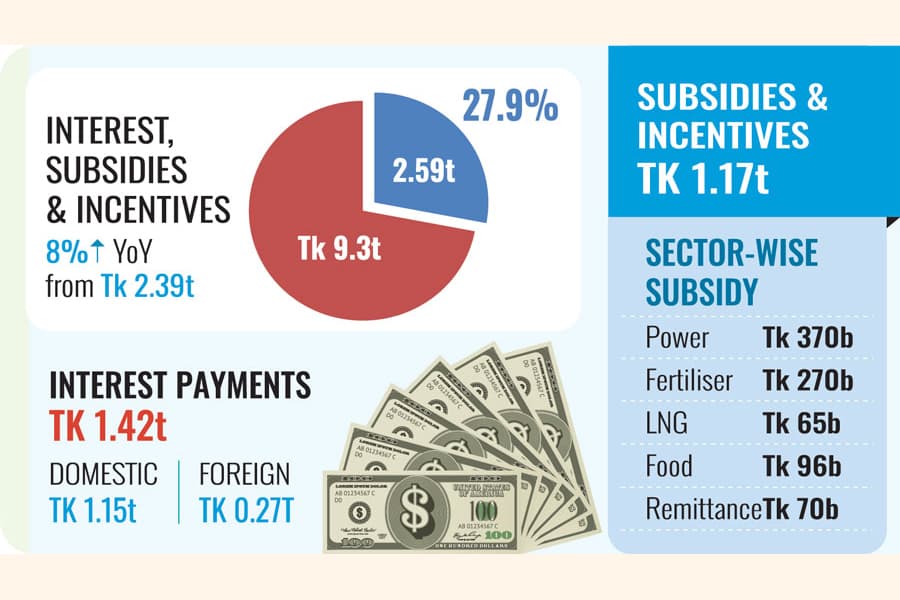
Interest payments, subsidies, incentives and cash loans could gobble up big pies of the next budget as the government earmarks over Tk 2.59 trillion on this account and officials predict higher energy costs could bloat the figure.
The sum is roughly 27.86 per cent of the national budget worth Tk 9.3 trillion for fiscal year 206-27, officials at the finance division say.
The amount is 7.99-percent higher than the Tk 2.39-trillion revised allocation in the current fiscal year.
They say subsidy allocations have not been estimated taking into account a potential doubling of fuel-import costs amid the ongoing volatility and caution that if the Gulf conflict persists, additional funding will be required for gas, power and fertiliser subsidies.
Finance Ministry officials also warn that government's interest burden on domestic borrowing could rise further if inflation does not ease and liquidity in the financial sector takes longer to recover.
Further fiscal pressure may arise if the BNP government proceeds with its election pledges to implement "family card" and "farmer card", which would require additional allocations, they note.
The projections emerged at a meeting of the Coordination Council on Fiscal, Monetary and Exchange Rate Affairs held last Friday with Finance Minister Ameer Khasru Mahmud Chowdhury in the chair.
According to documents presented at the meeting, the budget deficit for the next fiscal year has been estimated at Tk 2.35 trillion, or 3.4 per cent of GDP, taking into account the heavy burden of subsidies, incentives and debt obligations. In the revised budget for the current fiscal year, the deficit was set at 3.3 per cent of GDP, amounting to Tk 2.0 trillion.
To finance the deficit, the government plans to borrow Tk 1.19 trillion from domestic sources like banks and savings instruments, while Tk 1.16 trillion from foreign sources, an overall increase of Tk 350 billion, or 17.5 per cent, compared to the current fiscal year.
External borrowing alone is set to surge by over 84 per cent, according to the documents.
Officials note that the government is increasingly leaning towards external borrowing to ease pressure from high-cost domestic debt, as a significant share of interest payments is tied to bank loans and savings certificates.
Interest payments alone are estimated at Tk 1.42 trillion in the next budget, including Tk 1.15 trillion for domestic debt and Tk 270 billion for foreign loans.
However, officials caution that interest expenses could rise further if inflation persists, fuel prices increase, or liquidity conditions in the banking sector fail to improve.
Subsidy allocations, meanwhile, remain under pressure amid global energy-price volatility. The government has earmarked Tk 370.0 billion for the power sector, Tk 65.0 billion for LNG, Tk 270.0 billion for fertiliser and Tk 96.0 billion for food-support programmes.
Total spending on subsidies, incentives and cash loans is set at Tk 1.17 trillion, up from Tk 1.12 trillion in the revised budget.
Officials note that subsidy needs could increase further if the ongoing tensions in the Middle East continue to push up fuel-import costs. The finance minister recently informed parliament that higher global fuel prices had already added Tk 360.0 billion in subsidy pressure during March-June of the current fiscal year.
While allocations for agricultural, export and jute incentives are being kept unchanged, remittance incentives are set to rise by Tk 8.0 billion to Tk 70.0 billion, reflecting stronger inflows.
"Expenditures such as interest payments offer little scope for control," says economist and former Director-General of Bangladesh Institute of Development Studies (BIDS) Dr Mustafa K. Mujeri, adding that the government has scope of controlling such spending in future.
He told The Financial Express that subsidy spending, financed by public funds, needs to be rationalised through careful targeting.
He suggests phasing out blanket subsidies and limiting support to sectors that do not directly benefit the poor, warning that failure to do so would raise the debt burden on future generations.
Jahid.rn@gmail.com