

Bangladesh's investment climate is being vitiated by a mix of bureaucratic delays, policy uncertainty and rising business costs, making it harder for both local and foreign investors to expand operations and create jobs.
Experts say unless these longstanding barriers are addressed quickly, the country risks losing competitiveness and missing major investment opportunities.
Policy Exchange Bangladesh has identified eight major obstacles, with bureaucratic complexity and a restrictive regulatory framework topping the list.
Energy shortages, infrastructure bottlenecks, high tax pressure, weak institutional coordination and the absence of a clear investment strategy were also cited as major concerns at a policy dialogue in the capital on Wednesday.
The Metropolitan Chamber of Commerce and Industry (MCCI) and Policy Exchange Bangladesh jointly organised the meeting.
Policy Exchange Bangladesh Chairman and CEO Dr M Masrur Reaz presented the keynote paper titled "Improving the Investment Climate: Why It's Critical for New Government Priorities and the Upcoming National Budget."
In his presentation, Masrur Reaz said the country also faces the absence of a coordinated domestic and foreign investment strategy, which continues to weaken investor confidence.
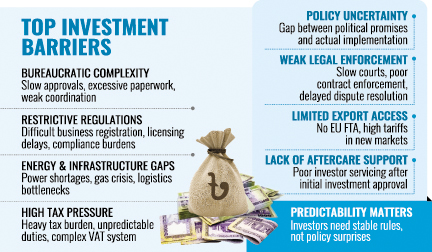
He identified additional barriers including the lack of structured investment promotion, a gap between political commitments and implementation, and weak coordination between the public and private sectors.
He also pointed to limited coordination between the Prime Minister's Office and various ministries, the absence of diversified competitive sectors, leaving the economy heavily dependent on only five key sectors, and inadequate post-investment support or aftercare services.
Against this backdrop, Policy Exchange proposed a set of immediate reforms to strengthen investor confidence.
Masrur Reaz said the government can pursue seven priority reforms.
These include formulating a comprehensive national investment policy, simplifying business registration procedures, addressing infrastructure and energy constraints, ensuring efficient use of economic zones, developing skilled human resources, promoting green investment, and establishing a modern legal framework for contract enforcement and dispute resolution.
BGMEA President Md Mahmud Hasan Khan attended the event as special guest, while EuroCham Chairperson Nuria López, corporate lawyer Barrister Margub Kabir, and Zinnia Huq, Chief Financial Officer (CFO) of Unilever Bangladesh, participated as panel speakers.
EuroCham Chairperson Nuria López said the absence of a free trade agreement (FTA) with the European Union, Bangladesh's largest export destination, is already affecting investor confidence.
"Do we have a free trade agreement with our major customer at this moment-the European Union? No," she said, noting that countries such as Vietnam and India have already secured similar agreements.
She warned that without preferential access to the EU market, Bangladesh risks losing competitiveness to regional peers offering more predictable trade frameworks.
"We need to have, we must have, we must start right now an FTA," López said. "If we don't have free trade access to our largest market, we don't have a horizon to invest."
She also said uncertainty over future market access is influencing investment decisions.
"I have recently started a new business in the agro-processing sector, but I am uncertain about the future. I do not know whether I will be able to export to Europe on equal terms with competitors from countries that already enjoy free market access," she said.
López stressed that predictability is essential for attracting long-term investment, adding that Bangladesh currently lacks it.
"We don't have predictability. We don't know what's going to happen in the future," she said, questioning whether there is a clear and investor-friendly policy direction.
She linked the urgency of an EU FTA to Bangladesh's broader challenge in attracting foreign direct investment (FDI), saying policy uncertainty continues to undermine investor trust.
Addressing the event as special guest, BGMEA President Md Mahmud Hasan Khan said Bangladesh should expand export markets through bilateral agreements with countries such as South Africa, Brazil and Turkey.
He noted that around US$8 billion in new opportunities have emerged in the ready-made garment sector, with further potential for expansion.
However, he stressed that high tariffs in these markets make such agreements necessary.
"We are discussing this matter with the government," he said.
He also identified energy shortages as the most critical challenge for businesses.
"For entrepreneurs, energy is a greater concern than financial constraints," he said, adding that without resolving energy and infrastructure bottlenecks, financial support would have limited impact.
Unilever Bangladesh CFO Zinnia Huq said business registration and documentation processes in Bangladesh are extremely slow and time-consuming.
She pointed to weak coordination among government agencies, which reduces efficiency and delays business operations.
Despite a double taxation avoidance treaty, she said prior approval from the National Board of Revenue (NBR) is still required for dividend remittance, making the process unnecessarily complex. She also highlighted a lack of transparency in audit procedures.
Barrister Margub Kabir said dispute resolution is central to investor confidence, but Bangladesh continues to struggle with a slow judicial system.
He cited the example of a Japanese company operating in Bangladesh for 25 years, while a contractual dispute dating back to 2018 remains unresolved.
"There is no lack of laws in Bangladesh; the issue is making them simpler and the process faster," he said.
Kabir added that foreign investors generally prefer arbitration to avoid lengthy court proceedings. However, even after arbitration awards, enforcement through courts faces similar delays.
He called for specialised commercial courts, faster enforcement mechanisms, and judges with commercial expertise to ensure timely resolution of disputes.
MCCI Secretary General Farooq Ahmed delivered the welcome address.
newsmanjasi@gamil.com