
Bangladesh confronts a nearly trillion-taka record revenue shortfall in the bygone three quarters of this financial year, scaling up pressure on government's fiscal management.
Until March, the National Board of Revenue (NBR) had lagged behind its target by about Tk 980 billion, marking the largest deficit in the country's history for the July-March period.
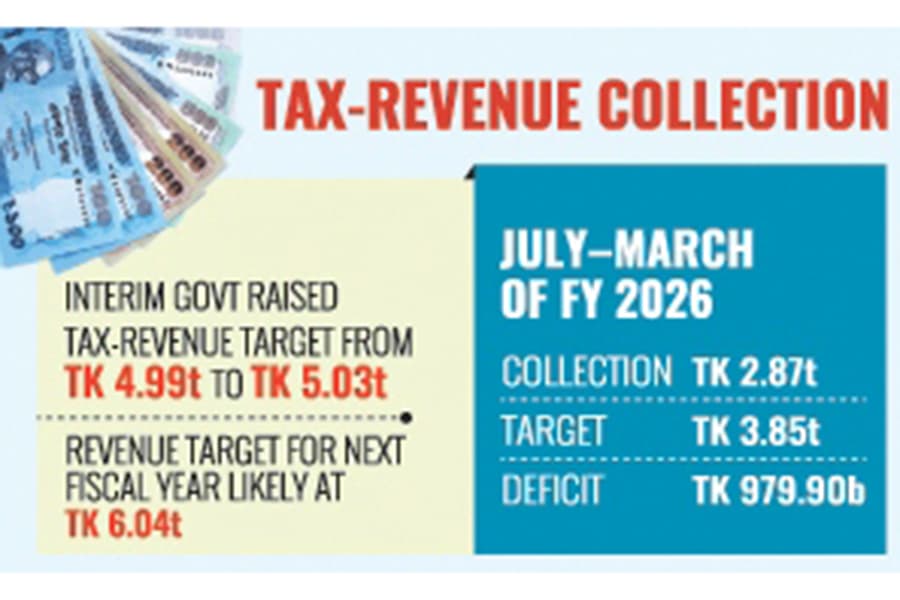
Revenue officials say the gap was partly due to an upward revision of the target without adequate assessment of prevailing economic conditions, as the interim government raised the tax-revenue target from Tk 4.99 trillion to Tk 5.03 trillion for the first time.
Revenue growth remained weak, rising only 2.67 per cent in March.
Over the July-March period, the NBR had collected Tk 2.87 trillion against a target of Tk 3.85 trillion, leaving a deficit of Tk 979.90 billion.
None of the three major tax heads met their targets, with income tax posting a shortfall of Tk 400 billion, VAT Tk 340 billion and import duty Tk 229.73 billion.
Officials and analysts attribute the poor performance to sluggish business activity, declining imports, weak investment inflows, Middle East tensions, rising fuel prices and persistently high inflation.
The large shortfall is set to put further pressure on the new government to manage rising expenditures and secure external budget-support funds.
On Tuesday, Finance Minister Amir Khosru Mahmud Chowdhury held a meeting with Prime Minister Tarique Rahman discussing conditions tied to the loan from the International Monetary Fund (IMF) and the next course of action.
Under the original US$4.7-billion IMF loan programme, Bangladesh is required to increase revenue by at least 0.5 per cent of GDP annually, although the tax-to-GDP ratio declined by 0.66-percentage points last year instead of a coveted rise.
In the remaining three months of the fiscal year, from April to June, the NBR will need to collect about Tk 2.15 trillion, which translates into Tk 710 billion to Tk 730 billion per month, far exceeding the current monthly average of Tk 300 billion to Tk 370 billion. Professor Mustafizur Rahman, distinguished fellow at the Centre for Policy Dialogue (CPD), says weak revenue mobilisation has forced the government to rely more on bank borrowing to meet expenditures, warning that a year-end shortfall now appears inevitable and describing the situation as worrisome.
"Although the government has started trimming development spending to contain the budget deficit and ease borrowing pressure, such measures cannot be sustained for long."
The revenue target for the next fiscal year, set at Tk 6.04 trillion, will be difficult to achieve unless the NBR intensifies efforts to reduce tax exemptions and identify new sources of revenue, the economist forewarns.
He cautions that if the current shortfall persists, achieving nearly 50-percent growth in revenue mobilisation next year would be unrealistic under prevailing economic conditions.
The economist, however, welcomes government move to introduce property tax and inheritance tax in the upcoming fiscal year as a positive step.
doulotakter11@gmail.com